The movement of the cryptocurrency market is not a set of random fluctuations, but a strictly cyclical system, operated by a complex interaction between behavioral psychology, internal laws of supply and demand and global macroeconomic variables. In the modern financial context, distinguishing between a Bull Market and a Bear Market does not stop at observing price charts, but requires a deep understanding of the transition periods of capital flows and changes in the belief structure of market participants.
The nature and technical definition of market cycles
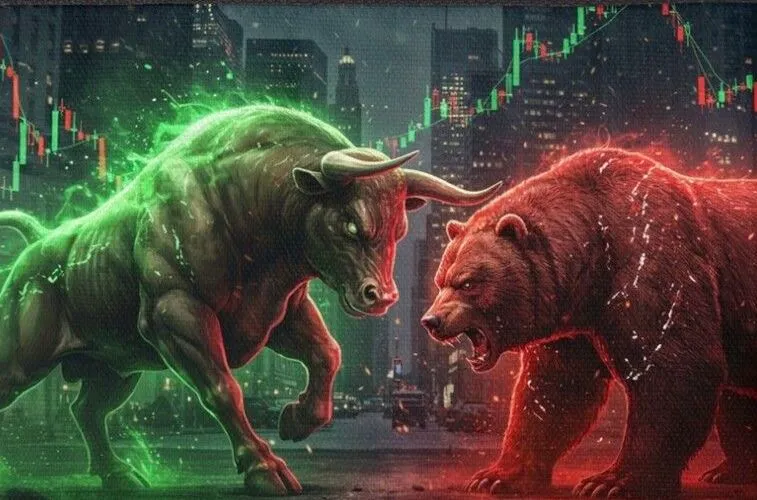
Financial markets are depicted through two dynamic symbols opposite objects: the bull represents the bull (price increase) and the bear represents the slap (price decrease). In cryptocurrency, these terms are used to refer to extended periods of price trends, often accompanied by marked changes in trading volume and investor sentiment.
Technical Definition of Bull Market
A market is officially recognized as a Bull Market when the price of a major asset increases by at least $20\%$ from the most recent low and maintains this trend for an extended period of time, often many months or many years. The most typical characteristic of this period is the overwhelming optimism, high level of investor confidence and the willingness to accept risks to seek profits.
Technically, the Bull Market is identified through a graph structure that includes subsequent peaks higher than the previous peak (Higher Highs) and subsequent bottoms higher than the previous bottoms (Higher Lows). This growth is often driven by factors such as the development of new technology, favorable regulatory regulations, or the entry of large capital flows from financial institutions. Historically, bull markets have tended to last longer than bear markets, with an average duration of around $3.5$ years ($42$ months) and average growth of up to $180\%$ for major indexes.
Technical Definition of Bear Market
In contrast, a Bear Market is a market downturn, defined as an asset price decline of at least $20\%$ from recent peak and continued downtrend for a long period of time. During this period, fear and pessimism prevail, leading to panic selling to preserve capital.
The chart structure of the Bear Market is characterized by the following peaks being lower than the previous ones (Lower Highs) and the next bottoms being lower than the previous bottoms (Lower Lows). Although bear markets are typically shorter in duration than bull markets — averaging around $9.6$ month to $10$ month — their severity is enormous, with declines that can wipe out more than $80\%$ of the capitalization of many asset classes. Bear Market triggers often include tightening monetary policy, black swan events or the collapse of key projects in the industry.
Compare Bull and Bear Market characteristics:
Price trend: Bull Market increases sustainably ($>20\%$ from bottom); Bear Market has a prolonged decline ($>20\%$ from the peak).
Mainstream psychology: Bull Market has an optimistic, excited psychology (Greed); Bear Market is covered by fear and pessimism (Fear).
Trading volume: High and gradually increasing in Bull Market; Low or decreasing in Bear Market.
Chart structure: Higher Highs, Higher Lows for Bull Market; Lower Highs, Lower Lows for Bear Market.
Average Duration: Bull Market lasts about $3.5$ year; Bear Market usually takes place in about $10$ month.
Economic impact: Bull Market signals growth and expansion; Bear Market comes with recession and tightening.
See more: What is Altcoin Season? Early signs
In-depth analysis of the four phases of the market cycle
According to analysis from Tan Phat Digital, based on Wyckoff theory, a full cycle of the cryptocurrency market is divided into four transition phases:
Phase 1: Accumulation
The accumulation phase often occurs after a strong downturn when the market has reached its bottom and depression is at its extreme. At this time, institutional investors and "Smart Money" began to buy quietly. Prices often move sideways, trading volume is low and positive news is lacking. This is when price risk is lowest for long-term investors.
Important events during this period include:
Selling Climax (SC): The final sell-off due to crowd panic.
Automatic Rally (AR): An automatic rally when selling dries up
Spring:A final test by pushing the price below support to eliminate weak investors.
Phase 2: Growth (Markup)
The Markup phase marks the official beginning of a Bull Market. When demand exceeds supply, the price breaks out of the accumulation zone and increases steadily. Public interest returned, media coverage was positive and sentiment turned to optimism. The FOMO phenomenon begins to appear, pushing asset prices up.
Phase 3: Distribution
This is the peak of the bullish cycle, where greed reaches its maximum level. While retail investors were still enthusiastically buying, smart investors started selling to take profits. The price often fluctuates strongly but does not create a significant new peak (Plateau), the trading volume is very large but the price moves sideways.
Stage 4: Recession (Markdown)
Markdown is an inevitable collapse when supply completely overwhelms. Prices began to plummet, accompanied by liquidations of leveraged positions. Fear reigns and buyers at the top begin panic selling. A common feature is the "Dead Cat Bounce" — short-term rallies that deceive investors before continuing to fall deeper.
Bitcoin and the Halving mechanism: The perpetual engine of the cycle
Unlike traditional finance, the crypto cycle has its own "heartbeat" with the Bitcoin Halving event taking place every 210,000 blocks (about $4$ every year).
The mechanism Technical: Halving reduces miners' block rewards by $50\%$, creating a supply shock. When new supply decreases but demand remains the same or increases, price increase pressure is inevitable.
Historical data of Halving cycles:
First time (November 28, 2012): Price at the time of Halving was $\$12$, peaking at $\sim\$1,163$ (increase of $\sim97$ times).
2nd time (July 9, 2016): The price at the time of Halving was $\$660$, peaking at $\sim\$19,666$ (an increase of $\sim30$ times).
3rd time (May 11, 2020): The price at the time of Halving was $\$8,579$, reaching peak at $\sim\$69,000$ (increased $\sim7$ times).
Time 4 (April 20, 2024): Price at the time of Halving $\sim\$64,000$ and this cycle is continuing with the appearance of Spot ETF funds.
Tan Phat Digital notes that although the percentage growth tends to Diminishing Returns due to larger market capitalization, but the Halving event is still the most important guide for investors.
Sentimental and technical indicators that guide the cycle
To determine position in the cycle, investors should monitor the following indicators:
Fear & Greed Index: $0-100$ scale. Below $24$ is Extreme Fear (opportunity bottom zone), above $75$ is Extreme Greed (risk peak zone).
MVRV Z-Score: Compare market capitalization with actual capitalization. Entering the red zone ($>7.5$) signals the top of the cycle; green zone (negative or near $0$) signals a bottom.
Puell Multiple: Measures miner profitability. When the index $>4.0$, miners tend to take strong profits, creating a market peak.
NUPL: Calculate unrealized profit/loss. When $>0.75$, the market falls into a state of extreme euphoria (Euphoria).
Bitcoin Dominance: When BTC.D increases ($>60\%$), capital focuses on Bitcoin; When there is a strong decrease ($<40\%$), capital flows to Altcoin (Altcoin Season).
Effective operating strategy
Strategy in Bull Market:
Hold and optimize the trend (HODL) of strong platform projects.
Scaling Out according to established profit targets
Use the Trailing Stop order to protect profits when the price turns around.
Control FOMO emotions to avoid chasing at the peak.
Strategy in Bear Market:
Prioritize risk management and hold cash (Stablecoin).
Apply price averaging strategy (DCA) to coins platform in low price area.
Take advantage of Lending/Earn protocols to increase safe assets from stablecoins.
Focus on research (DYOR) to prepare for the next cycle.
Vision 2026: Maturity of the Crypto cycle
Entering 2026, Tan Phat Digital predicts that the market will transform from speculation to system integration. Key factors include:
Fed interest rate: Expectation to decrease to $\sim3.25\%$, increasing global liquidity.
Inflation: Stable around $2.4\%$, reducing monetary tightening pressure.
Stablecoin capitalization: Forecast exceeding $\$300$ billion USD, creating huge "purchasing power".
Legal regulation: Laws such as MiCA (EU) and GENIUS Act (US) come into effect, increasing transparency.
Institutionalization: Extensive participation of ETFs and large enterprises (such as MicroStrategy) helps reduce extreme volatility
See more: What is DeFi (Decentralized Finance)? - Vision 2025-2030
Frequently Asked Questions (FAQ) about the Crypto market cycle
1. How to tell if a Bull Market has really started? Technically, a Bull Market is confirmed when the price of a key asset increases by at least 20% from the bottom and creates a structure "the next peak is higher than the previous peak". In terms of sentiment, optimism began to spread and financial institutions began to announce large investments.
2. Does Bitcoin Halving Always Lead to an Immediate Price Increase? No. History shows that Bitcoin price usually does not increase immediately after Halving but needs 12 to 18 months to absorb the supply shock and reach a new peak. Before the Halving, the market often had deep corrections from 14% to 20%.
3. What is the main difference between a correction and a Bear Market? A correction is a short-term price decline (usually less than 2 months) and a decrease of less than 20% in an uptrend. A Bear Market is a prolonged downturn (10 months on average) with a decline of over 20% from its peak.
4. How should the Fear & Greed Index be used to take profits? Investors should apply reverse thinking: When the index is at the Extreme Greed level (75-100) for a long time, it is a signal to take partial profits. On the contrary, the Extreme Fear level (0-24) is often an opportunity to accumulate cheap assets.
5. Is the DCA (price averaging) strategy effective in the Bull Market? DCA is most effective in the Bear Market or accumulation phase to reduce the average cost of capital. In Bull Market, instead of "buying" DCA, investors should use "Scaling Out" DCA to preserve profits gradually.
6. Is Bitcoin's 4-Year Cycle Likely to Be Broken in 2026? Likely. The emergence of ETFs and institutional capital flows is maturing the market, which could lead to longer cycles and lower volatility. Some experts predict 2026 will be the year of systems integration rather than extreme boom/busts.
7. Which "Black Swan" could cause a sudden Bear Market in 2025-2026? Major risks include: sudden changes in Fed interest rate policy, large-scale cyber attacks on blockchain infrastructure, or threats from quantum computing to Bitcoin's security.
8. When does "Altcoin Season" (Altcoin Season) usually take place? Altcoin Season usually begins when Bitcoin price has increased sharply and begun to move sideways at the peak, and at the same time, the capitalization proportion of Bitcoin (BTC Dominance) has decreased sharply as capital flows to riskier assets.
9. Which On-chain indicator is the most reliable exit signal? The combination of the MVRV Z-Score entering the red zone (>7.5) and the NUPL index exceeding 0.75 (Exit zone) are historical signals that the market has overheated and is about to reverse.
10. What should be done if the investment portfolio is losing heavily in the Bear Market? The top priority is to preserve remaining capital, eliminate junk speculative assets and switch to Bitcoin or Stablecoin to wait for the bottom. Absolutely avoid selling off in "despair" if On-chain indicators show that the price is at an extremely deep discount.
Properly understanding the Bull and Bear Market cycles is the key to surviving in the cryptocurrency world. Tan Phat Digital recommends that investors practice reverse thinking: accumulate when the market panics and know how to leave when the crowd is most passionate. Discipline, risk management and continuous learning will be the most powerful weapons to conquer every market cycle.
Share


