I. Definition and Status of Augment Code in the Era of Synthetic AI
The world of software development is undergoing a fundamental transformation, driven by Artificial Intelligence (AI). The concept of Augment Code represents this evolution, marking a step beyond simple coding support tools. This is not just a tool to help code faster, but a platform that comprehensively supports the entire software development process, focusing on contextual accuracy and complex task execution.
A. What is Augment Code? Augmentation Definition and Concept
Augment Code is defined as an AI-powered coding platform specifically designed to augment the software development process by providing intelligent code assistance, debugging, and project management features. Unlike full automation tools, Augment Code acts as a tool to support, enhance and supplement the coding process, helping to optimize repetitive tasks and reduce the manual work that programmers have to do.
The scope of application of Augment Code is very wide. It is not limited to basic source code completion but also extends to more complex tasks such as refactor optimization, test case writing, technical documentation creation, and deep debugging support. This shows that the platform's role has shifted from simply being a code completion tool to a programming partner capable of handling complex logic requirements.
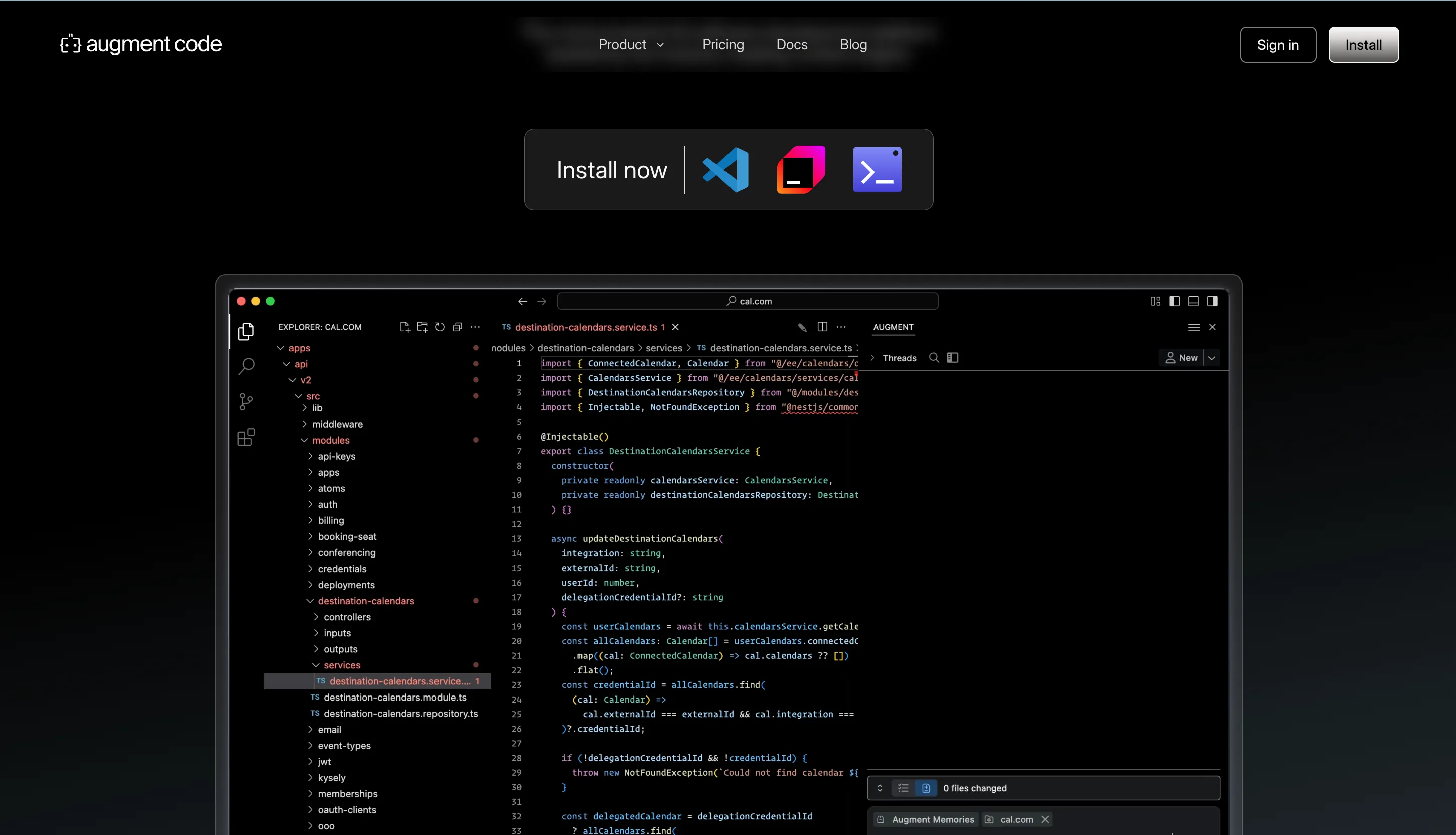
The core features that make Augment Code powerful include Context Engine, Agent Tasks, Next Edit, Code Suggestions, and the ability to seamlessly integrate with familiar Integrated Development Environments (IDEs) like VS Code or IntelliJ. The combination of these elements creates a next-generation programming support system, capable of significantly reducing confusion and saving programmers' time.
Tan Phat Digital – Comprehensive technology solutions
Website: tanphatdigital.com
Hotline: 0374225294
The technical team supports installation, integration and training for effective use.
There is a service of maintenance - code optimization combined with AI, helping businesses develop software quickly and safely.
Especially suitable for SMEs, startups, and technology companies large.
Thanks to its reputation over many years of implementing technology solutions, Tan Phat Digital is considered the leading address to buy Augment Code in Vietnam.
B. Unique Architecture: Context Engine – The Key to Outstanding Accuracy
The most important difference, placing Augment Code in the position of a second generation AI programming tool, is the Context Engine architecture. While many other programming AI tools rely heavily on the local context of the file being edited or the current working window, Augment Code is capable of processing logic across the entire codebase.
Context Engine works by deeply understanding the project structure, dependencies, and internal logic of the source code, especially important for large systems (monorepo) or systems with many modules. This capability radically addresses one of the biggest challenges of previous generation programmable AI: the lack of deep understanding of each project's specific context, leading to inappropriate recommendations.
Furthermore, Context Engine allows programmers to proactively "focus on context" by selecting specific pieces of code, files, or folders that they want the AI to rely on to increase the accuracy of suggestions. This allows the platform to quickly grasp tasks, understand new components, bugs, or APIs, and provide suggestions/solutions clearly documented with reference sources.
While the document does not specify which default AI model is used, real-world users have noted Augment Code's performance to be extremely agile, accurate, and on par with advanced models like Claude Sonnet 3.5. This shows that Augment Code not only relies on collecting context but also optimizes the underlying AI architecture to process information quickly and efficiently.
The focus on Context Engine and Agent Tasks represents an important paradigm shift in the programmable AI market: from code completion (completion) to task execution (execution). By featuring Agent Tasks—capable of performing multi-step tasks, such as creating endpoints or refactoring modules—Augment Code allows programmers to delegate complex sequences of actions, minimizing the time spent writing prompts and testing individual lines of code. This is key to freeing programmers from low-level tasks, allowing them to focus on core business logic and architecture.
C. Competitive Comparison: Augment Code vs. Major Competitors (Copilot & CodeWhisperer)
The AI programming tool market is crowded, with strong competitors such as GitHub Copilot and Amazon CodeWhisperer. However, Augment Code has found a unique position by emphasizing accuracy, security, and the ability to execute complex tasks.
GitHub Copilot is known for its flexibility and multilingual support, based on large volumes of data from GitHub's public repositories. Meanwhile, Amazon CodeWhisperer is a superior choice for programmers working extensively in the AWS ecosystem, taking advantage of deep integration with services like Lambda, DynamoDB, and S3. CodeWhisperer also has the advantage of learning from Amazon's internal source code and providing the ability to flag or filter code suggestions similar to training data to support license compliance checks.
Augment Code creates competitive advantage by focusing on overall context understanding (Context Engine) and flexible integration capabilities. This platform not only provides powerful Agent features, but can also pull more context and work with more than 100 external tools (External Tools). More importantly, Augment Code puts security and privacy first, pledging that users' source code is secure and private by default.
This strategy positions Augment Code as a "Security First" solution, aimed directly at the large enterprise market. With large companies increasingly concerned about copyright and Intellectual Property (IP) leakage from AI models based on public data, Augment Code's focus on Context Engine and default security becomes a factor in purchasing decisions. IP filtering and protection capabilities help Augment Code compete more effectively in customer segments with large codebases (monorepo) and strict compliance requirements.
For easy visualization, below is a comparison of the competitive criteria between Augment Code and major competitors:
Augment Code
Core goals: Enhance & Manage projects (Execution/Context).
Context Understanding Mechanism: Context Engine (Understands the entire codebase/monorepo).
Multi-Step Feature: Agent Tasks, Next Edit (Multi-file editing).
Training data source: In-house Code, Default privacy guaranteed.
GitHub Copilot
Core goal: Programmer support (Completion).
Context Understanding Mechanism: Context window dependency.
Multi-Step Feature: Basic code completion.
Source training data: Primarily from GitHub Public Repositories.
Amazon CodeWhisperer
Core goal: Optimize in AWS Ecosystem.
Context Understanding Mechanism: Good (Deep AWS integration).
Multi-step feature: Basic code completion.
Training data source: In-house Code, Provides copyright filtering.
II. In-depth Analysis of the Benefits (ROI) of Augment Code for Programmers and Teams
Investment in any programming AI tool needs to be justified by a clear return on investment (ROI), especially in a business environment that requires high efficiency. Augment Code not only promises to increase speed, but also aims to solve the "Productivity Paradox" – the problem that prevents many previous generation AI tools from achieving the desired efficiency in professional environments.
A. Solving the "Productivity Paradox" of AI Programming
Recently, many studies have questioned the actual productivity increase of modern AI programming tools for seasoned programmers. A study by METR has shown that, for experienced software engineers, using AI tools can increase task completion time by up to 19%.
The most surprising thing was the contradiction between reality and perception: while working slower, study participants still believed that AI helped them complete work 20-24% faster. This phenomenon is called the "productivity illusion".
Researchers have identified five main causes of this slowdown:
Project complexity (AI performs poorly with large codebases, over a million lines of code).
Over-optimism about AI's capabilities.
Lack of understanding of the project's specific context.
Low reliability of suggestions (only accepts less than 44% of AI-generated suggestions, must spend considerable time checking, verifying and editing).
Change in workflow (spending too much time interacting with AI, writing commands, waiting for responses, and evaluating results, instead of writing code).
Augment Code is designed to directly address these bottlenecks, transforming the illusion of productivity into actual performance:
Overcoming Lack of Context and Complexity (Causes 1 & 3): Augment Code's Context Engine is a direct technical solution to the problem of lack of context understanding. By understanding project structure and logic across the entire codebase, it ensures recommendations are free from logic deficiencies on large projects (monorepo), where previous generation AI tools often fail.
Increased Credibility (Cause 4): The ability to "Focus on context" and provide "clear evidence" greatly increases the quality of suggestions. When programmers receive accurate suggestions that are consistent with the project architecture, the suggestion acceptance rate will increase much higher than the 44% threshold, thereby reducing time spent on unnecessary testing and editing.
Optimize Workflow with Agent Tasks (Cause 5): If programmers have to spend a lot of time interacting with AI through writing prompts and checking results, then using Agent Tasks (performing multi-step tasks) of Augment Code helps shorten this interaction cycle. Instead of having to send a series of prompts to create an endpoint or refactor a module, the programmer only needs to issue one task. The system automates that sequence of actions, helping convert interaction time into real code time or strategic work.
It is important to quantify the speedup due to Agent Tasks. When Augment Code handles repetitive and multi-step tasks, it helps programmers maintain a seamless, uninterrupted "flow state", thereby maximizing real-world performance.
B. Optimizing the Software Development Life Cycle (SDLC)
Augment Code provides clear benefits in every phase of the Software Development Life Cycle (SDLC):
Increasing Development Speed: For common programming tasks, AI assistance can help increase development speed by 20% to 40% depending on the complexity of the problem. Augment Code does this by automating repetitive tasks, reducing hours of manual work, and inserting code in the right place.
Improve Code Quality and Reduce Errors: AI has the ability to detect logic errors, missing imports, or wrong conventions. By providing intelligent code suggestions and in sync with the team's coding style, Augment Code helps reduce source code errors from the beginning, minimizing debugging time and costs later.
Refactor Support and API Integration: The Next Edit feature is an especially powerful tool, allowing AI to support multiple file editing and synchronous logic updates without disrupting the program flow. This is invaluable for complex API refactoring or integration tasks, which often consume hours of manual work by senior programmers. Augment Code also integrates documents from more than 300 popular libraries, reducing time spent searching for external information.
Increase Onboarding Speed: For a new developer joining the team or a new project, understanding the huge codebase can take weeks. Augment Code helps new programmers easily understand the project thanks to its ability to explain context and suggest detailed codebases. This significantly shortens onboarding time, allowing new members to contribute value faster.
The strategic role of Augment Code is not just a utility tool but a platform that leverages technical performance, especially in highly collaborative environments and complex codebases.
The Strategic Role of Augment Code in SDLC:
Context Engine: Understand project structure, dependencies, monorepo.
Impact: Reduces the risk of logic errors, increases suggestion accuracy, overcomes the productivity paradox.
Agent Tasks: Perform complex multi-step tasks (e.g. create features, refactor modules).
Impact: Reduce interaction time (writing prompts/tests), moving from illusion to real productivity.
Next Edit: Automatically edit and synchronize logic between multiple files.
Impact: Optimize refactoring and fix bugs on large codebase, keep working flow.
Document Integration: More than 300 popular libraries have available docs, displaying reference sources.
Impact: Reduce time searching for information, increase initial code writing speed.
III. Corporate Security and Legal Compliance: The Gold Standard of Augment Code
For large-scale organizations and businesses with significant intellectual property (IP), security and legal compliance are the biggest barriers when adopting programmatic AI tools. Tech leaders face a difficult decision: ban AI completely and miss out on productivity advantages, or allow uncontrolled use and face serious security risks. Augment Code chose a third solution: build comprehensive security controls to protect growth without compromising IP.
A. Legal Risks and Intellectual Property (IP) Rights in AI Programming
The use of synthetic AI tools raises many ethical and legal questions that require careful consideration.
First, Copyright issue is the focus. Copyright laws are changing rapidly, and many countries are debating who owns AI-generated output, especially if it directly copies or is heavily influenced by copyrighted material. Not knowing the source of training data (as is the case with GitHub Copilot, which is based on a public repository) creates significant legal risk for businesses.
Second, Data Privacy and Security is paramount, especially when dealing with sensitive information. Exposing user data or internal source code to third parties via cloud APIs is a major concern. All data transmissions must be encrypted and continuously monitored.
Third, Accountability and Transparency are key factors to promote trust. Organizations need to understand the “how” and “why” behind AI recommendations. A lack of understanding of the model and training data can lead to the risk of harmful bias or stereotypes, affecting the quality of the final product.
Augment Code addresses this management challenge by positioning itself as a risk mitigation tool (De-Risking Tool). By committing to "Security and privacy" by default, Augment Code provides a more reliable solution for large technology companies where compliance and IP protection are more valuable than speed alone.
B. 4-Layer Framework
To strike a balance between speed and security, Augment Code has developed and integrated a multi-layer security control framework, designed to protect enterprise-level AI development workflows. This framework includes four continuous layers of protection:
Prevention Layer
The main goal is to prevent the leak of sensitive data before it is transmitted to the AI model.
Includes: Automatic filtering of credentials and sensitive data from previous prompts when transmitting them; and apply rate limits on access to AI models to prevent overuse or attack models.
Protection Layer
Ensures data safety during storage and transmission.
Includes: Requires encryption of all data at rest and in transit; Implement granular role-based access control (RBAC) and establish isolation at the project level.
Detection Layer
AI-generated source code security and quality testing layer to identify potential vulnerabilities or copyright issues.
Includes: Requires execution of automated security testing tools, including Static Application Security Testing (SAST), Dynamic Application Security Testing (DAST), and Software Component Analysis (SCA) on every pull request that contains code written or edited by AI.
Response Layer
Ensures the ability to trace and respond quickly when security incidents occur or are detected.
Includes: Maintains detailed mapping between commits (code change history) and the original prompts that create them.
This 4-layer Security Controls Framework proves that Augment Code is not just a speed booster, but also an effective IP risk management platform that meets the most demanding standards of large enterprises.
Where to buy reputable Augment Code
IV. Experience in Purchasing and Effective Augment Code Licensing Model
Purchasing and deploying Augment Code requires a clear understanding of the licensing structure and selection of a reputable distribution partner to ensure authenticity and support effectiveness.
A. Licensing Model
Augment Code uses a modern licensing model, focusing on flexibility and cost control:
Subscription and User-based Model: Augment Code is sold as an annual subscription, with no perpetual copyright. Licenses are issued per user (User-based), meaning each programmer needs a separate license, not shared. This is consistent with the modern software management model and ensures compliance within the enterprise.
Credit System: The use of premium features such as Chat, Next Edit, Completions, or document integration is measured by the "Credits" system on a monthly basis. The pricing structure offers a variety of plans, from free to enterprise level, based on the number of Credits including:
Trial Plan (Free):
Estimated Price (Monthly): $0.
Credits (Monthly): 30,000*.
License Type: User-based, Subscription.
Suitable Target Audience: Product Reviews.
Indie Package:
Estimated Price (Monthly): Approximately 20 USD.
Credits (Monthly): 40,000.
License Type: User-based, Subscription.
Suitable Objects: Individual programmers, Freelancers.
Max Plan:
Estimated Price (Monthly): Approximately 200 USD.
Credits (Monthly): 450,000.
License Type: User-based, Subscription.
Suitable Audience: Large Enterprises/Teams.
Licensing based on fixed monthly Credits is a very important Operating Expense (OpEx) control strategy for large companies. This model eliminates the risk of unlimited API costs (common with token-based/LLM pricing models), and ensures operational costs can be predicted and streamlined within budget. Finance departments can easily evaluate ROI when they know the exact limits of investment costs. If a user exceeds the allocated Credits, the management team can purchase additional Credits or upgrade the package in the next subscription cycle.
V. Frequently Asked Questions (FAQs) About Deploying and Using Augment Code
1. Does Augment Code slow down the development environment (IDE)?
A common concern with deeply integrated AI tools is the possibility of slowing down the development environment (IDE) due to data processing and transfer. However, according to feedback from programmers who have used Augment Code on large codebases, this platform works very quickly, accurately, and importantly, does not slow down popular IDEs like VS Code. This speed and smooth experience is rated by users as being on par or even faster than some advanced competitors.
This is explained by the optimized architecture of Augment Code, especially the way Context Engine manages data transmission and processing. The performance-focused design aims to maintain a seamless "flow" for programmers, ensuring that AI support does not become a barrier that disrupts the development process.
2. What large language model (LLM) is AI Augment Code trained on?
Like many other cutting-edge technology companies, Augment Code does not explicitly disclose the default AI model it uses to protect its competitive advantage. However, the source code quality and response speed show that Augment Code is using high-performance large language models (LLM), which can be hybrid models or custom models.
Based on user experience, the quality and speed of Augment Code are comparable to the latest generation models such as Claude Sonnet 3.5. This proves that regardless of the platform model, Augment Code has heavily optimized its architecture (especially the Context Engine) to provide high-quality output and extremely fast response speeds.
3. How to control the cost of using monthly Credit?
The cost of using Augment Code is strictly controlled through a fixed monthly Credit model. Customers who sign up for a subscription package (for example: Max) will receive a certain amount of Credits (450,000 Credits).
Cost management becomes transparent and predictable, helping the finance department control OpEx. If a user or team is expected to exceed the number of Credits granted, the manager can purchase additional Credits as needed or upgrade to a higher package in the next subscription cycle. Tan Phat Digital, as an agent, can provide detailed advice based on team size, frequency of AI use and project type to choose the optimal Credit package, avoiding waste or service interruption due to Credit shortage.
Where to buy cheap Augment Code?
4. Does Augment Code ensure ownership of AI-generated source code?
Ensuring intellectual property (IP) rights and source code security is one of Augment Code's top priorities. The platform promises that customers' source code is private and secure by default.
Furthermore, Augment Code applies the Multi-Layer Security Control Framework (4-Layer Framework) presented in section III.B. This framework acts as a comprehensive risk mitigation strategy, including automatically filtering sensitive data from prompts, encrypting all data, and requiring strict security tests (SAST/DAST/SCA) on AI-generated code. These measures ensure that no sensitive information is leaked and that the source code inserted into the customer's codebase passes copyright compliance checks.
Augment Code represents a remarkable evolution of programming AI tools, moving from a simple code completion support role to a complex task execution platform, thanks to Context Engine and Agent Tasks. Its comprehensive contextual understanding is the key to solving the industry's recognized "Productivity Paradox," turning perceived productivity into actual performance by increasing the reliability of suggestions and automating sequences of actions.
For large enterprises and organizations with high security requirements, Augment Code's focus on a 4-Layer Framework and commitment to default security is a competitive advantage. comb. This platform provides a solution that enables the benefits of AI without compromising intellectual property and legal compliance.
To ensure successful implementation, organizations should adopt Augment Code in a User-based model annually and manage Credits strategically to control costs. Purchasing genuine copyright through a reputable partner like Tan Phat Digital is an important recommendation, helping to ensure legality, receive optimal prices, and professional technical support. Investing in Augment Code, therefore, is not just an investment in coding speed, but also an investment in the quality, security, and long-term risk management of the software development process.
Share