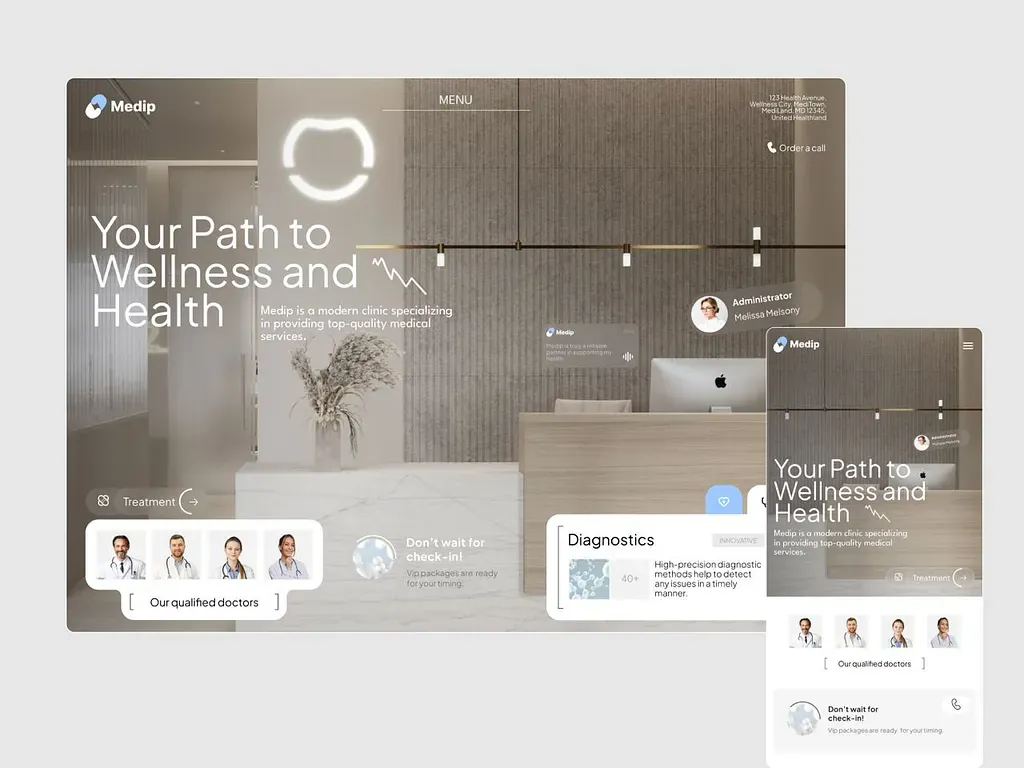
Entering the year 2026, the field of clinic website design has evolved far beyond building a simple information introduction page. According to the direction of experts at Tan Phat Digital, the website is now a core component in the digital health ecosystem, where the boundary between online and in-person services is blurred. This shift is driven by the maturation of Telehealth technology, with the global market forecast to reach massive scale.
Website serves as a strategic gateway for proactive healthcare journey management. User expectations have changed from searching for information to the need for a seamless experience: from real-time scheduling, to remote video consultations, to securely looking up personal records. This requires design units like Tan Phat Digital to have a deep understanding of technology, behavioral psychology and modern data security standards.
Recovery User Experience (UX) and Interface (UI) Design Philosophy
In 2026, medical website design will witness a strong shift from cold, "institutional" interfaces to digital spaces Supports mental health recovery. Studies show that users form an impression of a website in just 0.05 seconds, so an empathic interface has the ability to build trust immediately before the patient begins reading any words.
Key design elements based on "Healing Aesthetics":
Biophilic Design (Nature Simulation):Tan Phat Digital integrates natural elements into digital interfaces such as high-resolution landscape images, fractal patterns (tree branches, water waves), and lighting effects that simulate circadian rhythms. These elements help lower blood pressure, reduce cognitive stress, and improve mood in patients with anxiety.
Calming Aesthetics: Replace "sterile" white with neutral tones, sage green, or warm earthy colors. These colors have been shown to reduce cognitive fatigue and create a sense of security for patients.
Minimalist Navigation & Autonomy (Minimalism): Streamlined website structure, eliminating complex menus so patients can find important information (scheduling, emergency contacts) in as little as 3 clicks. Providing "Hands-Free Appointment" buttons through Voice UI helps users feel in complete control of their care journey.
Skeuomorphic icons for the elderly: To reduce technological barriers, Tan Phat Digital uses icons that simulate real objects (e.g., clip art for health records) to help older patients easily identify features without too much direction instructions.
Reassuring micro-interactions: Use gentle motion effects like progress bars or "V sent" confirmation animations to remove uncertainty as users work on complex medical forms. These interactions act as subtle feedback signals, providing a feeling of being heard and acknowledged.
The Integration of Telehealth and the Online Health Ecosystem
Telehealth has evolved from an ad hoc solution to a mainstream healthcare standard in 2026 . The website deployed by Tan Phat Digital serves as a centralized operating platform, connecting patients and doctors through a hybrid journey from online to in-person.
Secure Communication and Video Consultation Portal
Modern clinic websites directly integrate high-quality video consultation portals (Video Consultation Portals), providing a professional medical examination experience at home .
Installation-free experience:Patients directly access remote consultations through a web browser on any device without downloading third-party applications, minimizing technical barriers for the elderly.
Real-time synchronized appointment schedule: The calendar system is deeply integrated with the doctor's schedule (Physician schedules), allowing instant and automatic confirmation of available schedules. Automatically send multi-channel appointment reminders via Zalo, SMS or push notifications on mobile devices.
Multi-layer security communication: Chat and messaging channels are end-to-end encrypted according to TLS standards for data in transit and AES-256 for data at rest. All medical information exchanges are absolutely confidential, complying with HIPAA and GDPR standards to protect patient privacy.
Online payment & Connecting hospital fees: Integrating non-cash payment gateways, allowing patients to settle hospital fees and drug costs right on the website interface. The system automatically synchronizes invoices with clinic management software (HIS), helping to save waiting time at the counter
See more: Reputable website design service in Ho Chi Minh Minh
Wearable Health Monitoring (IoT)
In 2026, clinic websites have become the center of the Internet of Medical Things (IoMT) network, connecting smart wearable devices directly into clinical processes. Tan Phat Digital deploys deeply integrated solutions to turn raw data from devices into accurate medical decision support information.
1. Cross-platform integration (Apple HealthKit & Google Health Connect)
The clinic's website and accompanying application use modern SDKs to synchronize medical data from popular wearable devices:
Data unification:Direct integration with Apple HealthKit (iOS) and Google Health Connect (Android) to collect heart rate indicators, blood oxygen levels (SpO2), and sleep quality sleep and physical activity level.
Gateway mechanism: The website acts as an intermediate connection gateway, receiving data from the device via Bluetooth Low Energy (BLE) and transmitting it to the clinic's cloud storage system via high-speed 5G network.
2. Chronic disease monitoring and early warning
The system shifts from a "reactive" to a "proactive" care model with continuous monitoring capabilities:
Real-time clinical indicators: Biosensors allow physicians to continuously monitor blood sugar levels (for diabetics) or hands-free electrocardiograms (ECGs) for early detection of atrial fibrillation (AFib) episodes before clinical symptoms appear ready.
Smart warning system: When the indicators exceed the safety threshold (for example: heart rate > 174 bpm), the website will automatically send an emergency warning to the treating doctor and patient's relatives via push notification.
3. Dashboard visualizes data for doctors and patients
Tan Phat Digital designs specialized dashboard interfaces (Dashboards) to help analyze health trends instead of just displaying discrete numbers:
Interface for doctors (High-density view): Allows to quickly view the status of dozens of patients at the same time, highlighting high-risk cases for timely intervention time.
Patient interface (Calm UI): Uses simple charts, soft colors (green, blue) and non-medical language so patients can easily track recovery progress without feeling worried.
4. Security and Compliance with international medical standards
Transmission of biometric data requires the most stringent security protocols:
End-to-end encryption: Applying AES-256 standards for data at rest and TLS for data in transit to prevent any unauthorized interference.
HL7 FHIR Interconnection: Data from Wearable devices are standardized in the HL7 FHIR (Fast Healthcare Interoperability Resources) format, ensuring the website can "talk" and synchronize perfectly with the electronic medical record system (EMR/HIS) of major hospitals.
Artificial Intelligence (AI) and Personalizing the Patient Journey
In 2026, AI is no longer simple rule-based chatbots but has become into "Digital Medical Assistant" systems capable of understanding complex clinical contexts.
1. Smart Clinical Triage
Instead of static forms, the website integrates a new generation AI Chatbot that is fine-tuned on large medical language models such as Med-PaLM 2 or BioGPT.
Clinical interview structure: AI conducts structured conversations to ask about time of onset, severity of symptoms, and symptoms. Related symptoms and personal risk factors.
Accurate routing: Based on collected data, the system automatically classifies the level of urgency (emergency, same-day examination, or self-care at home) and recommends the most appropriate specialty.
Operational efficiency: Clinics that apply this solution record a reduction in load for the call center of up to 40% and 30% faster patient screening speed.
2. Predictive User Experience (Predictive UX) and Personal Dashboard
AI analyzes data from search history, authorized health data and wearable devices (IoT) to change the interface in real time.
Customized Dashboards: Chronic patients (such as diabetes or heart disease) will have their own interface that displays blood sugar or blood pressure monitoring graphs synchronized from the wearable device, along with early warnings about health risks.
Smart navigation: The website automatically highlights the features users use most often, such as the "Request prescription refill" button for old patients or "Schedule first consultation" for new visitors.
Empathic interface: The system is able to recognize anxiety-provoking words to adjust the tone The response voice and interface color palette change to a softer tone, helping to immediately reassure the patient.
3. Seamless Omnichannel Patient Journey (Omnichannel Flow)
Uses modern data connection protocols to synchronize the patient journey across every touchpoint.
Consistent data: A conversation started from a web chatbot can continue seamlessly on Zalo/WhatsApp without the patient having to repeat the original symptom information.
Suggested time frame Optimal:AI automatically suggests examination hours based on the patient's living habits (stored in CRM) and the doctor's actual available schedule in the clinic management system.
4. AI Security and Absolute Privacy
AI architecture at Tan Phat Digital complies with HIPAA and GDPR standards to protect sensitive data.
Multi-layer encryption: Apply AES-256 encryption standard for data at rest and TLS for data in transit.
Data Sovereignty: Ensure patient information is only used for the intended purpose on-site clinical personalization, absolutely not shared with external public AI models.
Medical SEO Strategy and Clinical Authority (E-E-A-T)
Google is increasingly strict in evaluating content that affects health (YMYL). Tan Phat Digital focuses on optimizing the website according to the advanced E-E-A-T evaluation framework:
Experience: Content must demonstrate practical commitment. Specific actions: Share clinical case reports (anonymized), videos of successful patient treatment journeys and self-taken images/videos to demonstrate actual procedures at the clinic.
Expertise: Medical articles must be compiled or reviewed by a licensed doctor. Specific action: Build a detailed doctor biography page with practice certificates, years of experience and links to research works or LinkedIn profile.
Authority (Authoritativeness): Measured through third-party recognition. Specific actions: Build links from medical newspapers, government medical organizations or reputable professional associations.
Trustworthiness: Transparency and security. Specific actions: Clearly publicize price lists, medical data security policies, contact information and display real reviews from patients via Google Review.
Types of technical structured data (Schema Markup) that need to be optimized:
For "machines" to clearly understand professional semantics, Tan Phat Digital deploys a detailed JSON-LD Schema system:
MedicalClinic: Declare the clinic list. Important attributes: Name, exact address (MAP), actual business hours, emergency phone number, and accepted insurance types.
Physician: Identifies the medical professional. Key attributes: Medical degree (MD/PhD), specialty strengths, training history, and public medical identifier to confirm entity.
MedicalCondition: Clinical definition to appear in AI Overview. Key attributes: Typical symptoms, common causes, risk factors, and treatment outline.
MedicalProcedure: Describes the treatment procedure. Important attributes: Purpose of procedure, pre-examination preparations, expected recovery time and important safety notes.
FAQPage: Optimize patient's most popular question-answer pairs to capture "Featured Snippets" or direct answers from AI virtual assistants.
Optimize Voice Search Search)
In 2026, Voice Search is no longer a supplementary feature but a "lifesaver" for elderly patients or people with poor vision. Tan Phat Digital deploys a Voice SEO strategy focusing on empathy and native language.
1. Conversation content and structure "Immediate answers"
Users often ask long questions (5-7 words) with everyday language instead of typing short keywords. To be optimal, website content should:
Use popular question titles: For example, "Which general internal medicine clinic near District 1 is open in the evening?" or "How to make an appointment to see a pediatric specialist at home?".
First 2 sentences rule: The direct answer to the question must appear in the first 1-2 sentences of the paragraph so that virtual assistants (Google Assistant, Siri) can easily extract information.
Local language: Integrate familiar regional words such as "shop", "examination place", "recent" to match the speaking habits of Vietnamese people.
2. Integrating multi-region Text-to-Speech (TTS) technology
Tan Phat Digital applies leading AI solutions such as Vbee or FPT.AI to provide natural reading voice on the website:
North - Central - South voice options: Allows patients to choose familiar voice, helping them easily receive information about medication instructions or examination procedures without having to read long texts that cause eye strain.
Adjust speed and emphasis:AI has the ability to emphasize important information (such as appointment time, address) to help the elderly remember better.
3. Voice Control Interface (Voice UI)
Website aims for a "Hands-free" model, where patients can perform operations using just voice commands:
Hands-free scheduling: "Hey assistant, please schedule a cardiology exam at 8 a.m. tomorrow."
Quick lookup: "Check your blood test results me."
Technical support: Optimize Micro-interactions with sound confirmation of actions so patients know their orders have been successfully performed.
Market Analysis and Service Packages at Tan Phat Digital
The website design market in Ho Chi Minh City in 2026 has a clear differentiation. Tan Phat Digital is proud to bring optimal solutions at reasonable costs:
Basic Package (Starter) - Price from 3,000,000 VND: Suitable for new clinics. Includes medical interface, service/doctor introduction page, simple booking form, basic SEO optimization and fast page loading speed.
Professional Package (Premium/Plus) - Price from 12,000,000 VND: Suitable for large clinic chains. Exclusive interface design, integrated advanced scheduling system (based on available time frame/schedule), online payment gateway and comprehensive Marketing strategy support.
Case Studies Details 2026
1. Specialized Dentistry: Breakthrough 60% Appointment Rate
A dental clinic in Ho Chi Minh City has redesigned its website with support from Tan Phat Digital. Previously, the website had a bounce rate of up to 78%. After optimizing the mobile-first interface and integrating smart booking forms at strategic locations, the number of online medical appointments increased by 60% after only 90 days.
2. 315 Obstetrics System: Optimizing Branch Network
With more than 120 clinics, 315 Obstetrics and Gynecology's website integrates a smart digital map to help patients find the nearest facility in real time. Publishing the detailed price list right on the website has helped increase reliability and reduce direct consultation time at the counter by 30%.
3. Ivy Health International: Premium Digital Membership Model
Ivy Health integrates an online membership card management system, allowing patients to purchase gold/silver examination packages and enjoy priority examination privileges. The website connects directly with Medpro to help people book medical examinations quickly, improving the efficiency of serving VIP patients.
4. Doctor Check Clinic: Specialized in American Standard Endoscopy
Doctor Check focuses on displaying international certifications (AACI, ISO) and screening process in 60-90 minutes. The website interface focuses on "Evidence Medicine", helping patients feel completely secure when receiving accurate diagnosis results on the same day.
5. Saigon Center Dental: Leading the Medical Tourism Trend
Focusing on international customers, this unit's website supports multiple languages and integrates CT Cone Beam 3D technology. With more than 10,000 successful cases shown through real video reviews, the website has become an extremely effective channel to attract patients from Australia and the US.
6. Le Van Thinh Hospital: Digitizing the Reception Process
The hospital has deployed self-service kiosks connected to the website, helping patients self-register for examination and pay fees using QR codes. Data of thousands of examinations per day are instantly updated to the electronic medical record system, helping to reduce pressure on reception department personnel.
7. Thien Minh Food: Increase Traffic by 300% Thanks to Semantic SEO
Through the Semantic SEO strategy (Semantic SEO), this website has achieved organic traffic growth of up to 300%. Optimizing content around complementary medicine topics helps the website occupy the "People Also Ask" position on Google, attracting a large number of potential customers.
8. Le Hoang Dental Clinic: Modern UI/UX Aesthetics
The project focuses on using vivid images of the examination process and actual facilities. The simple but luxurious design helps patients easily visualize the service, making a difference compared to competitors who use mass stock photos.
9. Saigon Healthcare: Building a Doctor's Personal Brand
This clinic's website has dedicated detailed pages to introduce the team of doctors from major hospitals (Cho Ray, Nhan Dan 115). The "Expert-centered" marketing strategy has helped the clinic affirm its clinical reputation and attract patients in need of intensive treatment.
10. MedArmor AI Hospital: Virtual Hospital Vision 2026
A pioneering project that applies a virtual care model, using AI to analyze EMR data and provide early warnings about diseases. MedArmor's website acts as a remote coordination center, allowing online consultations and continuous health monitoring without the need for patients to come in person.
Frequently Asked Questions (FAQ) About Clinic Website Design 2026
1. Why do clinics need a professional website in 2026?
A professional website is not only the face of the brand but also a tool to attract new patients through Google, build trust through transparent information and optimize operating processes thanks to the 24/7 scheduling feature.
2. What is the most prominent medical interface design trend today?
It is minimalist design (Minimalism) combined with a "healing" color palette (soft colors) to reduce patient anxiety, and micro-interactions that help confirm user actions in a subtle way.
3. What does AI technology support for clinic websites?
AI can preliminarily classify patients through smart chatbots, suggest appropriate specialists based on symptoms, and personalize display content for each specific patient.
4. What benefits does the Telehealth feature directly integrated on the web bring?
Patients can receive remote consultation via encrypted video calls without needing to install additional applications, helping to save travel time and reduce the risk of cross-infection.
5. How much does it cost to design a clinic website at Tan Phat Digital?
Tan Phat Digital offers flexible packages, starting from the Basic package from only 3,000,000 VND to high-end systems customized according to the clinic's unique needs.
6. How long does it usually take to complete a medical website project?
Normally, a basic website can be completed in 3 to 10 working days. For more complex systems, the time can last from 15 to 20 days.
7. How important is the WCAG 3.0 standard for medical websites?
This is a mandatory accessibility standard, ensuring that people with disabilities or the elderly can use the website easily through features such as screen reader compatibility and flexible font sizes.
8. How to get a clinic website to rank high on Google (SEO)?
The clinic needs to focus on E-E-A-T (Experience, Expertise, Authority, Trust) content strategy, transparent doctor profiles and citation of reputable medical sources.
9. Which medical Schema Markup is necessary for SEO?
Important Schema types include: MedicalClinic (clinic information), Physician (doctor information), MedicalCondition (pathology information) and MedicalProcedure (treatment procedure).
10. Does the website ensure the safety of sensitive patient data?
Yes, modern websites are required to integrate high-end SSL, data transmission encryption and storage systems with strict access permissions to protect privacy.
11. Does Tan Phat Digital provide maintenance support after handing over the website?
We commit to free technical support and maintenance within the first 12 months, and provide detailed content management training materials for clinic staff.
12. Can the clinic website connect to electronic medical records (EMR)?
Absolutely possible. Website 2026 is designed to communicate data according to HL7 FHIR standards, allowing patients to securely look up test results and treatment history online.
13. What should you keep in mind when optimizing Voice Search for the elderly?
Content needs to be written in a natural conversation style with long keywords in question form, and directly answer the problem in the first 1-2 sentences.
14. Does the website help the clinic stand out on Google Maps?
Yes, through optimizing Local SEO and integrating LocalBusiness Schema, the website helps the clinic appear priority in the "Map Pack" when patients search for medical services near their area.
15. What standards does the content of medical articles on the website need to meet?
Content must be clinically accurate, moderated by expert doctors, and presented in language understandable to the general public instead of just using confusing medical terminology.
Clinic website design in 2026 is the intersection between the art of rehabilitation design and the power of artificial intelligence. With the companionship of Tan Phat Digital, clinics can own a professional platform, helping to enhance their reputation and attract patients effectively in the digital era.
Investing in a website today is building a solid foundation for the sustainable development of the clinic in the future.
Share