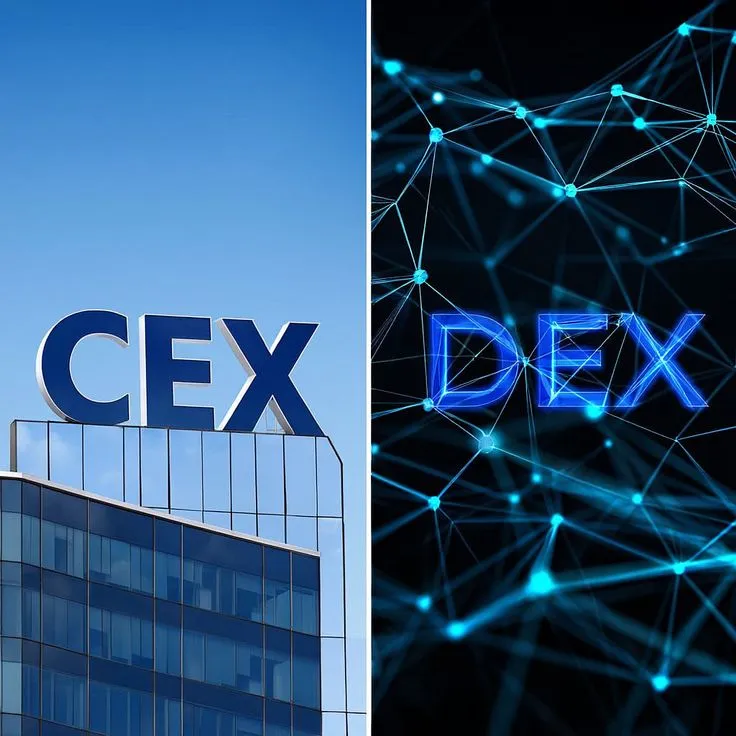
The rapid development of the global digital asset market has created two opposing but coexisting trading extremes: centralized exchanges (Centralized Exchange - CEX) and decentralized exchanges (Decentralized Exchange - DEX). In particular, Binance and Uniswap are not simply trading platforms, but also represent two different financial operating philosophies. According to analysis from experts at Tan Phat Digital, by the end of 2025, this polarization has become more complicated as Layer 2 solutions, protocol upgrades and new legal regulations, especially in the Vietnamese market, have redefined the relationship between CEX and DEX. Analyzing the differences between Uniswap and Binance requires a multi-dimensional view from technical structure to legal barriers and asset security.
Technical Architecture and Order Matching Mechanism: AMM vs. Centralized Order Book
The most core difference between Uniswap and Binance lies in the platform architecture and the way transactions are carried out. While Binance operates on the traditional Order Book model, Uniswap pioneered the Automated Market Maker (AMM) model.
Difference specifications:
Order matching mechanism: Binance uses a Centralized Order Book, while Uniswap uses an Automated Market Maker model (AMM).
Transaction method: Transactions on Binance take place between Users - Exchange - Users. On Uniswap, transactions are made directly between Users and Smart Contracts.
Asset custody: Binance is a custody exchange (Custodial) - an exchange that holds your money. Uniswap is a non-custodial exchange - you manage your personal wallet.
Customization: Binance decides on the features; Uniswap allows for expansion and customization through the "Hooks" structure in version V4.
Binance's Order Book Engine and Matching Engine
Binance operates as a custodial intermediary entity, where all buy and sell orders are aggregated into a central order book. Binance's order matching engine is capable of processing millions of transactions per second with extremely low latency. This model brings high efficiency for high-frequency transactions and allows for features such as margin trading (Margin) and futures contracts (Futures). However, users must deposit assets into the exchange's wallet, meaning Binance has complete control over that asset.
The Evolution of AMM and the Turning Point of Uniswap V4
In contrast to Binance, Uniswap completely eliminated the order book and replaced it with liquidity pools (Liquidity Pools). Prices are determined by a constant product algorithm x⋅y=k, where the amount of assets in the pool adjusts the price according to actual supply and demand. By the end of 2025, Uniswap V4 officially went live, introducing a "Hooks" structure that allows for customized trading logic such as on-chain limit orders, dynamic fees based on market fluctuations, and automatic position rebalancing.
Liquidity Analysis and Capital Efficiency
Liquidity is the deciding factor for the survival of the exchange. Binance currently maintains a dominant position in terms of total daily trading volume, but Uniswap has demonstrated superior capital efficiency in some segments.
Binance's market depth: Is the world's largest concentration of capital flows, allowing institutions to execute buy and sell orders worth tens of millions of USD with minimal slippage.
Centralized liquidity efficiency on Uniswap: From version V3, Uniswap allows liquidity providers (LPs) to limit price ranges. This helps provide liquidity many times deeper than leading CEX exchanges in certain asset pairs.
UniswapX: Launched to solve the problem of fragmented liquidity by aggregating liquidity sources from both on-chain and off-chain liquidity providers (Fillers), bringing the most optimal prices to users.
Cost Structure and Token Economics
2025 will see a significant reduction in on-chain transaction costs. The team at Tan Phat Digital noted major changes after Ethereum's Dencun upgrade.
Comparing specific costs:
Standard transaction fees: Binance (VIP 0) applies a 0.1% fee, while Uniswap (L2 like Base/Arbitrum) ranges from 0.05% to 0.3% depending on according to the liquidity pool.
Gas/Network Fees: At Binance, this fee is almost zero (included in the transaction fee). On Uniswap (Layer 2), gas fees have now dropped to negligible levels, typically less than $0.10 per swap.
Token Discount: Binance reduces fees by 25% when using BNB. Uniswap does not reduce fees directly but allows users to receive rewards for providing liquidity or using UniswapX to trade without gas fees.
Deposit/Withdrawal of fiat currency: Binance strongly supports P2P (Vietnamese bank transfer), while Uniswap depends on bridges or card purchase portals with higher fees.
Security, Custody, and Risk Management
The security differences between Binance and Uniswap reflect the trade-off between convenience and autonomy.
Binance (SAFU and Proof of Reserves):Binance maintains a SAFU insurance fund worth more than $1 billion and periodically updates its Proof of Reserves (PoR) report. Binance's reserve ratio is always above 100% (for example, BTC reaches 105.78%). However, users face centralization risk when the exchange holds the private key.
Uniswap (Self-Regulation and Smart Contract Risk): Uniswap is a non-custodial platform, users have full control over their funds. The main risk comes from vulnerabilities in the smart contract source code or individual errors in securing the recovery phrase (Seed phrase).
Legal Picture in Vietnam 2025: Sandbox Testing Framework
The year 2025 is an important milestone when Vietnam issues Resolution 05/2025/NQ-CP on piloting the crypto asset market.
Regulations for centralized exchanges: To be licensed for a pilot (maximum of 5 exchanges), businesses Must have a minimum charter capital of 10,000 billion VND and over 35% of capital from financial institutions such as banks or securities companies. Binance is still operating as an international exchange and has not participated in the pilot due to strict capital requirements and foreign ownership ratio (maximum 49%).
Uniswap's position: DEX exchanges like Uniswap are difficult to manage under traditional legal frameworks because of their anonymity and lack of local legal entities. This brings privacy to users but also makes it difficult for the government to collect taxes and protect investors.
Ecosystem and Expansion Products
Both platforms are constantly expanding their ecosystems to retain users.
Binance Ecosystem: Offers "super apps" with Binance P2P (supports 800+ payment methods), Binance Earn (yields on 300+ assets), and new token sales via Launchpad.
Uniswap ecosystem: Is the largest DeFi platform, integrating with more than 300 different applications. In addition to Uniswap, users also use specialized exchanges such as Curve (optimized for Stablecoins) or Aerodrome (on the Base network) to increase profits.
Strategic choice in the new era
Binance and Uniswap are currently two complementary tools rather than complete replacements. Tan Phat Digital recommends the "Hybrid" model: use Binance to convert fiat currency (VND) and trade major asset pairs; and use Uniswap to discover new projects, ensuring privacy and full control of long-term assets. Mastering both platforms will help investors optimize costs and security in the digital financial era of 2025.
Share


