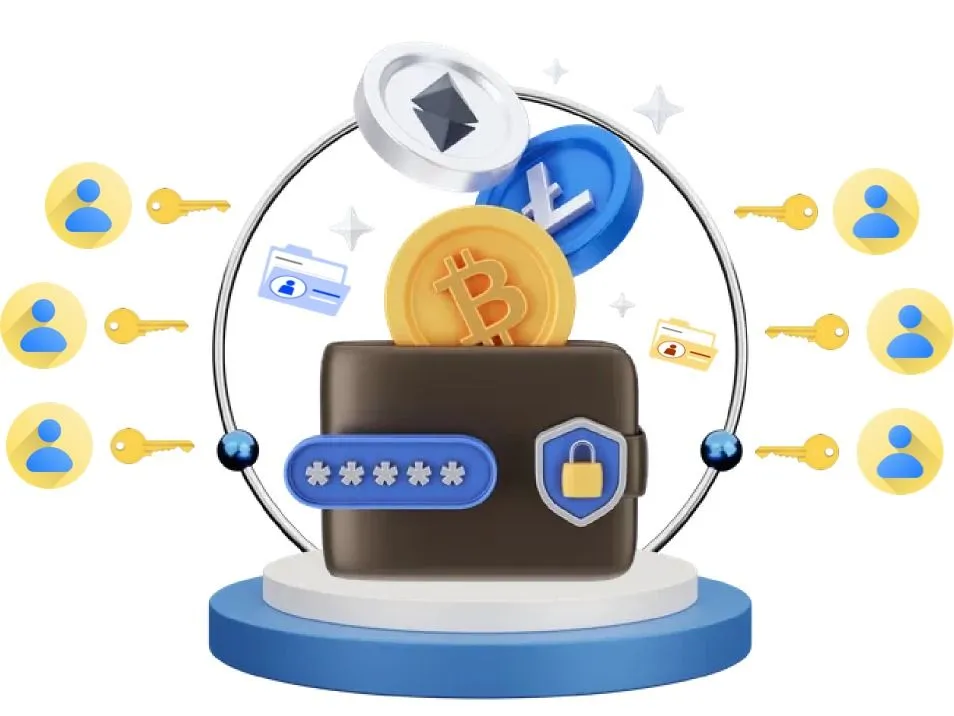
The rise of digital assets has posed unprecedented challenges to security key management. For more than a decade, the BIP-39 seed phrase-based wallet model has served as the backbone of asset self-governance. However, according to records from Tan Phat Digital, actual operations show that this model contains inherent risks of single point of failure and human error. Multi-Party Computation (MPC) technology has emerged as a promising alternative, promising to completely eliminate the seed phrase vulnerability through decentralization of control. The analysis below will extensively evaluate whether MPC wallets are truly more secure than traditional seed phrase wallets, by looking at technical aspects from key sharding to core trust assumptions.
The Evolution of the Key Management Model: From EOA to MPC
The history of cryptocurrency wallets begins with Externally Owned Accounts (EOA), where a private key sole holder of total control of the assets. Initially, users had to manage complex alphanumeric character strings, which led to frequent lost keys. To improve user experience, standards such as BIP-32 (decentralized wallet - HD) and BIP-39 (seed phrase) have been introduced. Despite making backups easier with 12 to 24 English words, the essence of security remains unchanged: anyone who gets hold of the phrase has full access to the assets.
The shift to MPC is not just an interface change but a revolution in the cryptographic layer. MPC allows parties to jointly calculate a function based on their secret data without ever revealing that data to each other. When applied to cryptocurrency wallets, MPC replaces the concept of a single private key with a distributed process, ensuring that a complete private key never exists anywhere in the system.
Seed Phrase Wallets: The Gold Standard and Its Inherent Vulnerabilities
The seed phrase model operates on the assumption that the user is capable of protecting a physical secret absolutely. The private key is generated from the seed phrase and stored on a device. To perform a transaction, this private key must be loaded into memory for signing, creating a centralized attack target.
Single Point of Failure
The biggest risk of seed phrase wallets is the concentration of power. If the seed phrase is lost, the assets will be locked forever. If the seed phrase is stolen through phishing or malware attacks, the entire asset will disappear in an instant. Even for large organizations, managing a single seed phrase is an "operational nightmare" because it creates extremely high internal risk when one individual can hold total control.
Human error and physical risk
Seed phrase backup often relies on physical media such as paper or metal. These materials can be destroyed by fire, flood or simply lost. In addition, ordinary users often tend to store seed phrases digitally (take photos, save in the cloud), which violates basic security principles.
See also: MPC Wallet What is it?
Multi-Party Computation (MPC): The only solution to eliminate weaknesses
MPC completely changes the approach by dividing ownership. Instead of a single key, the system creates many independent "key shares". These key fragments cooperate to create a valid digital signature for the blockchain without ever needing to be reassembled to recover the original private key.
Key Sharding Mechanism: Fragmentation and Secret Distribution
Key sharding in MPC uses algorithms such as the Threshold Signature Scheme (TSS) to ensure that each key fragment is a meaningless mathematical value in isolation. Below is a detailed comparison between the two models:
Seed Phrase Wallet:
Key Initialization: Generate a full key then generate the seed phrase.
Storage: A single location (device or paper).
The only weakness: It does exist (it is the Seed phrase).
Recoverability: Depends entirely on the physical preservation of the phrase.
MPC Wallet:
Key Initialization: Creates distributed key fragments from scratch, never forming a full key enough.
Storage: Distributed across multiple devices or independent parties.
Unique weakness: None (Attacker must compromise multiple parties simultaneously).
Recoverability: Relies on modern multi-factor authentication (3FA) mechanisms.
See also: What is a non-custodial wallet?
Distributed Key Generation (DKG): Contactless key generation
In the process DKG, participating parties jointly generate their key pieces without either party knowing the other party's pieces. The corresponding private key exists only as an abstract mathematical concept; it is never physically formed on any drive or memory. This prevents the risk of the key being leaked at the time of initialization.
Threshold Signature Scheme (TSS): Signing transactions without key recovery
When a transaction needs to be performed, the parties holding the key fragments participate in a multi-round computation process. This process ensures:
The final signature is completely valid and indistinguishable from a signature from a regular EOA wallet.
No party can arbitrarily sign a transaction without reaching an approval threshold (e.g., 2-of-2 or 2-of-3).
The full private key never appears in the device memory during the process sign.
Analyzing Trust Assumptions: Assumptions of trust in MPC wallet
While MPC brings outstanding advantages, Tan Phat Digital emphasizes that it also introduces new trust assumptions. Trust is transferred from the users themselves to the service provider and their technical infrastructure.
Liveness and Availability
In the popular 2-of-2 model, users cannot transact if the provider server is offline. As a solution, 2-of-3 models that use an independent third party or backup recovery mechanism (escrow) are often preferred for long-term storage.
Blind Signing Risk and Integrity of Intent
The major challenge is the "intent verification gap". If a hacker compromises the wallet application and changes the destination address, the MPC process will still proceed with "blind" signing. Modern systems are solving this problem by adding a transaction simulation layer before signing to analyze the user's true intentions.
Self-custody in the MPC context
Most MPC wallets meet the non-custodial standard because the provider cannot unilaterally initiate a transaction without the user's key fragment. However, security still depends on whether the vendor is transparent about the source code or not.
Detailed security comparison: MPC vs. Seed Phrase vs. Multi-Sig
According to analysis by Tan Phat Digital, the position of the three solutions is summarized as follows:
Seed Phrase Wallet:
Mechanism: A single private key.
Attack surface: Weaknesses concentrated in the seed cluster phrase.
Gas Cost: Lowest (only 1 signature).
Privacy: High.
Compatible: All chains.
Multi-Sig Wallet:
Mechanism: Multiple unique private keys established.
Attack surface: Many weaknesses (attacker must capture multiple keys).
Gas cost: High (due to multiple signatures on-chain).
Privacy: Low (exposes on-chain wallet structure).
Compatibility: Restrictions on supporting chains smart contract.
MPC Wallet:
Mechanism: A mathematically fragmented key.
Attack Surface: Distributed (must compromise multiple key fragments simultaneously).
Gas Cost: Low (signature generated is identical to single wallet).
Privacy: High (no cross-chain traces exposed).
Compatible: All chains (chain-agnostic).
Practical security vulnerabilities: Lessons from BitForge and TSSHOCK
While powerful in theory, MPC implementations can lead to vulnerabilities if controls are lacking. The BitForge (2023) vulnerability demonstrated that a malicious actor could send specially crafted messages to extract entire key fragments after a certain number of signings. This emphasizes that the security of MPC depends entirely on the rigor of its mathematical implementation and in-depth security audits.
Performance and latency
The performance of MPC wallets has improved significantly over protocol generations:
GG18: Requires 9 communication rounds, few latency seconds.
GG20: Reduced to 6 rounds, significantly improving speed.
CGGMP21: The most modern standard, only requires 4 communication rounds, latency less than 100ms under optimal conditions.
Risk management and recovery mechanism
MPC solves the problem theme "lost is all lost" through flexible mechanisms:
3FA model (like Zengo): Combines Email, Cloud Backup and facial biometrics to restore key fragments.
Business Continuity: Reputable providers use source code escrow (Escrow) and Proof of Life to ensure users can restore their accounts. even if the company goes bankrupt.
The future: Convergence of MPC and Account Abstraction (AA)
Tan Phat Digital predicts the future will be a combination of both technologies:
MPC at the bottom: Secure, distributed private key management and signing.
Account Abstraction on the upper layer:Enforce transaction logic (spend limits, gas payments in any token).
This combination provides a traditional application-like experience (Web2) without sacrificing the security of Web3.
Comparative analysis: Hardware Wallets (Hardware Wallets) vs. MPC Wallet
Hardware Wallet (Cold Storage):
Storage: Offline in a dedicated security chip.
Protection: Against physical tampering.
Recovery: Based on physical seed phrase (risk) lost/stolen).
Convenience: Low (need to connect device to sign).
Scalability: Poor for corporate environments.
MPC Wallet (Hot/Warm):
Storage: Distributed across multiple nodes or devices device.
Protection: Not dependent on a single physical device.
Recovery: 3FA, biometrics, social recovery.
Convenience: High (fast online signing).
Extensibility: High (management via API and cloud). cloud).
Frequently Asked Questions (FAQ)
What is an MPC wallet?
This is a wallet that uses multi-party computing technology to divide private keys into many independent pieces stored in different places.
Why doesn't MPC wallet need a seed phrase?
Since the key never exists in its unique complete form, there is no "seed phrase" to back it up in the traditional way.
Is an MPC wallet truly "non-custodial"?
Yes, because the service provider only holds a piece of the key and cannot arbitrarily move assets without approval from the user's key piece.
What are "Key Shards"?
Are the mathematical components of a private key. Each piece standing alone is meaningless and cannot be used to restore the wallet.
What happens if I lose my phone?
You can restore access through multi-factor authentication (3FA) like email, biometrics, and encrypted cloud backups.
What happens if the wallet provider goes bankrupt?
Reputable wallets establish a "Guaranteed Access" mechanism through an independent third party or escrow the source code for users to restore their keys when needed.
Does MPC Wallet support multiple blockchains?
Yes, MPC architecture is "chain-agnostic", meaning it can operate on any blockchain that uses standard digital signatures.
Compared to hardware wallets, how secure is MPC wallet?
MPC offers institutional-like security but with more flexibility, eliminating physical risk from securing manage seed phrases.
What is the risk of "blind signing"?
It is when a user signs a transaction without clearly seeing the content inside, which can lead to erroneous approval of malicious contracts.
What is the transaction speed of MPC wallet?
Signing speed ranges from 100ms to several seconds depending on the number of key fragments and network connection quality.
when MPC performs off-chain signing and only posts a single signature to the blockchain. How does "Key Rotation" work?
The system periodically refreshes existing key pieces. This helps neutralize old key fragments if they are accidentally stolen before.
Can MPC be combined with Account Abstraction (AA)?
Yes, MPC manages the signing key (off-chain) and AA manages the execution logic (on-chain), creating the most comprehensive security solution available today.
Is MPC technology compliant with international standards such as NIST?
The NIST agency is in the process of developing official standards for threshold signatures (TSS), which will promote adoption by major banks.
After extensive analysis, Tan Phat Digital affirms: MPC wallets are actually more secure and convenient than wallets seed phrase in most real-world scenarios.By eliminating unique weaknesses and modernizing the recovery process, MPC brings peace of mind to both individuals and organizations.
However, you should note:
Choose a reputable vendor: Prioritize open source code and be audited by leading units.
Understand the recovery mechanism Recovery: Ensure there is a backup plan if the provider goes out of business.
Incorporate intent verification: Use wallets with built-in transaction simulation to avoid sophisticated phishing attacks.
MPC technology is redefining the standard of trust, shifting from trust in an individual to trust in the power of distributed mathematics.
Share


