Mnemonic Seed Phrase Technical Architecture and Ecosystem in Blockchain: From Cryptographic Theory to Standards Implementation
The rise of blockchain technology and decentralized digital assets has posed a fundamental challenge for mainstream users: how to manage complex cryptographic keys without sacrificing security or accessibility. In the early days of Bitcoin, backing up wallets often required users to store wallet.dat files containing separate keys or long strings of hexadecimal characters, which not only made manual recording difficult but also posed a huge risk of copying errors. The landmark solution to this problem, which Tan Phat Digital will analyze below, is the birth of Mnemonic Seed Phrase — a method of standardizing the transformation of random binary data into easy-to-manage natural language word strings.
Historical context and formation of the BIP39 Standard
Before 2013, there was a lack of standards common for wallet initialization and recovery has led to fragmentation, where the backup phrase of one wallet software cannot be used by another wallet software. To address this situation, leading developers including Marek Palatinus, Pavol Rusnak, Aaron Voisine, and Sean Bowe proposed Bitcoin Improvement Proposal No. 39 (BIP39). BIP39 was designed as an open source protocol for creating deterministic wallets, allowing the entire key structure of a wallet to be reconstructed from just a single string of mnemonic words.
The main motivation for BIP39 is to improve the user experience by providing a backup method that is easier to read and write than raw binary or hexadecimal representations. According to Tan Phat Digital's assessment, the seamless interoperability between different wallet platforms — from hardware wallets like Trezor, Ledger to software wallets like MetaMask or Trust Wallet — has turned BIP39 into the gold standard in the cryptocurrency industry. This innovation not only helps minimize the risk of losing assets due to data entry errors, but also facilitates the development of more complex wallet structures such as Hierarchical Deterministic Wallets (HD Wallets).
Analysis of the Mnemonic Phrase Initialization Technical Process
The process of generating a seed phrase is not an arbitrary random choice of words, but a series of rigorous mathematical steps that ensure uniqueness and auditability error. This process involves generating entropy, calculating a checksum, and mapping binary data to a defined vocabulary list.
Initializing Entropy and Security Variation
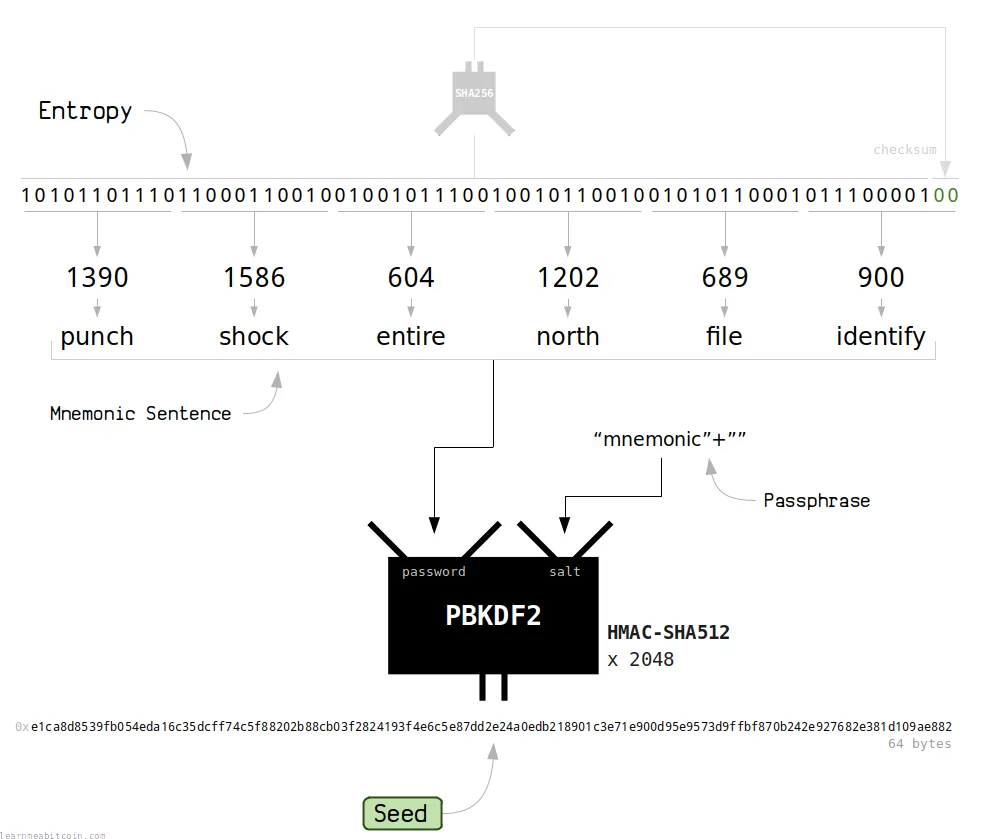
The foundation of every Mnemonic phrase is entropy, a completely randomly generated sequence of binary bits. According to the BIP39 specification, the length of the entropy (ENT) must be a multiple of 32 bits and be between 128 and 256 bits. Hardware wallets typically use a True Random Number Generator (TRNG) chip to collect data from physical transformations, ensuring maximum randomness.
The relationship between entropy and word count is strictly regulated to balance security and usability. Below are the detailed technical specifications compiled by Tan Phat Digital:
Entropy 128 bits: Checksum code 4 bits, Total length 132 bits, creating 12 words.
Entropy 160 bits: Checksum code 5 bits, Total length 165 bits, produces 15 words.
Entropy 192 bits: Checksum 6 bits, Total length 198 bits, produces 18 words.
Entropy 224 bits: Checksum 7 bits, Total length 231 bits, produces 21 words.
Entropy 256 bits: 8 bits Checksum, Total length 264 bits, produces 24 words.
Checksum and SHA-256 Algorithm
To ensure integrity, BIP39 integrates an internal checksum mechanism by hashing the initial entropy via the SHA-256 algorithm. A portion of the hash result, equal in length to the ENT / first 32 bits, will be taken as the checksum. For example, with a 12-word phrase (128 bits of entropy), the first 4 bits of the SHA-256 hash code will be appended to the end of the original string to form a 132-bit string. On recovery, if the checksum does not match, the wallet will warn of an invalid phrase, helping to prevent errors from keystrokes.
Binary Decomposition and Mapping to a Vocabulary List
The complete bit string is divided into fixed groups of 11 bits. Each group represents a numeric value from 0 to 2047 (because $2^{11} = 2048$). This value is the index to select the corresponding word in the standard vocabulary list. For example, a group of 11 bits with the binary value 00110010100 equivalent to the decimal number 404 would map to the 405th word "crater".
BIP39 Vocabulary List Specification
The BIP39 Vocabulary List includes 2048 carefully selected English words. Tan Phat Digital emphasizes the following optimal features:
Uniqueness of the First Four Characters: Users only need to enter the first four letters to be able to accurately identify the word in the dictionary. This allows hardware wallets to support word auto-completion.
Selection Criteria: The list removes confusing word pairs (like "build" and "built") or homonyms. The list is sorted alphabetically to support a binary search algorithm or a prefix tree (trie) structure.
Key Derivation Mechanism: From Mnemonic to Binary Seed
The mnemonic phrase is then converted to a 512-bit "binary seed" via the key derivation function PBKDF2 with parameters:
Password (Password): UTF-8 NFKD standardized mnemonic phrase.
Salt: Fixed string "mnemonic" combined with optional passphrase.
Iterations: 2048 times to slow down brute force attack attempts.
Output: 512 bits (64 bytes).
Passphrase: 25th Security Layer
BIP39 allows an optional passphrase (13th or 25th word). Tan Phat Digital considers this an extremely important layer of protection because it creates a completely different binary seed even if the original 24 words are revealed. It brings “plausible denial” capabilities, allowing users to maintain hidden wallets with varying balances. However, if you forget the passphrase, all assets will be lost forever because there is no recovery mechanism.
Wallet Hierarchy: BIP32 and BIP44
To manage thousands of addresses, Mnemonic works in coordination with BIP32 (Hierarchical Deterministic Wallet) and BIP44 (Multi-account structure). Below is a list of popular coin indices in SLIP-0044 that Tan Phat Digital has updated:
Index 0: BTC (Bitcoin)
Index 1: Testnet (Common to all coins)
Index 2: LTC (Litecoin)
Index 3: DOGE (Dogecoin)
Index 5: DASH (Dash)
Index 60: ETH (Ether)
Index 61: ETC (Ether) Classic)
Index 144: (Solana)
Alternative Standards and SLIP39
Besides BIP39, there are other standards such as:
Electrum Seed: Has a built-in versioning system to define derivation algorithms.
AEZeed: Used by the Lightning Network (LND), contains the date of birth information of wallet.
SLIP39: Uses Shamir's Secret Sharing (SSS) algorithm to split the seed set into multiple pieces (e.g. create 5 pieces, need 3 pieces to restore), eliminating risk from a single weak point.
Security Analysis and Storage Strategy from Tan Phat Digital
Mnemonic's security is based on the randomness of entropy. The probability of correctly guessing a 12-word phrase is $2^{128}$ (about $3.4 \times 10^{38}$), and that of 24 words is $2^{256}$ (about $10^{77}$). However, the biggest risk often comes from human mistakes such as digital storage (photography, cloud saving) is vulnerable to hackers.
Tan Phat Digital recommends the following safe storage strategies:
Metal Physical Storage: Use steel or titanium plates that are fire resistant above 1400°C and corrosion resistant worn out.
Dispersion Principle: Make at least two copies and store in different geographical locations to avoid risks from natural disasters or local theft.
Absolutely No Online Entry: Only enter the seed phrase directly into the hardware wallet device or official wallet application in a secure environment.
Phrase mnemonic represents the perfect intersection between high-level cryptography and user-centered design. Although new technologies like Account Abstraction are evolving, Tan Phat Digital believes that the Mnemonic architecture will still be the core foundation of digital sovereignty in the near future. Understanding the technical mechanisms and adhering to strict security rules is the best way to protect your assets in the blockchain era.
Share


