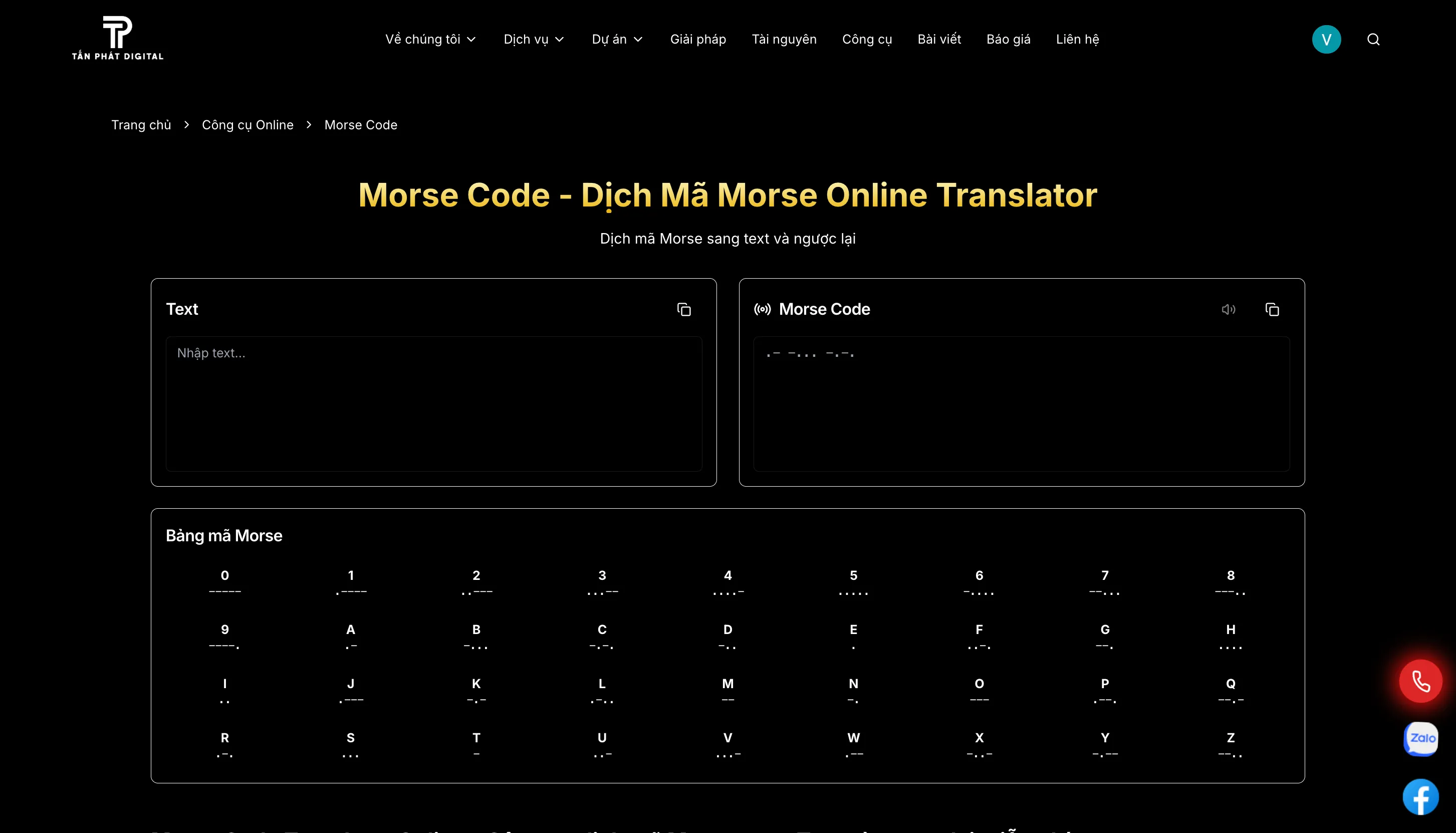
The persistence of Morse code in the digital era is not only a nostalgic phenomenon but also a testament to the power of simplicity and efficiency in communication. Invented by Samuel Morse and Alfred Vail in 1836, Morse code laid the foundation for humanity's first telecommunications revolution. Although satellite communication systems and the internet have become ubiquitous, Morse code still maintains its position as an important backup method of communication in maritime, aviation, and military applications and is an indispensable survival skill. In Vietnam, the application of Morse code to Vietnamese requires specific conversion standards to handle the system of diacritics and special characters, leading to the birth of specialized online Morse code translation tools such as Tan Phat Digital's solution.1
History of formation and evolution of the telegraph system
The history of Morse code begins with an idea that arose in the mind of Samuel Morse, an amateur artist and inventor, when he was on a ship crossing the Atlantic in the early 1830s. As scientists at that time were discovering new advances in electrical theory, Morse envisioned a device capable of transmitting messages through wires using electrical pulses. Although this idea had been pursued by many other inventors for nearly a century, Morse succeeded thanks to perseverance and a simple but optimal engineering design.
Originally, Morse's design included a "lock" (essentially a spring switch) to send signals and a sounder to receive messages. However, the biggest difficulty lies in the encryption system. In the first sketch, Morse planned to use combinations of dots and dashes to represent the numbers 0 through 9. According to this plan, words and phrases would be looked up in a special numbered dictionary. Realizing the inconvenience of this method, Morse, along with his colleague Alfred Vail, developed the Morse alphabet, allowing each character to be spelled directly using strings of dots (dit) and dashes (dah).
The birth of Morse code was not merely a technical invention but also the beginning of an international communication standard. In 1851, a conference of European nations agreed on a simpler and more precise variation, known as "International Morse Code". The core difference between the international code and the original US Morse code lies in the consistency of dashes and the elimination of variable spaces within the same character. International Morse Code has been the lingua franca of the global maritime and aviation industries for more than a century.
The technical structure and timing rules of Morse code
Morse code is not a collection of random symbols; It is built on an extremely tight timing system to ensure accurate decoding even in weak or noisy signal conditions. The essence of Morse code is the separation of characters based on the length of the electrical pulse and the silence between them.
Basic time units and constituent ratios
In the Morse code system, every component is defined based on the ratio with a dot (.), considered a basic unit of time:
Dot (Dit): 1 unit of time. This is the shortest electrical pulse and is the basic unit of measurement.4
Dash (Dah): 3 units of time. Long electrical pulse, equivalent to the length of three consecutive dots.4
Component distance: 1 time unit. This is the silence between dots and dashes within the same letter.4
Character spacing: 3 time units. Silence between two letters in the same word.4
Word spacing: 7 time units. Silence between two complete words in a sentence.4
This length distribution is based on research on how frequently letters are used in English. The letter "E" is assigned the shortest code of a period (.), while the second most common letter "T" is assigned a dash (-). Less common characters such as "Q" (--.-) or "Z" (--..) have a longer and more complex code structure. This principle helps optimize the overall transmission speed.
PARIS transmission speed calculation model
To standardize the measurement of Morse code transmission speed, the international community uses the unit Words Per Minute (WPM). The word PARIS was chosen as the standard because when encoded with a word space at the end, it has a total length of exactly 50 time units.4
The structure of the word "PARIS " (including the space after the word) is analyzed as follows:
P:.--. (11 internal units + 3 space units after the word = 14)
A:.- (5 internal units + 3 space units after the word = 8)
R:.-. (7 internal units + 3 space units after the word = 10)
I:.. (3 internal units + 3 space units after the word = 6)
S:... (5 internal units + 7 space units after the word = 12)
Total: 14 + 8 + 10 + 6 + 12 = 50 units.4
Based on this standard, the length of a dot (t_{dit}) in seconds at a WPM speed (s_{wpm}) is determined by the formula:
t_{dit} = 60/(50 x s_{wpm})
At 20 WPM, a dot will last exactly 60 milliseconds (0.06 seconds). The algorithms in Tan Phat Digital's tool use this timing rule to reproduce the sounds "dit" and "dah" with absolute accuracy.1
Application of Morse code in Vietnamese: Telex and VNI Solutions
The biggest challenge when applying Morse code in Vietnam is the system of diacritics and extended Latin letters. Because the international standard Morse code does not support these characters, users need to use intermediate encoding rules.
Telex rules in Vietnamese Morse code
The Telex system replaces caret and tone marks with standard Latin characters 5:
Â: Type AA (Example: CHAAN - Chan)
Á: Type AW (Example: TRAWNG - Moon)
Đ: Type DD (Example: DDI - Go)
Ê: Type EE (Example: TEEN - Name)
O: Type OO (Example: OONG - Mr)
E: Type OW (Example: TROWN - Smooth)
U: Type UW (Example: TUWNG - Tuong)
UU: Type UOW or OUW (Example: TUOWNG - Tuong)
Sharp Mark: Type the letter S at the end of the word.
Accent Huyen: Type the letter F at the end of the word.
Question Mark: Type the letter R at the end of the word.
Til: Type the letter rel="noopener noreferrer" href="https://tanphatdigital.com/vi/tools/morse-code">Tan Phat Digital's online Morse code to Vietnamese translation tool, users should enter text in this Telex format to receive the correct Morse code for Vietnamese content.
VNI rules in Morse code
VNI typing method uses numeric keys to represent accents, but is less common Telex in traditional telegraphic communication 7:
Color Mark: Number 1
Asterisk Mark: Number 2
Question Mark: Number 3
Fall Mark: Number 4
Heavier Mark: Number 5
Hat (â, ê, xo): Number 6
Catch (uh, ô): Number 7
Moon (ă): Number 8
Letter D: Number 9.8
Analysis of tools Modern Morse code translation
The development of technology has brought powerful translation solutions, typically Tan Phat Digital's tools and large ecosystems.
Tan Phat Digital's Morse code translation tool
Tan Phat Digital's online tool stands out with its ability to serve the Vietnamese user community through features 1:
Offline processing on the browser: Conversion realtime without sending data to the server, ensuring privacy and working well even when the network is lost.
Web Audio API: Plays international standard "dit" and "dah" sounds at precise speed, supporting effective listening learning.
Responsive interface: Works smoothly on both computers and mobile phones (mobile-friendly).
Supports special characters: Provides full code table from A-Z, 0-9 and common punctuation marks such as period, comma, question mark, exclamation mark.1
Other technology solutions
Gboard (Google): Integrates a Morse keyboard for people with disabilities, supports connecting peripheral switch devices to "type" Morse with body movements.9
Morse Code Engineer: Uses camera and microphone to automatically detect and decode light or sound signals from the environment.10
Aspose Morse Code Translator:Browser-based solution that allows listening to audio and creating professional Morse documents.11
Applications in security, defense and survival
Morse code remains the ultimate method of communication in emergency situations. In aviation, it is used to identify navigational beacons. In maritime, the SOS signal (... ---...) is the international standard for calling for help. 3
Techniques for aiming and broadcasting SOS signals using a life-saving mirror 12:
Determining the target: Searching for the ship or aircraft that needs to send the signal.
Sighting technique: Hold the mirror in front of your face, use your thumb or make a V shape with your raised hand. aiming point to look through the gap between the fingers towards the target.
Adjustment: Rotate the mirror face so that the reflected light hits the aiming point (hand) and points straight at the target.
Code generation: Cover the mirror face or tilt the mirror to create a rhythm of 3 short flashes (S), 3 long flashes (O), 3 short flashes (S).12
10 Frequently Asked Questions (FAQs) about Morse code
1. How is the SOS signal in Morse code written? SOS is encoded as
... ---...(3 dots, 3 dashes, 3 dots). This is an international distress signal because it has a simple rhythmic structure, is easily recognizable and cannot be confused with other characters.2. How to send Morse code with a reflector when in distress? You need to use your finger as an aiming point towards the target (ship, plane), then adjust the mirror so that the reflected light hits that finger. To play SOS, tilt the mirror to create a rhythm of 3 fast flashes, 3 slow flashes, and end with 3 fast flashes.
3. Why does the letter 'E' only have a single dot (.)? Samuel Morse designed the code based on the frequency of use of letters in English. 'E' is the most common letter so it is assigned the shortest code to optimize communication speed.
4. How does Morse code support people with disabilities? People with limited mobility or quadriplegia can use Morse code via switches, buttons or even blinking their eyes (eyelid) to enter text into support applications like Gboard.
5. Accented Vietnamese is translated into Morse code using what rules? To translate Vietnamese, people use the telegram (Telex) rules. For example:
ÂbecomesAA,DbecomesDD, and tone marks such as Sac, Huyen, Q, Nga, Nang correspond to the lettersS,F,R,X,Jplaced at the end of the word.6. What is the Koch method of learning Morse code? This is a method of learning Morse code by sound instead of memorizing it by sight. Learners start with 2 characters at high speed (about 20 WPM) and only add new characters when they reach over 90% accuracy.
7. What does PARIS speed 50 time units mean? This is the international standard for measuring WPM speed. The word "PARIS" (with a space after the word) has a total length of exactly 50 time units (dit), helping to standardize the calculation of accurate transmission times for all types of text.
8. Can I use Morse code on my Android/iOS phone?Yes, you can set up the Gboard keyboard to type Morse code directly. In addition, Tan Phat Digital's tool allows you to translate and play Morse audio right on your phone browser without needing to install additional software.
9. Is Morse code still used in modern military? Despite the availability of satellite technology, Morse code is still maintained in the military and maritime industry as a secret back-up communication method, has good interference resistance and works with minimal equipment.
10. How is the distance between components in Morse code regulated? International standard rules stipulate: the distance between parts in a word is 1 unit, between letters in a word is 3 units, and between words is 7 time units.
Morse code is not only a historical legacy but also an effective communication tool in the future. The combination of traditional Vietnamese Telex/VNI rules and modern tools such as Tan Phat Digital 's online Morse code translation solution has made accessing this type of code easier and more convenient than ever.1
Share