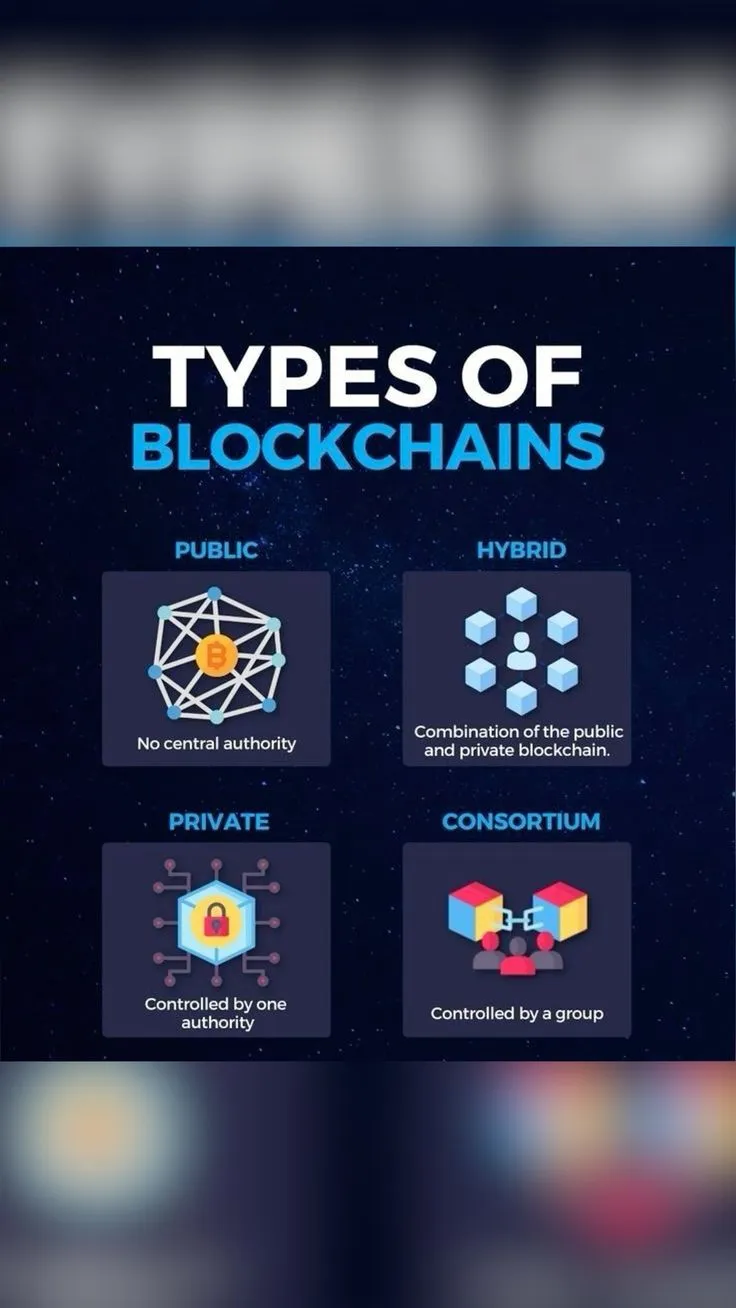
According to the team of experts at Tan Phat Digital, the shift of global digital infrastructure in the period from 2025 to 2030 is witnessing a fundamental revolution. Blockchain technology is no longer just a term associated with speculative cryptoassets but has become the backbone of modern data management, finance and supply chain systems. Blockchain, in essence, is a distributed ledger mechanism (Distributed Ledger Technology - DLT) that allows the storage and transmission of information in a transparent, secure and irreversible way. However, depending on the intended use, security needs and legal regulations, this technology is deployed in many different architectural forms, in which Public Blockchain, Private Blockchain and Permissioned Blockchain (often including Consortium Blockchain) are the three main pillars that shape the way organizations interact in the digital space.
Choosing a suitable type of blockchain is not simply a technical decision but an important business strategy, directly affecting the ability to expansion, operating costs and business compliance. As Vietnam moves towards implementing the Digital Technology Industry Law in early 2026, a thorough understanding of these models becomes more urgent than ever for technology managers and engineers. The following analysis by Tan Phat Digital will delve into every technical corner, advantages and disadvantages, and practical application roadmaps of these types of blockchain in the era of comprehensive digitalization.
Public Blockchain: Decentralized philosophy and the power of a borderless network
Public Blockchain, or public blockchain, represents the earliest and purest form of this technology, built on the philosophy of a financial system and the data does not need a trusted intermediary (trustless). This is a completely open network, where any individual with an internet connection can participate in reading data, sending transactions and most importantly, contributing to the authentication process to achieve consensus in the network.
Definition and operating mechanism of Public Blockchain
A public blockchain operates on the principle of permissionless. This means there are no barriers in terms of identity or geographical location for participating parties. The integrity of the data in this system is not maintained by a specific organization but by the coordination of thousands, even millions of independent nodes around the world.
The core mechanism that allows Public Blockchain to exist without collapsing before attacks from bad actors is the technical-economic consensus algorithms. Nodes in the network must invest resources — either computational power (in Proof of Work - PoW) or deposited assets (in Proof of Stake - PoS) — to gain the right to write new data to the blockchain. For example, in the Bitcoin network, miners must solve complex cryptographic problems to find the valid hash value for each block, a process that requires enormous amounts of energy but ensures that changing transaction history is economically impossible.
Each block in the blockchain contains a digital fingerprint of the previous block, forming an unbreakable logical link. The basic formula for determining the validity of a new block can be described by a cryptographic hash function:
H_n=Hash(H_{n-1}+Data+Nonce)
Where H_n is the hash of the current block, H_{n-1} is the hash of the previous block, and Nonce is the variable value that miners must search for to satisfy the difficulty of the network.
Salient characteristics of ants public architecture
Absolute transparency is the most important identifying feature of Public Blockchain. Every transaction since the Genesis Block is recorded and can be traced by anyone through blockchain query tools. This transparency creates a data democratized environment where no entity can hide or manipulate information without detection.
In addition, censorship resistance helps Public Blockchain become a powerful tool in protecting transaction freedom. Because the network has no centralized point of failure, it is extremely difficult for a government or organization to try to shut down or prevent transactions on a global scale.
Advantages and technical barriers of Public Blockchain
The biggest advantage of this model lies in its extremely high security thanks to deep decentralization. To attack a large public network like Bitcoin or Ethereum, an attacker would need to control more than 51% of the hashing power or total deposited assets, a scenario that requires financial resources that far exceed the benefits that can be gained from the attack. Furthermore, the open source nature encourages continuous innovation from the global developer community, leading to the birth of complex applications such as decentralized finance (DeFi) and decentralized autonomous organizations (DAO).
However, Public Blockchain often faces the "blockchain trilemma", which involves having to sacrifice one of three factors: security, decentralization or scalability. Because every transaction needs to be validated by the majority of nodes in the network, the processing speed (TPS - Transactions Per Second) of public blockchains is often low and latency is high. Bitcoin can only process about 7 transactions/second, while Ethereum 1.0 fluctuates around 15-20 transactions/second, this number is too small compared to the thousands of transactions per second of traditional payment systems like Visa. Additionally, absolute transparency becomes a weakness for businesses that need to protect trade secrets or customer information under privacy regulations such as GDPR.
Typical Example of Public Blockchain
Bitcoin: The first Blockchain, focused on storing and transferring value as digital gold.
Ethereum: Background leading smart contract platform, allowing to build a diverse ecosystem of decentralized applications from finance to gaming.
Solana and Cardano: New generation blockchains focus on solving the problem of performance and energy savings through innovative consensus mechanisms.
See more: Blockchain vs Database
Private Blockchain: Optimization for corporate governance and data control
In contrast to the open world of Public Blockchain, Private Blockchain (private blockchain) is a system with unique characteristics. authority, operates in a closed network and is managed by a single organization. This can be considered an evolution of traditional centralized databases, combined with the security and data integrity features of distributed ledger technology.
Definition and authority in Private Blockchain
In a Private Blockchain, the operating entity (usually a corporation or a government agency) holds ultimate control over the entire network. This organization has the right to decide who is allowed to participate in the network as a node, only has the right to initiate transactions and who is allowed to view data records.
Different from the absolute "immutable" philosophy of Public Blockchain, in the private model, administrators have the right to override, edit or even delete entries if necessary to correct business errors or comply with legal requirements. This makes Private Blockchain more flexible in real business operating scenarios where data entry errors or policy changes need to be updated quickly.
Outstanding specification and performance
Because the number of validating nodes in Private Blockchain is usually very small and tightly controlled, the network does not need expensive consensus algorithms such as PoW. Instead, more lenient consensus protocols such as Raft or Paxos are often used to optimize transaction confirmation speed.
Private Blockchain's performance often exceeds that of public blockchains, with the ability to process thousands of transactions per second and almost instant finality. This makes it an ideal solution for internal business processes that require large transaction volumes such as warehouse management, internal payment reconciliation or human resource management.
Analyzing pros and cons from a business perspective
The most obvious advantage of Private Blockchain is security and privacy. Sensitive business data is never exposed to the public internet, helping to prevent industrial espionage risks and ensuring strict compliance with internal data protection regulations. Operating costs are also often lower due to not having to pay high transaction fees (gas fees) to the network like in public systems.
However, centralization is a fatal drawback of Private Blockchain. The core value of blockchain is decentralized trust, which is almost completely eliminated in this model. Users or external partners are forced to place their trust in a single governing organization. If the central administration system is compromised or if the operating organization has fraudulent intentions, the entire ledger can be manipulated without any independent oversight mechanism to intervene. In addition, maintaining a private blockchain infrastructure requires large initial investment costs in hardware and a team of operating experts.
Typical example of Private Blockchain
Walmart's food tracking system: Using private architecture to manage the origin of goods from supplier to store shelf, helps reduce traceability time from 7 days to 2.2 seconds.
Ripple (in internal bank transactions): Some banks use Ripple's technology as a private ledger to perform financial reconciliation between global branches.
See more: What is Blockchain?
Permissioned Blockchain and Consortium Blockchain: Hybrid model for multilateral cooperation
Permissioned Blockchain (permissioned blockchain), especially the Consortium form (confederation), is emerging emerged as a neutral solution, solving the problem of cooperation between organizations without having to place absolute trust in any party. This is a delicate combination between the decentralization of Public Blockchain and the control ability of Private Blockchain.
The nature of Consortium Blockchain
In the Consortium model, the right to manage the network does not belong to a single individual or organization, but is shared by a group of entities. Each member of the consortium will operate a validator node, and a transaction is only considered valid when it receives consensus from a certain percentage of members according to predetermined rules. This system establishes different roles and access levels (Role-Based Access Control - RBAC).
Detailed comparison of technical specifications between three types of Blockchain
Public Blockchain:
Access rights: Public, anyone can participate.
Consensus mechanism: Proof of Work, Proof of Stake.
Blockchain:
- Overridden by administrator.
Transaction costs: Low (internal operating costs).
Permissioned/Consortium Blockchain:
Access rights: Permissioned, for verified partners.
Consensus mechanism: PBFT, PoA, Raft.
Computer Decentralization: Medium (Distributed among parties in the alliance).
Transaction speed: Fast to Medium.
Ability to modify: Difficult to change, requires consensus of the alliance group.
Transaction costs: Average (shared among members).
Outstanding advantages in B2B environment
The Permissioned/Consortium model brings a perfect balance for inter-organizational (B2B) business activities. It provides transparency and auditability between business partners without exposing data to the public. Because the validating nodes are all known and reputable entities, the network can use efficient consensus algorithms such as Practical Byzantine Fault Tolerance (PBFT) to achieve high processing speeds while still protecting against fraud from a small portion of members. The presence of multiple custodians enhances security compared to a purely private model.
Administrative and integration challenges
The biggest disadvantage of Consortium Blockchain lies not in the technical but in the political and administrative aspects. Convincing rival organizations to join a shared network and agree on data standards and consensus rules is an extremely complex negotiation process. In addition, connecting blockchain systems with different permission levels (interoperability) is still a technical challenge without a perfect solution.
Typical example of Permissioned/Consortium Blockchain
Hyperledger Fabric:Modular platform that allows businesses to build blockchain networks with private channels (channels).
R3 Corda: Designed specifically for the financial industry, handling complex transactions between financial institutions.
NDAChain (Vietnam): National blockchain platform operates according to the Consortium model with 49 validating nodes.
In-depth analysis of consensus algorithms
The heart of any blockchain system is the consensus mechanism. The choice of this algorithm directly determines the performance and safety of the entire system.
Efficiency of popular consensus algorithms
Proof of Work (PoW):
Fault Tolerance type: Byzantine (BFT).
Speed (TPS): Low (usually < 10).
Resource Consumption: Extremely high.
Suitable for: Large-scale Public Blockchain.
Proof of Stake (PoS):
Fault Tolerance Type: Byzantine (BFT).
Speed (TPS): Medium (100 - 2,000).
Resource consumption: Low.
Suitable for: Modern Public and Hybrid Blockchain.
Practical Byzantine Fault Tolerance (PBFT):
Fault Tolerance Type: Byzantine (BFT).
Speed (TPS): High (1,000 - 5,000).
Resource consumption: Medium (due to network congestion).
Suitable for: Consortium Blockchain.
Fault tolerance formula: $f < \frac{n-1}{3}$ (where $n$ is the total number node).
Raft:
Fault Tolerance Type: Crash (CFT).
Speed (TPS): Very High (> 10,000).
Resource Consumption: Very Low.
Suitable for: Internal Private Blockchain set.
Proof of Authority (PoA):
Fault Tolerance Type: Byzantine (BFT).
Speed (TPS): Very high (> 10,000).
Resource consumption: Very low.
Suitable for: E-government and business alliances large industry.
Practical Applications and Blockchain Context in Vietnam 2026
The maturity of blockchain technology in the period 2025-2026 in Vietnam is no longer based on promises but is shown through actual growth numbers. The market is expected to maintain a compound growth rate (CAGR) of up to 47.5%.
Key projects "Make in Vietnam"
NDAChain: National infrastructure with 49-node Consortium architecture, with the participation of leading corporations such as Viettel, FPT, Masan, Zalo, Misa. The system supports NDA DID electronic identification, helping people own a unique identification wallet for administrative procedures.
See more: What is Centralized? Decentralized vs Centralized
10 Typical Case Studies on Blockchain Applications (2025-2026)
Below is a collection of 10 typical examples of applying Blockchain to real life and business, classified by key areas.
J.P. Morgan (Onyx) - Tokenized Payment System: The Onyx project (now renamed Kinexys) uses blockchain to process wholesale payments through tokenized deposits and smart contracts. This solution allows for near-instant cross-border settlement, helping multinational customers optimize cash flow and reduce overnight waiting costs.
GSBN (Global Shipping Business Network) - Global Logistics Alliance: A non-profit alliance of major shipping lines (COSCO, Hapag-Lloyd) using the Hyperledger Fabric platform to digitize trade. Actual results show that Cargo Release time has been reduced from a few days to a few hours, handling more than 1 million shipments at a speed of over 100 transactions/second.
Vietnam Ministry of Education and Training - Diploma Lookup System (NQA): Vietnam is one of the pioneering countries in applying Public Blockchain at the national level to manage diplomas. The National Qualifications Archive (NQA) system running on TomoChain helps store information about about 1.5 million qualifications each year, allowing recruitment units to authenticate education levels instantly and absolutely prevent counterfeiting.
HSBC & Vietcombank - Blockchain Letter of Credit (L/C) Transaction: HSBC Vietnam cooperates with Vietcombank to successfully carry out domestic L/C transactions on the platform Contour. The traditional process that takes 3-5 working days has been shortened to just 27 minutes, opening a new standard for trade finance 4.0 in Vietnam.
Walmart - Traceability and Food Safety: Walmart uses Private Blockchain architecture to track the route of sensitive products such as pork from China or mangoes from Mexico. This system helps reduce food traceability time from 7 days to 2.2 seconds, helping to quickly localize defective products when there are food safety incidents.
NDAChain - Vietnam National Digital Identity Infrastructure: Layer 1 Blockchain platform with 49 authentication nodes managed by the Government and large corporations. NDAChain plays the role of infrastructure for the NDA DID identification system and "Citizen Identity Wallet", helping to protect national data from the risk of falsification and leakage, while also supporting people to carry out paperless administrative procedures.
Axie Infinity (Sky Mavis) - Gaming & NFT Revolution: The famous "Play-to-earn" game project developed by Vietnamese people has attracted millions of global players. At its peak in 2025, Axie Infinity is not just a game but also creates a new digital economy, helping people in developing countries earn real income through in-game activities.
Vinhomes (Vingroup) - Real Estate Tokenization: Vinhomes coordinates with technology partners to pilot a model of "split" real estate ownership through Tokenization. This solution helps individual investors with little capital to still own part of high-end real estate projects, increasing market liquidity and transparency in the transaction process.
Pilot of Carbon Credit Exchange (Vietnam 2025): Pilot project of Emissions Trading System (ETS) starting in June 2025. Blockchain is used to record and authenticate carbon credits from renewable energy and agricultural projects, ensuring that each credit can only be transacted once and cannot be double counted.
Agridential.vn - Trace the origin of exported agricultural products: The platform has issued more than 8 million Blockchain QR codes for more than 600 Vietnamese agricultural products. A typical case study is the pilot traceability of exported Durian fruit in early 2026, helping to make production logs transparent and meet strict standards from international markets such as China and the EU.
Labor market and career potential
According to a report from Tan Phat Digital, the demand for blockchain human resources in Vietnam is growing strongly, and it is forecast that more will be needed. 200,000 experts in the next 3 years.
Blockchain industry personnel income forecast in Vietnam in 2026
Blockchain Engineer:
Junior: 20 - 35 million VND/month.
Middle: 50 - 90 million VND/month.
Senior: 120 - 250 million VND/month.
Blockchain Product Manager:
Junior: 30 - 45 million VND/month.
Middle: 60 - 110 million VND/month.
Senior: 150 - 220 million VND/month.
Smart Contract Auditor:
Junior: 40 - 60 million VND/month.
Middle: 90 - 150 million VND/month.
Senior: 200 - 400 million VND/month.
Most frequently asked questions about technology Blockchain
Below is a collection of the most common questions from users and businesses in the process of learning about Blockchain in Vietnam in 2026.
Are smart contracts legally valid in Vietnam?
Yes. Under the Digital Technology Industry Law 2026, the State has established a legal framework for recognizing cryptographic assets and digital authentication processes. Smart contracts are considered a method of automatically executing agreement terms, having legal value when meeting cybersecurity and electronic identity standards.
Can I use Bitcoin or cryptocurrency to pay for everyday purchases? Currently No. Vietnamese law in 2026 clearly defines virtual assets as a tool for exchange or investment, not a legal means of payment to replace VND. Using cryptocurrency to pay for goods and services is still strictly prohibited according to monetary security regulations.1
How is Blockchain different from traditional cloud storage? The biggest difference is centralization. Cloud storage is based on a central server from a provider (like Google or AWS), while Blockchain distributes data across a peer-to-peer (P2P) network. Blockchain is highly immutable (cannot be edited or deleted), and Cloud allows administrators full authority to change data.3
What happens if I lose the "Private Key"? In decentralized Public Blockchain systems, if you lose the Private Key, you will permanently lose access to the assets and data associated with that key. There is no "forgot password" department or support center that can restore your Private Key.5
Can quantum computers break the security of Blockchain in the future?
There is a risk. However, Blockchain ecosystems are actively transitioning to "Quantum-resistant" protocols. The period 2025-2026 sees the implementation of post-quantum cryptography (PQC) and zero-knowledge proof (ZKP) methods to protect the network against attacks from quantum computers in the next decade.
How can two different Blockchain networks exchange data?
Via Interoperability technology. Solutions such as "Bridges", the IBC (Inter-Blockchain Communication) protocol or intermediary platforms such as Polkadot and Hyperledger Cactus allow different blockchains to securely share value and information.
How can small businesses (SMEs) with little capital apply Blockchain?
Small businesses can use theBaaS model (Blockchain-as-a-Service). Instead of building expensive private infrastructure, SMEs can rent available Blockchain services on the cloud platform from providers such as Viettel, FPT or AWS to deploy applications at a flexible cost.
Why are public Blockchain networks slower than private networks? Because public Blockchain (like Bitcoin) requires consensus from thousands of nodes globally, leading to large latency. Meanwhile, private Blockchain only needs confirmation from a few designated nodes, making the processing speed thousands of times faster.6
Can Blockchain ledgers meet personal data protection regulations (GDPR)?
This is a big challenge because the "indelible" nature of Blockchain conflicts with the "right to be forgotten" of GDPR. Therefore, businesses often use the Hybrid model: only hash codes are stored on Blockchain, while sensitive personal data is stored in an external database that can be erased.
What is the biggest practical benefit when using Blockchain in the supply chain?
It is Transparency and Traceability. Businesses can track a product's journey from raw materials to consumers in real time. This helps eliminate counterfeit goods, reduce manual paperwork by 85% and shorten dispute resolution time by 30%.
In-depth analysis of Blockchain types shows that there is no "universal" solution. The success of a business depends on the smooth coordination between these models. Tan Phat Digital believes that the period 2026 will be a golden time for Vietnamese businesses to take advantage of the new legal corridor to break through in the digital era.
Share


