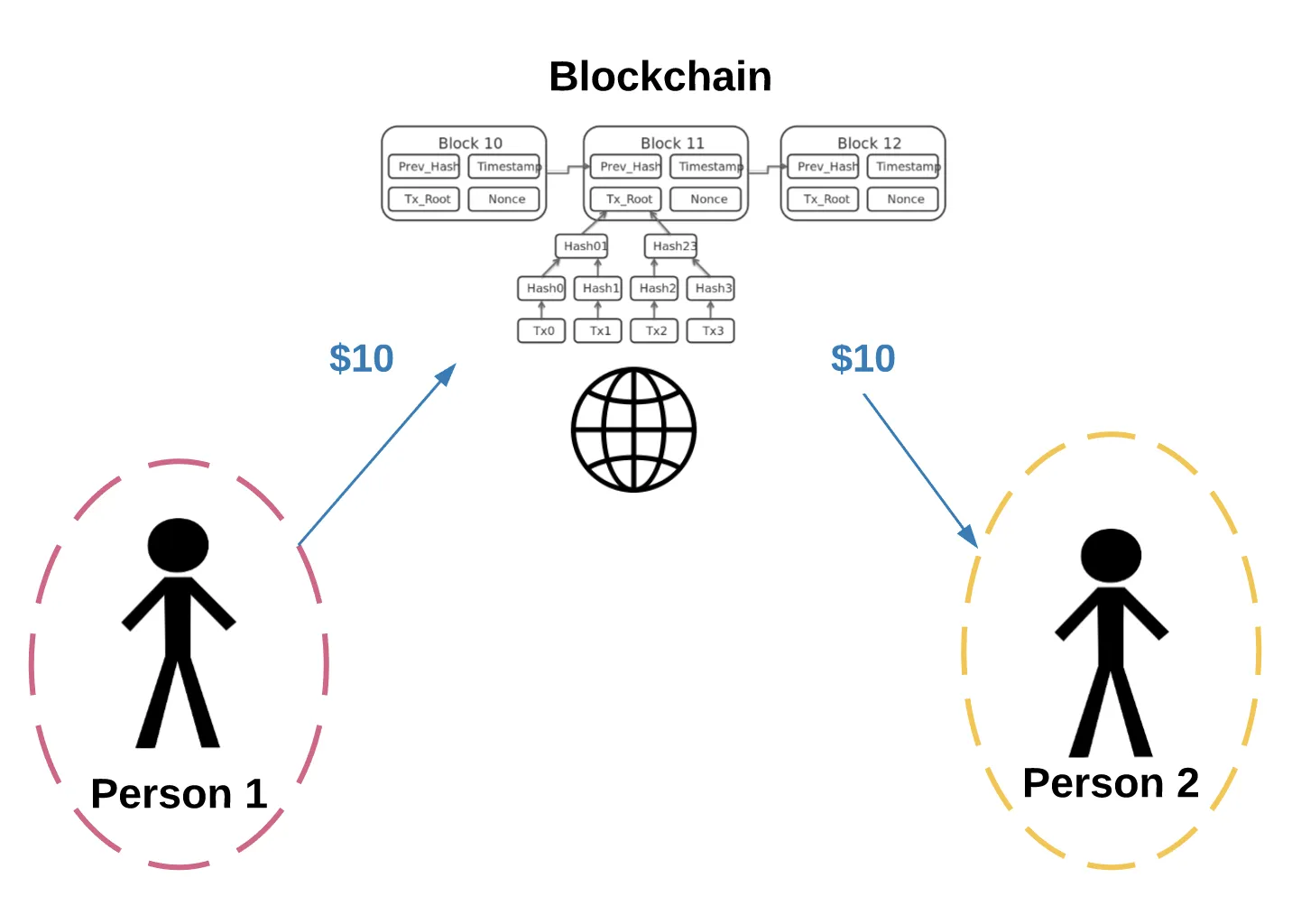
The concept of "trustless" in the digital economy era is not a denial of the value of trust, but a breakthrough in shifting the object of trust from vulnerable human entities to transparent mathematical systems. In traditional economic models, trust acts as a lubricant for all transactions, but it often comes with high intermediary costs and risks from the concentration of power.
According to Tan Phat Digital's analysis, the emergence of blockchain technology, starting with Bitcoin, has introduced an environment in which participating parties do not need to know or trust each other, nor even need a third party to coordinate, for the system to operate correctly and safe. The essence of "trustless" lies in the ability to disperse trust into a network of independent actors, where honesty is maintained through economic incentives and cryptographic proof rather than personal reputation.
The shift from institutional trust to algorithmic trust
In the history of finance, institutions such as banks, governments and auditing organizations have acted as guarantors of truth. However, these centralized systems always have inherent weaknesses. Data can be altered, manipulated by central authorities without public permission, or attacked by external actors. Incidents such as the collapse of the Mt. Gox in 2014, where mismanagement by a centralized entity led to the loss of millions of dollars in Bitcoin value, highlighted the risks of placing total trust in a single organization.
In contrast, trustless systems are built on the principle of complete decentralization. There, power is not in the hands of any individual or organization but is distributed to the entire network of nodes. A trustless system allows individuals to place their trust in abstract concepts such as mathematics and computer code instead of political or financial institutions. Although humans can be bribed or make mistakes, open source operates consistently and can be audited by anyone.
The basic difference between these two models can be summarized as follows:
About the nature of power:A centralized system delegates authority to a central point, while a trustless system is distributed to the entire network.
About the mechanism Authentication: Centralized systems rely on third-party control, while trustless systems rely on community consensus.
About transparency: Centralized systems are often closed or limited, while trustless systems are public and can be verified by anyone.
About data risks: Centralized systems are easily manipulated by administrators, while trustless systems immutable, cannot be changed after recording.
About error resistance: Centralized systems are easily paralyzed if the center is attacked, while trustless systems are highly error-tolerant because there is no single weakness.
About the object of trust: Centralized systems place trust in organizations, brands and people; Trustless systems place trust in source code, mathematics and economics.
It should be noted that the concept of "trustless" does not completely eliminate trust in an absolute way, but actually reduces and redistributes that trust. Instead of trusting the goodness or integrity of a counterparty, users trust pre-programmed rules and cryptographic security protocols. In a sufficiently large peer-to-peer (P2P) network, this decentralization makes it extremely costly and economically infeasible to attack the system, thereby creating a state of self-trust without human intervention.
The underlying technical mechanism that makes Trustless systems possible
To achieve a state of operation without intermediary trust, Blockchain combines three key technological pillars: arbitrary cryptography symmetric, peer-to-peer (P2P) and consensus algorithms. Each of these components plays a specific role in establishing truth and protecting data.
Asymmetric Cryptography and Digital Identity
Cryptography is the first layer of protection in a trustless system. Blockchain uses a public key and private key pair to authenticate identity and asset ownership. The public key acts as a widely shareable receiving address, while the private key is used to create a digital signature for each transaction.
When a user makes a transaction, they use the private key to sign that transaction information. The network can then use the corresponding public key to verify that the transaction actually came from the rightful owner, without that person having to reveal his or her private key. The biggest benefit of asymmetric cryptography is that it provides undeniable digital signatures, helping to establish authenticity in an environment where participants can be completely anonymous.
Peer-to-Peer Networks and Distributed Ledgers
Trustlessness cannot exist without data dispersion. Blockchain operates on a network of thousands of computers (nodes) that simultaneously store a copy of the transaction ledger. When a new transaction is made, this information is transmitted throughout the network and nodes check its validity against protocol rules.
This structure ensures that no single node has control over the transaction history. If a node intentionally changes data in its copy of the ledger, it will immediately become inconsistent with thousands of remaining nodes and be rejected by the network. Maintaining global data synchronization is the basis for creating a "single version of the truth" without the need for a central server.
Consensus Algorithms: The Engine of Trust
Consensus algorithms are the mechanism by which nodes in the network reach agreement on the current state of the ledger. In a decentralized environment, where participants can act for personal gain or even have destructive intentions, the consensus algorithm acts as an automatic "arbiter".
Proof of Work (PoW): This is the original mechanism used by Bitcoin. It requires miners to solve extremely complex cryptographic problems to gain the right to add a new block to the chain. The difficulty of the problem ensures that changing past data requires a huge amount of computing power, making cheating financially unprofitable.
Proof of Stake (PoS): Instead of using computational power, PoS selects validators based on the amount of assets they "stake" into the system. If a validator intentionally authenticates incorrectly, their staked assets will be confiscated. PoS provides greater energy efficiency and makes the system easier to scale.
Detailed comparison of the two mechanisms:
Proof of Work (PoW): Security based on physical resources (electricity, hardware); authentication through mining; very high operating costs; Very high fault tolerance and long term tested; relatively slow transaction speed.
Proof of Stake (PoS): Security based on economic resources (tokens/coins); validation through asset staking (staking); Low operating costs and environmental friendliness; high fault tolerance (depends on stake allocation); Faster transaction speed, suitable for large scale.
In addition to the above two popular mechanisms, there are other variations such as Delegated Proof of Stake (DPoS), where users elect representatives, or Proof of Authority (PoA) suitable for private networks. All aim at the goal: creating an environment where honest behavior is the most mathematically optimal choice.
Permissionless and the relationship with the Trustless system
A concept that often goes hand in hand with Trustless but has a different meaning in terms of access rights is Permissionless (No need for permission).
Permissionless is What?
Permissionless is a term used to refer to open blockchain networks, where anyone has the right to participate without needing approval or identity verification from a central governing authority. In a permissionless system:
Free participation: Anyone with an internet connection and the right device can become a node, perform transactions or participate in the consensus process.
Complete openness: The entire transaction history and source code of the network is public for anyone to read and inspect.
Censorship resistance: Because there are no barriers to entry, no entity can prevent an individual from making a valid transaction on the network.
Compare Trustless and Permissionless
Here are the basic differences that differentiate these two important concepts:
About the focus: Trustless focuses on the object of trust (trusting the system/algorithm instead of people), while Permissionless focuses on the right to participate (everyone has rights instead of the chosen one). filter).
About properties: Trustless is a consequence of decentralization and cryptography; Permissionless is a choice of governance and access model.
About relationships: A Permissionless system (like Bitcoin) typically must be Trustless to operate securely between strangers. However, a Trustless system can be Permissioned – for example a network between banks where they trust a common algorithm but only licensed banks have the right to participate.
For example: Bitcoin and Ethereum are systems that are both Permissionless and Trustless. Meanwhile, networks like Ripple or Hyperledger are often Permissioned (need permission) but still use Trustless mechanisms to ensure data integrity between members.
Case Study: Successful models in the Trustless world
To illustrate the power of trustless technology, Tan Phat Digital has compiled 5 typical cases of successful blockchain application in the world world:
TradeLens (IBM & Maersk) - Marine transportation logistics: This is an ecosystem that connects parties in the global supply chain. TradeLens uses blockchain to digitize shipping documents (bills of lading) and track container routes in real time. As a result, processing times for international shipments have been reduced by up to 40%, eliminating delays caused by traditional paperwork.
SkyCell - Smart Pharmaceutical Logistics: This Swiss company uses smart containers equipped with IoT sensors connected to blockchain to transport vaccines and specialized drugs. Blockchain records temperature and humidity history immutably, helping to reduce the damage rate of goods to less than 0.1%, ensuring absolute quality for the medical industry.
Walmart - Food traceability: Walmart has implemented a traceability system based on Hyperledger Fabric. Previously, finding the origin of a batch of mangoes sold in the US took about 7 days; With blockchain, this process takes only 2.2 seconds. This helps quickly prevent food poisoning cases and ensure consumer safety.
Aave - Decentralized Lending in DeFi: Aave is a testament to eliminating the intermediary bank. Aave's smart contracts automatically execute loans when users provide collateral. The system automatically manages interest rates and liquidates assets if collateral values drop sharply, ensuring the safety of the entire protocol without the need for human approval.
Jamaica NIDS - National Identification System: Jamaica is implementing a National Identification System (NIDS) based on secure authentication principles. NIDS provides a reliable way to verify citizens' identities without relying on easily counterfeited paper records, creating the foundation for a transparent and trustless e-government.
See also: What is a private key and passphrase in a wallet?
Trustless system in practical applications
Tan Phat Digital recognizes that the ability to operate without trust has opened up new horizons for industries from finance to supply chain management.
Decentralized Finance (DeFi) and Smart Contracts
Smart Contracts are programs that run on the blockchain, automatically executing terms when predetermined conditions are met. In the DeFi world, smart contracts completely replace the role of intermediaries such as traditional banks or exchanges.
Trustless lending: On platforms like Aave or Compound, users can borrow assets by mortgaging an amount of other digital assets. Smart contracts will automatically manage collateral ratios and execute liquidations if necessary, eliminating cumbersome approval processes.
Demanded Exchanges (DEX): Decentralized exchanges like Uniswap use automated Market Maker algorithms. Users transact directly with smart contracts, ensuring full control of assets until the transaction is completed.
Oracle: Trustless Data Bridge
One of the limitations of blockchain is its "self-closing" nature. Oracle is a solution that feeds data from the real world into the blockchain. To maintain trustlessness, decentralized Oracle networks such as Chainlink were born. Instead of relying on a single data source, Chainlink uses a network of independent nodes to collect, aggregate and collate data, ensuring the final result has the highest reliability through the steps of: selecting Oracle according to SLA agreement, reporting data from API and aggregating results to eliminate outliers.
Breakthrough in Logistics and Supply Chain Management
The traditional logistics industry is often hindered by regulations Submit complex documents. Blockchain provides a transparent ledger to track goods journeys in real time.
TradeLens: A collaborative project between IBM and Maersk helps digitize bills of lading, allowing parties to exchange data directly, reducing shipment processing time by up to 40%.
Skycell: Using smart containers equipped with IoT sensors to transport sensitive pharmaceuticals. The entire temperature history is permanently recorded on the blockchain, ensuring absolute product quality.
Self-Sovereign Identity (SSI)
The current identification model often depends on large third parties. SSI gives individuals full ownership of their digital identity. In this system, the user (Holder) receives authentication proof from the issuer (Issuer) and presents it to the verifier (Verifier) without revealing all personal data. For example, the Zero-Knowledge Proofs (ZKP) technique allows proving that a person is over 18 years old without showing the actual date of birth.
Analyzing the differences between Blockchain systems
The level of "trustless" can vary depending on the type of network:
Public (Public/Permissionless): Anyone has access and authentic; very high level of decentralization; Typical examples are Bitcoin, Ethereum.
Private: Access rights are limited and authentication rights belong to only a single entity; low level of decentralization; examples are corporate intranets.
Permissioned: Access is restricted and authentication is reserved to selected entities; average level of decentralization; For example, Quorum, Hyperledger.
Public networks provide the highest trustlessness but often have speed problems. In contrast, permissioned networks bring greater efficiency to businesses but require a certain level of trust in the operator.
Frequently Asked Questions (FAQs)
Here are answers to the 10 most common questions about trustless systems and blockchain:
What is trustless in cryptocurrency? Is the characteristic of a system that allows users to transact without need to trust any intermediary third party, thanks to the transparency of the source code and the security of the mathematics.
What is Permissionless blockchain? Is a completely open blockchain network (like Bitcoin), allowing anyone to participate, read data, send transactions and participate in the authentication process without needing permission from any management organization.
Why is it said that Blockchain cannot be broken? Because data is distributed across thousands of nodes and secured by tightly linked hash functions. To change data, an attacker must control more than 51% of the network power, which is extremely difficult and expensive on large chains.
Is Blockchain a scam? Blockchain technology itself is a transparent and safe tool. However, bad guys can take advantage of users' ignorance to commit fraud outside the system (phishing, fake networks).
What is the difference between Trustless and Permissionless? Trustless involves minimizing trust in people; Permissionless refers to free access to the network. A system can be trustless but still require permission.
Is Trust Wallet really secure? Trust Wallet is a non-custodial wallet, meaning it does not hold your private keys. It's safe as long as you keep the 12 recovery phrases absolutely confidential and don't share them with anyone.
Can smart contracts be modified after deployment? According to the technical specifications, smart contracts are immutable and cannot be modified after being posted to the blockchain, unless the original source code is designed with a special upgrade mechanism.
What is a 51% attack? Is a situation in which one entity controls more than half of the network's computing power (hashrate) or staked assets, allowing them to manipulate data or perform double spending.
How is Blockchain 4.0 different from previous generations? Blockchain 4.0 focuses on practical applicability for businesses, combined with technologies such as Artificial Intelligence (AI) and Internet of Things (IoT) to optimize operating processes.
What is Oracle's role in a trustless system? Oracle acts as a "bridge" that provides information from the real world (prices, sports results, weather) securely into the blockchain so that smart contracts can execute correctly.
See more: What is DeFi (Decentralized Finance)?
Risks and limitations of the Trustless system
Despite being revolutionary, the trustless system still faces challenges knowledge:
Source code vulnerabilities: In the "Source code is law" philosophy, logic errors in smart contracts can be exploited forever because of the immutability of data. Errors like reentrancy attacks have caused huge losses in DeFi history.
Human factor: Users are fully responsible for the private key. If you lose your recovery phrase, your assets will be lost forever. Bad actors also often take advantage of human psychology through social engineering scams.
Infrastructure attacks: Routing attacks, denial of service (DDoS) attacks or governance manipulation in DAOs (through the acquisition of large amounts of tokens) are still potential threats.
The future and social transition
Evolution Blockchain development is aiming to optimize trustlessness on a global scale. Layer 2 solutions are helping the network achieve transaction speeds comparable to traditional systems like Visa without sacrificing security. In countries like Jamaica, the implementation of a National Identification System (NIDS) based on secure authentication is paving the way for transparent public services. The future could be a Machine Economy, where IoT devices automatically transact via smart contracts.
Trustless system is a new philosophy on how to interact in the digital world. By replacing intermediaries with the power of cryptography and mathematics, blockchain has created a foundation for transparency and personal freedom. Understanding the difference between trustless and permissionless is the first step to mastering the potential of the future technology revolution. The team of experts at Tan Phat Digital believes that, despite many barriers, the value that a trustless system brings is undeniable and will continue to reshape the global economic structure.
Share


