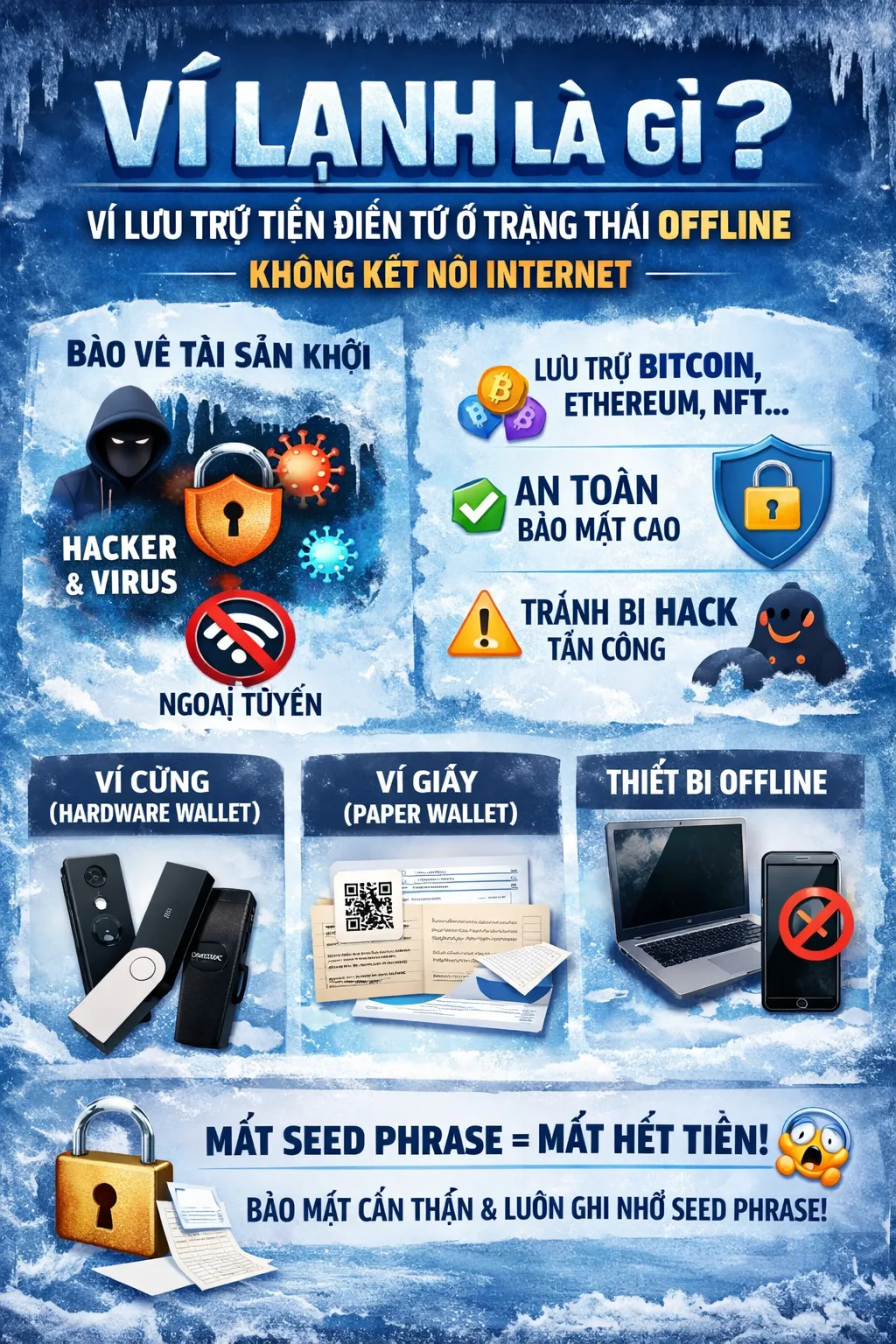
The development of the digital asset market not only brings new financial opportunities but also poses unprecedented challenges in cybersecurity and personal asset management. According to analysis from Tan Phat Digital, in the context of attacks on centralized exchanges and increasing risks from third-party custody platforms, the concept of self-custody has become a vital principle for professional investors. The centerpiece of this strategy is the Cold Wallet, an infrastructure solution designed to completely isolate the private key from the Internet environment, creating a solid physical and technical barrier against remote intrusion attempts.
A cold wallet, also known as a hardware wallet, is not simply a regular data storage device like a hard drive or USB. It is an extremely small specialized computing device, optimized for cryptographic operations and protecting information confidentiality. The core difference between cold wallet and hot wallet, according to practical experience from Tan Phat Digital, lies in the connection status; While hot wallets always maintain a network connection to optimize convenience for daily transactions, cold wallets prioritize absolute safety by keeping the keys to access assets always offline. The sacrifice of speed and convenience in transaction operations is a necessary trade-off for peace of mind against malware, viruses and sophisticated phishing attacks that are costing the cryptocurrency community billions of dollars each year.
Technical Architecture and Operational Mechanism of Offline Storage Devices
To understand why cold wallets are considered the gold standard in digital asset security, requires in-depth analysis of the hardware structure and software protocols they use. The architecture of a modern cold wallet is built on a combination of specialized security chips and a minimalist operating system specifically designed to minimize the attack surface.
Secure Element and MCU security chip system
Most of today's leading cold wallet lines such as Ledger, Trezor Safe, and SafePal all use high-standard dual chip or single security chip structures. The most important component in this infrastructure is the Secure Element (SE), a type of microchip specifically designed to resist physical tampering attempts and error analysis. This is also the core technology used in systems that require extremely high security such as bank credit cards, biometric passports and phone sims.
Secure Element acts as a "digital safe", where private keys are created and permanently stored inside without ever being allowed to export outside the device. When a user makes a transaction, the transaction data from the computer will be sent to the cold wallet, SE will perform the confirmation signing inside the isolated environment, then only send the completed digital signature back outside to broadcast to the blockchain network. This ensures that even if the user's computer is completely controlled by a hacker, the private key is still safe inside the silicon shell of the SE.
Detailed analysis of infrastructure components:
Secure Element (SE): Stores private keys, performs transaction signing operations, and manages PINs. The most important role is against physical attacks, side-channel analysis, and hardware tampering.
Microcontroller (MCU): Controls the user interface, display, and communication with peripherals via USB/Bluetooth. The MCU handles non-sensitive tasks, acting as an information bridge but does not have direct access to the SE's private key.
Trusted Display: Displays transaction information directly from the Secure Element. This component ensures the "what you see is what you sign" (WYSIWYS) principle, preventing computers subject to Man-in-the-Middle attacks from changing the receiving address.
Physical Buttons:Requires direct human interaction to approve transactions, helping to prevent automated trading orders being remotely initiated by malware.
Standard Analysis Common Criteria EAL5+ and EAL6+
The reliability of a security chip is often evaluated through the Common Criteria (CC) standard with EAL (Evaluation Assurance Level) levels. During the period of 2025, the trend of shifting from EAL5+ to EAL6+ is becoming evident in high-end product lines.
The EAL5+ standard is considered financial level, capable of resisting medium-skilled attacks commonly found in the banking sector. Meanwhile, Tan Phat Digital believes that EAL6+ represents military or government level security, requiring extremely rigorous design and source code inspection processes, capable of resisting attacks from entities with large resources and high technology. The fact that a device like the Ledger Stax or Trezor Safe 5 achieves these certifications demonstrates its ability to resist complex physical attack techniques such as power consumption analysis or fault injection attacks. However, from an implementation perspective, the difference between EAL5+ and EAL6+ for individual users lies mainly in the assurance of manufacturing processes and hardware testing rather than breakthrough changes in day-to-day operations.
The world's leading cold wallet brands ecosystem 2025-2026
The current cold wallet market is a competition between different design philosophies from the high-end convenience of Ledger to the absolute transparency of Trezor or the minimalism of Tangem.
Ledger: The dominance of closed infrastructure and high applicability
Ledger is the most popular brand in the world with the product lines Nano S Plus, Nano X and the latest Flex/Stax. Ledger's philosophy is based on using closed source Secure Element chips to maximize physical security, while developing an extremely powerful Ledger Live software ecosystem.
Ledger Nano X features Bluetooth connectivity, allowing flexible asset management on both mobile phones and computers, supporting more than 15,000 different types of digital assets. However, Ledger's maintenance of closed source firmware has caused some debate in the community about transparency, especially after the company launched the Ledger Recover service - a solution that allows seed phrases to be recovered through splitting the private key and sending it to third parties. Even so, Ledger remains the top choice for users who prioritize staking, NFT management, and diverse support from DeFi applications.
Trezor: The Gold Standard of Open Source and Transparency
In contrast to Ledger, Trezor (developed by SatoshiLabs) pursues a 100% open source philosophy, allowing anyone to inspect the code device hardware and software sources. The birth of the Trezor Safe 7 series in 2025 marked a turning point with its "Quantum-ready" architecture, designed to combat future threats from quantum computers.
Trezor Safe 7 uses the TROPIC01 security chip - the world's first fully auditable security chip, helping to eliminate the risk of "back doors" often found in closed source chips. Besides, Trezor is also a pioneer in implementing the Shamir Backup standard (SLIP39), which allows users to split a recovery phrase into multiple parts (for example, create 5 parts and only need 3 parts to restore), helping to minimize the risk of loss due to natural disasters or theft.
SafePal: Air-Gapped security and support from Binance
SafePal emerges as a high-level security solution Extremely competitive prices and Air-Gapped mechanism (complete disconnection). The S1 and S1 Pro series do not use Bluetooth, WiFi or USB ports to transmit transaction data; instead, the device uses a built-in camera to scan QR codes back and forth with the phone app. This mechanism completely eliminates the risk of attacks via wireless connection protocols. SafePal especially attracts users thanks to the deep integration of Binance services right inside the application, allowing seamless spot trading and staking.
Tangem: Revolutionizing the user experience with Smart Cards
Tangem represents a new generation of cold wallets with a slim credit card design, using NFC technology to communicate with phones. Tangem's most unique feature is its "Seedless" philosophy (no need for recovery phrases). Instead of asking users to write down 24 words on paper – a weak link that can easily be exposed – Tangem uses sets of 2 or 3 cards to back up each other. The private key is generated inside the first card's EAL6+ chip and copied to the secondary cards via a secure NFC connection.
The 2025 Tangem 2.0 series added the option to create a seed phrase for traditional users, striking a balance between modernity and legacy storage standards. This is considered the ideal solution for beginners or frequent travelers who need a durable, waterproof and dustproof device.
Detailed comparison of popular wallet lines:
Ledger Nano X:
Connection mechanism: Bluetooth, USB-C.
Source code: Firmware close.
Security chip standard: ST33 (CC EAL6+).
Interface: Buttons, OLED screen.
Best suitable: Professional DeFi and NFT investors.
Trezor Safe 7:
Connection mechanism: Bluetooth, USB-C, Wireless.
Source code: Completely open (100%) Pro:
Connection mechanism: QR Code (Air-gapped).
Source code: Partly closed.
Security chip standard: CC EAL6+.
Interface: Color screen, D-pad navigation keys.
Most suitable: Investors who regularly trade on the ecosystem Binance.
Tangem Wallet 2.0:
Connection mechanism: NFC.
Source code: Completely open.
Security chip standard: CC EAL6+.
Interface: Completely via phone application.
Suitable merge: Beginners, require convenience and durability.
Operational administration process: From setup to transaction execution
Owning a cold wallet is just the beginning; True safety comes from adhering to strict operating procedures. Tan Phat Digital emphasizes that skipping basic checks or neglecting to store recovery information can lead to irreversible damage.
Initialization Phase: Establishing a Trusted Infrastructure
When receiving a new device, the first and most important step is to perform the "Genuine Check" process. Brands like Ledger and Trezor integrate this feature right into their management software. The device will perform an encrypted authentication process with the company's servers to ensure the security chip inside has not been altered or physically tampered with during shipping.
During setup, the device will generate a random 12, 18, or 24-word recovery phrase based on the BIP39 standard. This is the only and most important backup of all assets. Experts recommend absolutely not storing this phrase in digital form (taking photos, saving Word files, emailing) because it will lose the "offline" meaning of cold wallets. Instead, recording on specialized steel boards (like Keystone or Cryptosteel) is the optimal solution to protect against fires, floods, and paper degradation over time.
Receive and Send Assets Process: Physical Approval Mechanism
Receiving coins into a cold wallet is relatively simple: users get the wallet address from the management application, but the key step is to match that address with the live display on the cold wallet device. This prevents malicious code from changing the wallet address in the computer's clipboard.
When sending coins, the process becomes more rigorous:
Initialization: The user enters the address and amount on the computer/phone software.
Physical verification: Transaction information will appear on the cold wallet screen. Users must carefully check each character of the receiving address and amount.
Sign Confirmation: Only when the user presses the physical buttons on the wallet, the transaction is signed with the private key and sent. Any attempt to conduct a remote transaction without physical impact on the device will fail.
Strategy Integration: Withdraw funds from Binance to Cold Wallets
A common scenario is that investors buy assets on major exchanges like Binance and then transfer them to cold wallets for long-term storage. The biggest risk in this operation does not lie in the device but in choosing the wrong network (blockchain network).
When making a Withdraw order on Binance, users need to pay attention to the network rules:
Bitcoin (BTC): Must choose the original Bitcoin network.
Ethereum (ETH) and ERC20 Token: Must choose the network Ethereum (ERC20).
Binance Smart Chain (BNB and BEP20 Token): Choose the BSC (BEP20) network.
Choosing the wrong network can lead to permanent loss of assets or an extremely complicated recovery process. Tan Phat Digital always advises customers to conduct a small test transaction before transferring large sums of money.
Threat map 2025: Sophisticated forms of attack targeting cold wallet users
Although the Secure Element chip is almost impossible to break through remote technical attacks, threat actors have turned to exploiting psychological factors and people's lack of process. use.
Address Poisoning and Clipboard risks
This is one of the most sophisticated forms of fraud in 2025. Attackers use "vanity address" generation tools to create a wallet with the first and last 4-5 characters identical to the victim's address. Then, they send a very small amount of money to the victim's wallet so that this fake address appears in the most recent transaction history.
The danger lies in the habit of users often copying addresses from transaction history to make subsequent money transfer orders without checking the entire character string. If the victim accidentally copies the attacker's address, the assets will be sent directly to the criminal's wallet and cannot be reversed.
From Blind Signing to Clear Signing
In the Web3 and DeFi era, users often have to sign complex smart contracts. Older cold wallet devices often only display an unreadable hash string, forcing users to "blindly sign". Hackers take advantage of this to trick users into signing approval orders to withdraw all assets.
The birth of the Clear Signing standard is the solution to this problem. New devices support displaying contract content in natural language. This is an important step forward in protecting users against large-scale attacks such as the ByBit hack in early 2025 that caused $1.5 billion in losses.
Vietnam Cold Wallet Market: Supply Infrastructure and Technical Support
Vietnam has a high cryptocurrency adoption rate, leading to great demand for secure storage solutions. However, the risk of counterfeit goods or devices that have been infected with malicious code is an existing threat.
Official authorized dealers in Vietnam
To ensure absolute safety, Tan Phat Digital recommends that users only buy devices from officially authorized dealers:
DigiBit (digibit.vn): The only authorized agent of Ledger in Vietnam, with a system of stores in Hanoi and Ho Chi Minh City, providing a 12-month 1-for-1 warranty.
Bitcoin Wallet (vitienbitcoin.com): Longstanding distributor since 2017, authorized by Trezor, SafePal, Tangem and Blockstream.
ThuanCapital Store and Vilanh.com: Other reputable distribution channels provide a variety of security products and accessories.
Warning about unofficial shopping channels
Users need to be especially careful with stores on e-commerce platforms that do not have agent certification. Buying portable goods of unknown origin may save a small amount of money but puts all assets at great risk if the device has been physically tampered with.
Future vision: Digital asset security trends 2026-2030
Cold wallet infrastructure is evolving to address the threat of quantum computing and durable asset recovery stable.
Quantum Resistance
Current cryptographic algorithms are predicted to become obsolete before quantum computers. Cold wallet companies such as Trezor have begun integrating Post-Quantum Cryptography schemes into the firmware of new models, ensuring asset safety for decades to come.
Passphrase Mode (From the 25th) and Hidden Wallets
For large investors, the use of Passphrase mode will become a mandatory standard. Passphrase allows creating an infinite number of "hidden wallets" on the same set of 24 recovery words. Even if the attacker gets the initial 24 words, they cannot access the assets without the Passphrase.
Cold wallets are not just a technical tool but the foundation of personal financial sovereignty. Understanding the operating mechanism and forms of attack is a prerequisite to protect investment results.
Based on in-depth analysis, Tan Phat Digital recommends that investors implement a three-layer security strategy:
The Design Layer Device: Use at least one EAL6+ cold wallet from reputable authorized resellers.
Storage Layer: Back up the recovery phrase to a dedicated steel board and store it safely offline.
Operation Layer: Enable Passphrase, use Clear Signing, and always visually check the address on the device.
Security The safety of digital assets depends on the knowledge and discipline of the owner. In an immutable blockchain world, cold wallets are the strongest shield to ensure control of assets is always in your hands.
Share


