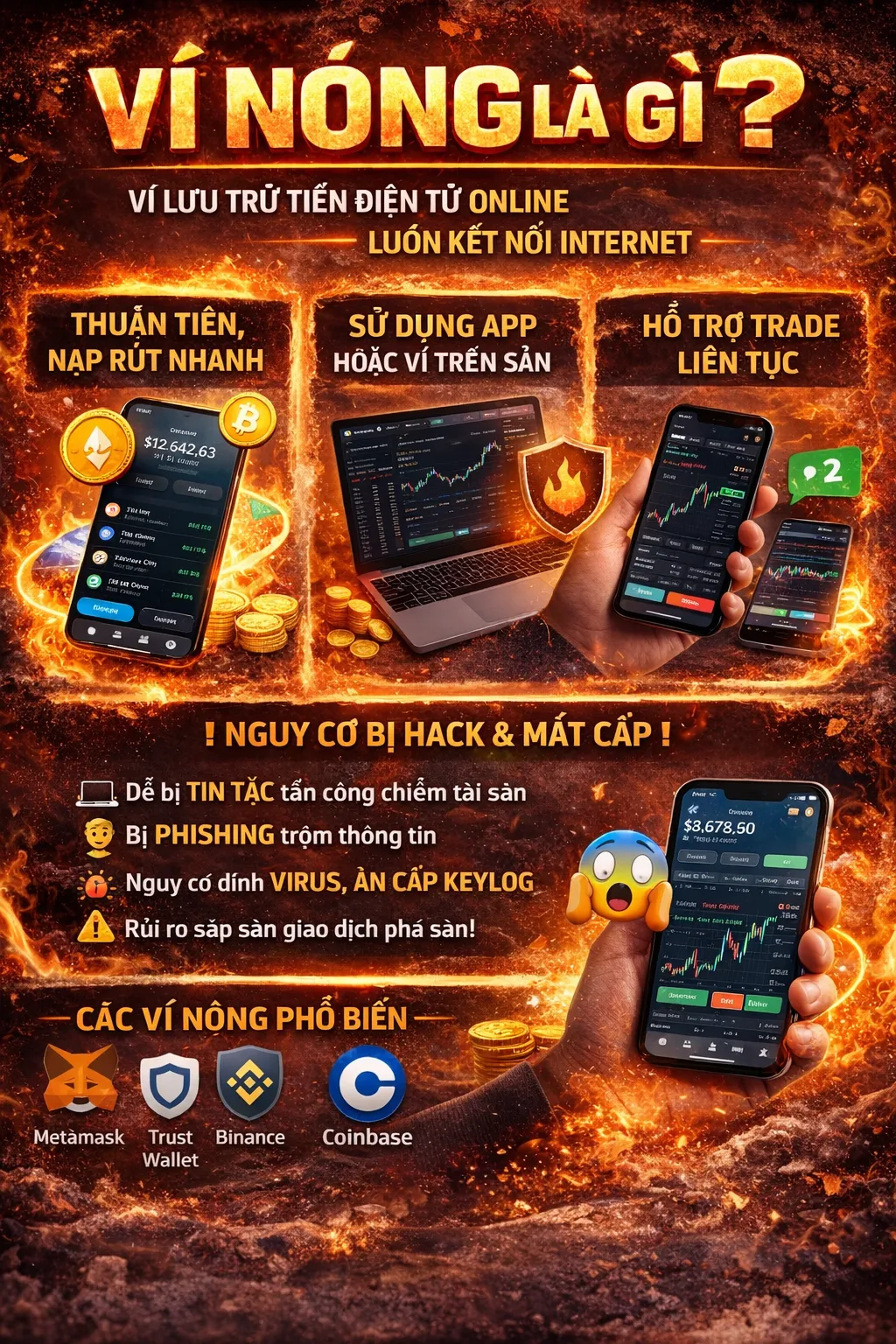
The shift of the global economy to blockchain infrastructure layers has created an urgent need to redefine asset custody methods. At the heart of this shift, according to Tan Phat Digital, hot wallets (Hot Wallets) have emerged not only as a storage tool but also as a key interaction interface between users and decentralized finance (DeFi) protocols.
Hot wallets, basically, are private key management software or applications that are maintained continuously connected to the Internet through devices such as smartphones and personal computers. or browser extensions. This "always online" characteristic creates a classic architectural trade-off in cryptography: maximum transaction ease in exchange for a broader attack surface against malicious entities. Entering 2026, the concept of hot wallets has evolved far beyond the simple storage applications of the past decade, integrating breakthrough technologies such as multi-party computing (MPC) and account abstraction (Account Abstraction) to solve security and user experience problems.
Analyzing the technical architecture and operating mechanism of hot wallets
To understand the nature of hot wallets, it is necessary to analyze separates the difference between storing physical and digital assets. In reality, cryptocurrency wallets don't actually contain "money" inside; instead, it stores cryptographic keys – digital proofs that give users control over units of assets recorded on the blockchain ledger. The Private Key is the most core component, acting as the ultimate digital signature to approve asset transfers or interactions with smart contracts.
In traditional hot wallet architecture, the private key is often encrypted and stored directly on the device's memory or in the application's execution environment. Because the device is always connected to the Internet, this private key can theoretically be accessed by malware, spyware or through operating system vulnerabilities. This is the reason why hot wallets are considered to have a higher security risk than cold wallets (Cold Wallets) - where private keys are kept completely offline.
Classification of hot wallets according to control of private keys
The most important differentiation in the hot wallet ecosystem lies in who holds the private key. The team of experts at Tan Phat Digital analyzes the following characteristics in detail:
1. Custodial Wallet
Key holders: Intermediary entities such as exchanges or digital banks.
Authentication mechanism: Login with traditional account/password, requires strict KYC/AML process.
Recoverability: Users receive support Password recovery through customer service.
Autonomy: Assets can be frozen or revoked by the custodian if there is a legal request.
Transaction fees: Usually includes intermediary service fees in addition to network fees.
2. Non-custodial Wallet
Key holder: Individual user holds full responsibility for security.
Authentication mechanism: Uses seed phrase or MPC cryptographic key fragments.
Recoverability: In principle none can recover if keys are lost (except for new smart wallets like AA/MPC).
Autonomy: Absolute ownership, no third party can prevent transactions.
Transaction fees: Only includes pure gas fees of the blockchain network.
Classification by deployment platform and user interface Use
Modern hot wallets are designed to optimize for each specific usage context:
Mobile Wallets: Operate as smartphone applications, leveraging biometric security features such as fingerprints or facial recognition.
Browser Extension Wallets: Chrome or Firefox extensions, impersonating game is the main "gateway" to interact with DeFi protocols and NFT markets.
Desktop Wallets: Install directly on the operating system, providing in-depth portfolio management features and an intuitive graphical interface.
Web Wallets: Direct access via browser without installation, although convenient, has the highest risk of phishing attacks.
Technological breakthrough Technology in 2026: "Cryptoless" Experience and Smart Wallet
The year 2026 marks a turning point when technical barriers are gradually eliminated. Two key technologies, MPC and Account Abstraction, have turned hot wallets into a smart financial operating system.
Multi-Party Computation (MPC) technology
MPC uses cryptographic protocols to divide keys into many independent pieces (key shares) stored in different entities, providing security advantages:
Anti-object theft reason: Hackers who have captured the phone still cannot make transactions due to missing key fragments on the server.
Recovery without Seed Phrase: Restore access via biometric or email authentication instead of easily lost phrases.
Institutional-grade security: Typically, Zengo wallet has a record of never being breached on a scale of millions of people
Account Abstraction (ERC-4337)
With AA, the wallet becomes a programmable smart contract, providing the following features:
Gasless transactions:Businesses can sponsor gas fees for customers to increase friendliness.
Flexible payments Active: Allows using stablecoins like USDC/USDT to pay fees instead of having to hold native tokens like ETH.
Smart governance: Set daily spending limits or social recovery mechanisms through a group of trusted relatives.
Compare technical features between traditional wallets and modern wallets:
Traditional EOA wallet system: Uses a single key (vulnerable to centralized attacks); restore using Seed Phrase; Mandatory transaction fees in native tokens; User experience is still quite complicated.
Modern MPC/AA Wallet (2026): Distributed keys (no single weakness); recovery via biometrics or email; flexible transaction fees; simple experience like Web2 banking applications.
Market analysis: Leading hot wallets and strategic positions
According to observations of Tan Phat Digital, the market in 2026 has clearly differentiated into specialized segments:
MetaMask: Still maintaining its position as a Web3 pillar with the system "Snaps" enable extreme customization and cross-EVM compatibility.
Zengo: Establishes the gold standard in security for individual users with complete removal of seed phrases and real-time Web3 firewall integration.
Trust Wallet & Coinbase Wallet: The expansion of the giants brings maximum convenience, deep integration with other staking and deposit/withdrawal services of fiat currency.
Exodus:The number one choice for users who value visual experiences and diverse asset management across multiple platforms.
Legal landscape and digital asset market in Vietnam in 2026
The year 2026 is a historical milestone when the Digital Technology Industry Law officially takes effect, recognizing digital assets as legal assets. Tan Phat Digital noted key changes:
Barriers to entry: Businesses operating exchanges must have a minimum charter capital of VND 10,000 billion, creating a playing field for large financial institutions such as VIXEX, TCEX or SSID.
User behavior: Ordinary users tend to switch to wallets Licensed signature integrated into banking applications to ensure compliance with Vietnamese law.
Risk management strategy from Tan Phat Digital
To protect assets in a cyber environment full of threats, Tan Phat Digital recommends users apply the "Defense in Depth" strategy:
Transaction layer (Hot Tier): Only keep a maximum of 10-15% of assets in hot wallets for investment and daily spending.
Reserve layer (Cold Tier): Store 70-80% of assets in hardware wallets (Ledger, Trezor) and store them offline.
Institutional layer (Institutional Tier): Using licensed bank custody wallets to serve formal financial goals.
Warning about attack types in 2026:
Address Poisoning: Hackers send strange tokens to obfuscate transaction history. How to avoid: Check the entire address, don't copy-paste blindly.
Scam Approve: Websites that lure approval for wallet access. How to prevent: Use Revoke tool to cancel strange access rights.
Deepfake Phishing: Use AI to impersonate support staff. How to avoid: Absolutely do not provide sensitive information via phone/text.
The future of hot wallets: From storage tools to financial operating systems
Vision by the end of 2026, hot wallets will become "invisible" and deeply embedded in economic activities. The explosion of tokenized real assets (RWA) will turn hot wallets into a "digital red book". At the same time, AI self-protected wallets will automatically activate Lockdown mode if abnormal transaction behavior is detected.
In summary, hot wallets in 2026 have become an essential infrastructure layer for the digital economy. Tan Phat Digital accompanies you in updating knowledge and taking advantage of the latest security technologies to turn hot wallets into powerful tools on the journey to conquer digital finance.
Share


