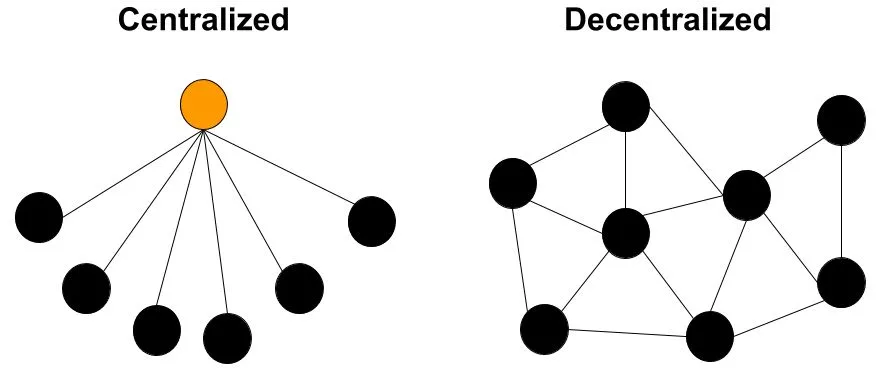
What is Centralized? What is the difference between Decentralized and Centralized?
The development of human society always revolves around the problem of optimizing resources and controlling power. In the context of digital transformation taking place strongly on a global scale, the debate between two system architecture models, centralized and decentralized, has gone beyond the scope of simple organizational governance to become a core issue in economics, information technology and finance. Centralization can be understood as the consolidation of decision-making authority and management processes at a single point or administration, where information is processed and directives are issued from the top of the hierarchical pyramid. In contrast, decentralization represents the dispersion of authority throughout the organization or network, allowing lower-level units or component nodes to have autonomy in decision-making and task execution. Each model brings with it unique advantages and challenges, creating a wide spectrum of options for system administrators and engineers depending on the need for speed, consistency, fault tolerance and flexibility.
The nature and operating mechanism of centralized systems
Centralized systems operate based on the principle of unified management, in which all important decisions originate from a single center and are transmitted reach down according to the hierarchical scheme. In corporate governance, this structure is often associated with organizations that value discipline, uniformity and efficiency in terms of scale. Senior managers hold absolute power in setting strategy, budgets, and operating rules, while lower-level employees primarily play the role of executing assigned orders. A good example is multinational corporations such as McDonald's, where centralization is used to ensure that the menu, food quality and service style are consistent at any store in the world.
The greatest advantage of the centralized model is the ability to maintain tight control and create consistency throughout the entire system. By concentrating resources and decisions in one place, organizations can take advantage of economies of scale, minimizing duplication of efforts and processes, thereby optimizing production costs. However, reliance on a single point of control also creates inherent risks. When all information flows and decisions have to go through the center, the system easily encounters bottlenecks, slowing down the response speed to rapid changes in the market or customer needs. Furthermore, the rigidity of this model can stifle the creativity of grassroots employees, who often have the closest contact with customers but have little authority to change or improve services.
Operational characteristics of centralized systems:
Decision power: Centralized at the top management layer of the organization. Consequence: Ensures synchronization strategy but slows down local processing speed.
Information flow: Moves vertically from top to bottom. Consequence: Clear in terms of command but lacks multi-dimensional feedback.
Consistency: Very high thanks to standards imposed from the center. Consequence: Building a strong brand but lacking regional flexibility.
Control ability: Tightness over resources and finances. Consequence: Minimizes process errors but increases management burden.
Decentralized Systems: Empowerment and Flexibility
Decentralization is not just the division of tasks but a systematic effort to delegate decision-making authority to the lowest levels that can exercise that authority effectively. In a decentralized organization, middle and junior managers are directly responsible for day-to-day decisions, allowing them to flexibly adjust to the specific conditions of the work environment or local market. This model is often favored in creative industries, technology companies or organizations operating in highly volatile environments, where the ability to react quickly is vital.
Different from the centralized model, the decentralized system promotes multi-dimensional information flow and encourages employees' active participation in the decision-making process, thereby improving team motivation and responsibility. This enables the organization to take advantage of collective intelligence and local expertise, factors that senior leaders at the center may not fully grasp. A typical example is McDonald's branches in India, where regional managers have the right to decide menus based on local tastes and culture, instead of completely adopting standard menus from the US. However, the challenge of decentralization lies in maintaining coordination and unity. Without clear common goals and effective communication mechanisms, decentralization can lead to overlapping, conflicting operating units or diluting the core values of the organization.
Operating characteristics of decentralized systems:
Decision power: Distributed to lower levels of management and employees. Consequence: Increases reaction speed and local adaptation.
Information flow: Multidimensional, open and flexible between departments. Consequence: Increased creativity but difficulty controlling accuracy.
Employee motivation: High thanks to autonomy and ability to contribute ideas. Consequences: Attracts talent but requires high levels of low-level management.
Sustainability: Better fault tolerance due to not being dependent on a single point. Consequence: Difficult to completely collapse but easy to encounter coordination problems.
Analyzing the differences between two architectural models
The difference between centralized and decentralized can be viewed through many different angles, from decision-making mechanisms, cost structures to scalability and system safety.
Decision-making mechanisms and flexibility activity
In centralized organizations, decision-making authority is reserved for central points, leading to an often lengthy and multi-layered approval process. This can cause serious delays in situations that require immediate action. In contrast, decentralization allows for "on-the-ground" decision-making, which shortens response times and increases the ability to adapt to market changes. However, this fragmentation also brings the risk of inconsistency and the possibility of conflicting decisions between component units.
Cost structure and economies of scale
Economically, centralization often results in better cost efficiency in managing shared resources. According to studies from the American Productivity and Quality Center (APQC), centralized manufacturing organizations have production costs about 10% lower than decentralized organizations. Centralization allows the organization to negotiate better with suppliers through bulk purchasing and minimizes recurring costs for infrastructure and management personnel. In contrast, the decentralized model can cause waste by maintaining the same resources in many different locations, although it can save costs in the long term by reducing errors due to lack of local information.
Scalability and system performance
In the field of information technology, scalability is an important comparison criterion. Centralized systems often struggle as user size increases, as the entire processing burden falls on the central server, creating bottlenecks. Upgrading often requires large investments in more powerful hardware (vertical scaling). Meanwhile, decentralized systems such as peer-to-peer (Peer-to-Peer - P2P) networks have natural scalability: each new user joining not only brings demand but also contributes additional resources (bandwidth, storage, processing) to the network.
Compare the core criteria:
Suitable organizational scale: Centralized systems are suitable for small to large scale average or stable industry. Decentralized systems are suitable for large-scale, multinational or volatile industries.
Setup costs: Centralized systems have lower costs by taking advantage of existing infrastructure. Decentralized systems have higher costs due to complex synchronization requirements.
Production efficiency: System is more centralized thanks to standardization. Decentralized systems are inferior due to duplication of resources.
Single weakness: Centralized systems exist (Single Point of Failure). Decentralized systems are not, highly fault-tolerant.
The Economics of Centralization and Decentralization: The Historical Debate
One of the deepest theoretical foundations of the distinction between these two paradigms comes from the debate on social calculation in economics between Austrian School economists such as Friedrich Hayek and sociological economists such as Oskar Lange.
Friedrich Hayek argued that knowledge in society never exists in a concentrated or complete form but is always dispersed among millions of individuals. He called this "knowledge of the particular conditions of time and place". According to Hayek, central planners can never collect enough information to coordinate a complex economy as effectively as the free market price mechanism.
Information technology architecture: From Client-Server to Peer-to-Peer
The dichotomy between centralization and decentralization is clearly expressed through two basic network models in informatics: the Server-Client model (Client-Server) and Peer-to-Peer (P2P) network.
In the Client-Server model, client devices are completely dependent on a central server. This is the most common structure in traditional enterprise networks. In contrast, in a P2P network, each node has equal rights and responsibilities, can both request services and provide resources to other nodes. P2P systems do not have a central point that can be knocked down to collapse the entire network.
Compare IT architecture:
Data management: Centralized model of storage at the server. Decentralized model, each node manages and stores its own data.
Stability: Centralized model is more stable in small networks. Decentralized models can be less stable when the number of nodes is small.
Infrastructure costs: Centralized models are expensive due to the need for powerful servers. Decentralized model is cheaper because it takes advantage of users' existing devices.
Security: Centralized model is easy to control but is a centralized target. The decentralized model is difficult to manage security uniformly across every node.
Artificial Intelligence and Digital Finance: The New Revolution
The emergence of Artificial Intelligence (AI) and Decentralized Finance (DeFi) is redefining the boundaries between the two models. In finance, TradFi (Traditional Finance) relies on centralized intermediary institutions, while DeFi uses smart contracts on the blockchain to enable transparent peer-to-peer transactions.
Comparing financial aspects:
Custody: TradFi is held by an intermediary institution. DeFi is where users hold their own private keys.
Authentication: TradFi goes through a manual/semi-automated approval process. DeFi automates via smart contracts.
Transparency: TradFi the institution's private transaction data. DeFi is public and auditable by anyone.
Data Governance: Centralized, Decentralized, and Federal
Data Governance is an area where the choice of architectural model has a profound impact on organizational performance.
Comparing data governance models:
Centralized Governance: Ownership belongs to the central authority. Low flexibility. High interoperability thanks to common standards.
Decentralized Administration: Ownership belongs to each individual department. Very high flexibility. Low interoperability due to lack of standards.
Federal Governance: Mixed central and divisional ownership. Medium to high flexibility. High interoperability thanks to framework standards.
Vietnam Context and Role of Tan Phat Digital
Vietnam is currently one of the global pioneers in the adoption index of digital assets and blockchain technology. With the National Blockchain Strategy until 2025, Vietnam is striving for comprehensive digital transformation from administrative management to digital economy.
In this wave of transformation, Tan Phat Digital (founded by CEO Nguyen Van Tan Phat) plays the role of consulting and implementing practical digital solutions for businesses. With deep expertise in SEO-standard website design and management system development, Tan Phat Digital helps businesses optimize their online presence, whether following a centralized model to synchronize branding or applying distributed technologies to increase security. Projects from Tan Phat Digital always focus on high page load speeds, exclusive interfaces and optimized user experience (UX/UI), helping Vietnamese businesses keep up with global technology trends.
Centralized and decentralized architectures are not mutually exclusive but often complement each other in modern systems. Businesses need to clearly define their goals—strict control or flexible innovation—to choose the appropriate model. With the companionship of professional technology partners such as Tan Phat Digital, the digitalization journey will become more methodical and effective, creating real value for businesses in the digital era.
Share


