The Shift from Support Tools to Artificial Intelligence Development Operating Systems
According to in-depth analysis from Tan Phat Digital, the development of software development tools is going through a historical turning point, moving from pure text editors to traditional Integrated Development Environments (IDEs) and now "AI-native" ecosystems. In this context, Amazon Kiro appears not just as an additional tool but as a redefinition of how software is conceived, designed and deployed. Kiro, which stands for Knowledge, Integration, Reasoning and Orchestration, represents Amazon Web Services' (AWS) ambition to master the entire software development lifecycle through autonomous AI agents.
Unlike first-generation coding support tools that only serve as an add-on feature, Kiro is built on an AI-first philosophy. This means that every layer of the IDE, from context management to terminal command execution to architectural planning, is designed to interact directly with large language models (LLMs), specifically Anthropic's Claude family of models. The launch of Kiro marks Amazon's effort to address the "execution gap" – where rapid prototypes often fail when moved to production environments due to a lack of structure, documentation, and rigorous testing processes.
Technical Platform and Inheritance from the Open Source Ecosystem
Amazon Kiro is built on top of the Code OSS platform, the open source version of Visual Studio Code (VS Code). Choosing this platform is a strategic decision that gives Kiro immediate compatibility with thousands of extensions, themes and configurations that the developer community has built over decades. This allows users to transition from VS Code to Kiro seamlessly without encountering usage barriers or losing existing productivity tools.
This compatibility goes beyond just the interface. Kiro fully supports profile migration, allowing direct import of shortcuts, settings and themes from VS Code via the Command Palette. Additionally, Kiro uses the OpenVSX registry instead of Microsoft's proprietary Marketplace, ensuring that open source extensions work flawlessly while maintaining Amazon's commercial and technical independence.
Technical Specifications and Platform Compatibility
To help you quickly grasp the technical elements, Tan Phat Digital lists the core specifications following:
Core platform: OSS Code (open source version of VS Code).
Mainstream AI models: Deep integration with Anthropic Claude Sonnet 4.5, 4.0 and 3.7 model lines.
Supported operating systems: Works stably on Windows (x64), macOS (Intel & Apple Silicon), and Linux (Debian/Ubuntu 24+).
Main programming languages: Full support of Python, Java, JavaScript, TypeScript, C#, Go, Rust, PHP, Ruby and many more.
Extension management: Compatible with OpenVSX registry.
Protocols connectivity:Uses the Model Context Protocol (MCP) to extend the data context.
The Spec-Driven Development Revolution: From "Vibe Coding" to High-Quality Source Code
One of Kiro's most important contributions to the development community was the formalization of the concept of "Spec-Driven Development". During the boom of generative AI, the term "Vibe Coding" appeared to refer to programming based on intuition and repetitive command prompts until the code works. However, this approach often produces source code that is difficult to maintain, lacks documentation, and is prone to system errors in complex projects.
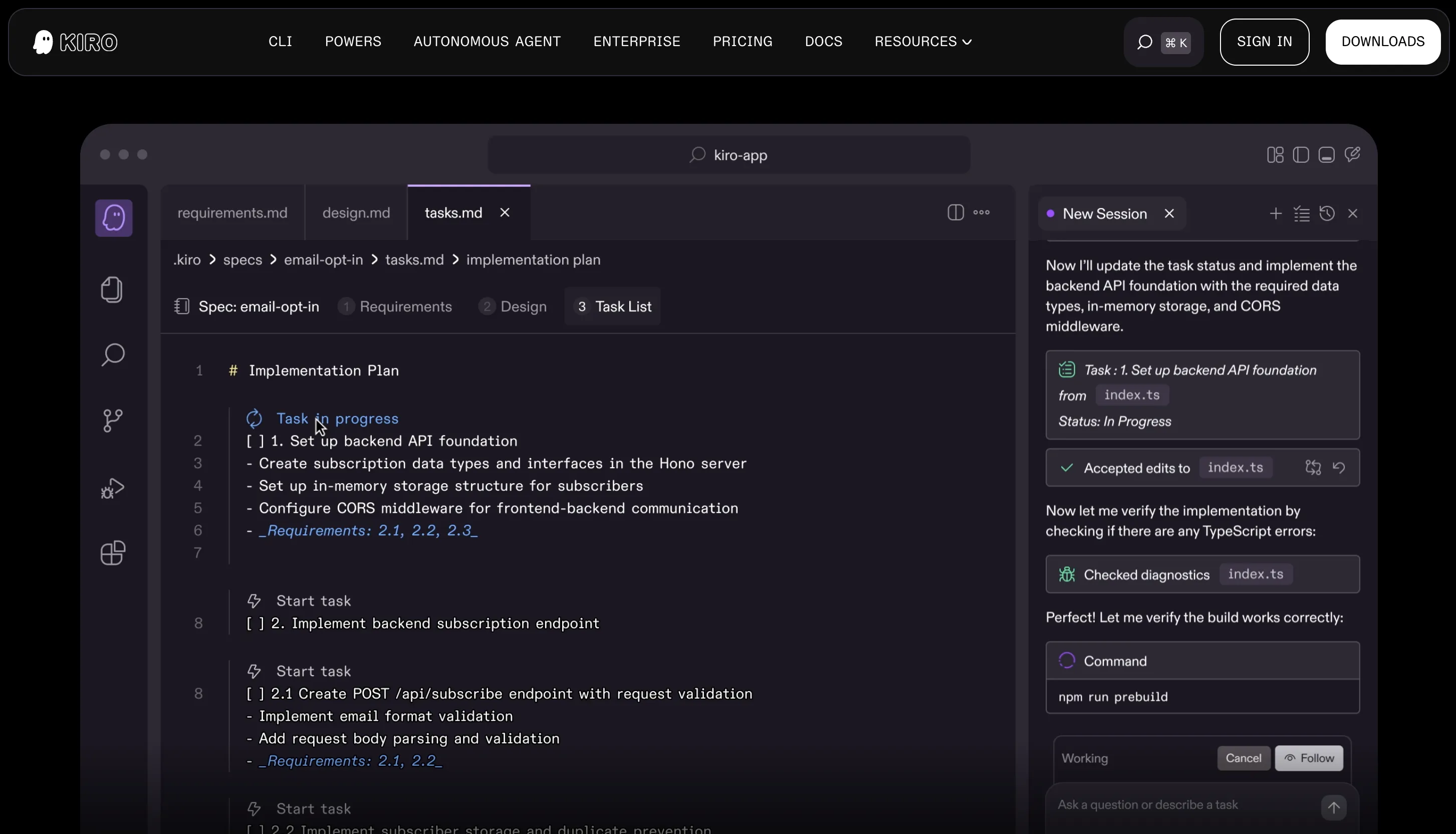
Kiro solves this problem by requiring a thinking process before writing the code. When a user provides a request in natural language, instead of generating code snippets on the fly, Kiro starts by building three foundational documents in Markdown format, stored right in the project's source code repository:
requirements.md (Requirements Document): Kiro converts ideas into user stories and acceptance criteria according to the EARS (Easy Approach to Requirements Syntax) notation. Normalized structure: "WHEN [condition/event] THEN THE SYSTEM WILL [expected behavior]".
design.md (Design Document): Analyze the current source code structure to propose a technical architecture, including data flow diagrams, suitable API and key architectural components (usually using Mermaid.js diagrams).
tasks.md (Task List): Break down the plan into atomic tasks, organized by dependency order, helping ensure traceability for each line of code created
This process not only helps reduce technical debt, but also creates a transparent roadmap for all changes, helping large teams collaborate effectively.
Agent Hooks: Smart Automation and Monitoring
Kiro introduces the concept of "Agent Hooks" – background AI agents triggered by specific events in the IDE. This is a significant step forward to help maintain source code quality without the need for constant human intervention.
How it works: Event (save file, create file) -> Agent reminder -> Autonomous action.
Practical application: Automatically create unit tests when saving source code, updating API documentation or suggesting Git commit content based on real changes
This capability turns Kiro into an advanced assistant, always monitoring the project to ensure security, formatting and documentation standards are strictly adhered to at all times.
Advanced Context Management and Multimodal Capabilities
To address the phenomenon of AI "memory loss" in large projects, Kiro uses a "Steering" system that helps AI deeply understand the working environment through three configuration files:
product.md: Product vision and user audience.
structure.md: Folder organization and naming conventions.
tech.md: Team technology stack and programming standards.
External In addition, Kiro strongly supports multimodal capabilities. Developers can upload a photo of a hand-drawn entity diagram (ERD) or interface sketch (UI mockup). Kiro's AI is capable of directly converting these images into actual source code (like TypeScript models or AWS CDK code), significantly shortening the gap from idea to deployment.
AWS Cloud Integration and Autonomous Agent Ecosystem
Kiro is part of AWS's strategy to simplify cloud application development. Users can create AWS infrastructure (Lambda, S3, DynamoDB) through simple English commands without immediately mastering the AWS CLI.
The "Kiro Powers" system provides specialized packages to extend Agent capabilities:
Figma: Consistently map UI design to source code.
Stripe: Automation payment integration and invoice management.
Netlify: Deploy web applications directly from the IDE.
Postman: Automate testing and API management.
Terraform: Professional infrastructure-as-code (IaC) management.
Datadog / Dynatrace: Log and metric queries for direct debugging.
AI Economic Modeling and Resource Management
Kiro uses a flexible credit system to help users easily control costs:
Kiro Free: $0/month (50 credits) - Suitable for experience experience.
Kiro Pro: $20/month (1,000 credits) - For professional individuals.
- focus.
In particular, Kiro has a fractional fee mechanism (up to 0.01 credit) for small edits, helping users optimize their budget most effectively.
Enterprise-Level Security, Privacy and Compliance
Security is a top priority for Kiro. Amazon commits that the source code of paid users will not be used to train AI. The system integrates "Human-in-the-Loop" (HITL) protection mechanisms, requiring human confirmation before executing sensitive commands such as running shell scripts or changing system configuration. Businesses also enjoy an IP compensation policy (IP Indemnity) to confidently deploy products to the market.
The merger of Q CLI and Kiro CLI
An important information for the programming community: Kiro CLI has officially replaced Amazon Q Developer CLI from November 2025. Users simply run the command q update to convert the entire terminal environment to Kiro CLI, enjoying a consistent experience between the command line and the IDE interface.
Comparing Kiro and Competitors (Cursor, Claude Code)
Tan Phat Digital summarizes the main differences as follows:
In terms of philosophy: Kiro focuses on planning (Spec-driven), while Cursor is strong on conversation (Chat-driven).
About audience: Kiro prioritizes complex and enterprise systems; Flexible Cursor for startups and fast UI/UX.
About accuracy: Kiro achieves a 95% accuracy rate in generating code from the specification, significantly higher than conventional prompt-only methods.
Amazon Kiro not only answers the question "What is Kiro" with a coding tool, but with a software engineering system comprehensive. With support from the AWS infrastructure and advanced Claude models, Kiro is reshaping a future where programmers act as coordinating architects, and AI takes care of the detailed execution. Tan Phat Digital recommends that teams start applying Kiro's Spec-driven process to improve product quality and optimize long-term development costs.
Share