
The digital asset market has undergone dramatic transformations, from the early stages of initial coin offerings (ICOs) to a complex and highly structured financial ecosystem. In this context, understanding token economics is no longer an option but has become a mandatory requirement for any investor or financial professional. The two core concepts that act as the "heart" of stability and sustainable growth in the blockchain project are Token Unlock (unlocking tokens) and Vesting (enjoying ownership rights). The combination of these two mechanisms creates a framework that manages circulating supply, regulates selling pressure, and most importantly, establishes a long-term incentive system for stakeholders.
The economics of Token Vesting and strategic implications for the ecosystem
Token Vesting is an asset governance process in which the tokens of a cryptocurrency project are retained or locked for a certain period of time determined and only released according to a specific schedule. The concept has deep roots in traditional finance, especially in employee stock option programs (ESOPs). However, in the blockchain world, this mechanism is automated and transparent through smart contracts, eliminating the need for trust in intermediaries.
Establishing a vesting schedule is more than just the act of delaying asset ownership. It serves as a powerful economic tool to address the problem of "business ethics" and information asymmetry between the project team and external investors. According to experts from Tan Phat Digital, when a large amount of tokens are locked, founders and early investors are forced to accompany the project through the initial difficult stages, instead of performing "exit dump" actions as soon as the project is listed.
Strategic functions for target groups:
Founding team & Employees: Creating "golden handcuffs" that promote engagement long term bundle. This helps reduce the turnover rate of key personnel and maintain sustainable technical development momentum.
Venture investors (VCs): Prevent mass profit-taking that causes price collapse at the time of listing (TGE). This mechanism helps maintain the stability of the price chart and attract additional secondary capital flows.
User community: Transparency of the supply route, creating a basis for more accurate valuation analysis. It also increases loyalty and encourages participation in project governance through the DAO.
Project ecosystem: Regulates cash flow for marketing, partnerships, and staking activities. This ensures financial sustainability for key future development milestones.
Anatomy of the operating mechanism via Smart Contracts
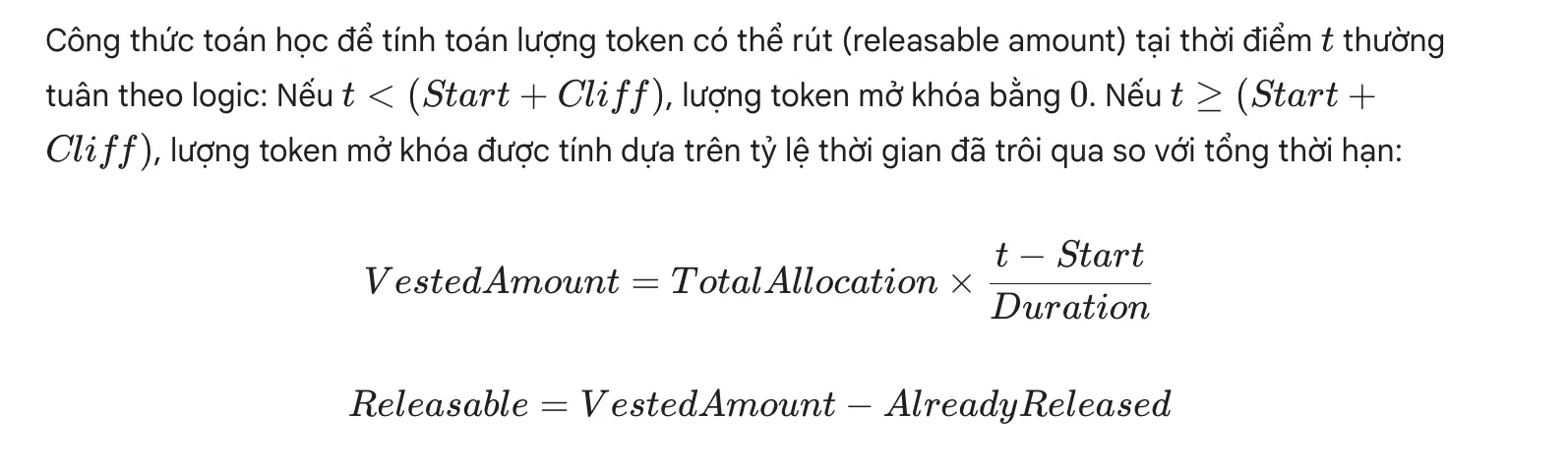
The real power of Token Unlock lies in its automatic execution. All the rules about when to unlock, the number of tokens, and the identity of the recipient are encoded into immutable smart contracts on the blockchain. Standard libraries such as OpenZeppelin are often used to implement secure and efficient systems.
Core technical parameters:
Beneficiary:The specific wallet address entitled to receive tokens after unlocking.
Start:Timestamp from which the schedule begins calculation.
Cliff: An initial period of time (usually 6-12 months) during which no tokens are released. This is a barrier to prevent premature withdrawal of stakeholders.
Duration: The total time that the unlocking process takes until reaching 100% of the token allocation.
Release frequency: Determines whether the tokens are paid per second (streaming), weekly, monthly or according to specific milestones.
Popular Vesting models today
Based on strategic goals, blockchain economists at Tan Phat Digital find that projects often apply the following models:
1. Linear Vesting Model
This is the simplest model, tokens are unlocked regularly over time. For example, a project that runs for 4 years will release exactly 1/48 of the tokens each month. This model provides high predictability for investors and market makers.
2. Cliff model combined with Linear
This is the "gold standard" for professional projects. For example, the project stipulates a 1-year cliff, followed by a linear vesting for 3 years. During the first 12 months, the recipient gets nothing. On the 13th month, they receive a large portion (usually 25%) and then small monthly portions.
3. Graded Vesting model
Allows to customize different unlocking rates at different stages. An important variation is Back-weighted Vesting, where the unlock rate increases gradually (Example: Year 1 unlocks 10%, Year 4 unlocks 40%). This structure creates great incentives for the team to stay as the project matures.
4. Milestone-based Vesting Model
Token unlocking is triggered when the project achieves specific achievements. This is a "KPI-driven" model that is becoming a big trend in 2026.
Technical Milestones: Launch Mainnet, complete Security Audit successfully.
User Milestones: Achieve target number of monthly active wallet addresses (MAU) (e.g. 100,000 people used).
Financial Milestone: Reach a certain total value locked (TVL) or protocol fee revenue level.
Governance Milestone: Pass a major proposal or change to the DAO structure.
Impact of unlock events on market price
Unlock tokens are often considered potential "supply shock". However, the actual impact is very diverse and not simply reducing prices.
Direct selling pressure and the "Sell before the news" mentality
When supply suddenly increases without corresponding growth in demand, prices will certainly be under pressure to adjust. Historical data shows that unlocks that account for more than 5% of total circulating supply often lead to significant price declines within 7 days surrounding the event.
In particular, the "News Selling" phenomenon often occurs when retail investors fear being sold off, leading to premature selling. Tan Phat Digital observed that the price often recovers immediately after the unlock is completed because the panic selling has been exhausted and the bad news has been fully reflected in the price.
Correlation between FDV and Market Cap
Investors need to monitor the Market Cap / FDV ratio. If this ratio is low (below 0.1), it means 90% of the supply is still locked. This is an alarming signal of huge inflationary pressure in the future, requiring demand to grow dramatically to maintain the current price level.
Analysis of motives by target group:
Team (Team): Taking profits to realize value or pay salaries. Short-term negative impact if there is no re-lock commitment.
Early investors (VCs): Pressure to divest from funds. Strong negative impact if the current ROI is too high (for example x50 or x100).
Community / Airdrop: Small users often sell immediately for liquidity. Negative impacts but dispersed and easily absorbed by market demand.
Ecosystem Fund (Treasury): Used for marketing and partners. Neutral or positive impact if it helps expand project adoption.
In-depth trading and risk management strategy
To survive in a market dominated by unlocking cycles, investors need to apply the strategies of professional financial institutions:
Delta-Neutral Strategy (Neutral Defense): Keep assets in Spot wallet (+1 Delta) and open equivalent Short position on the Derivatives exchange (-1 Delta). As a result, even though the price drops deeply after unlocking, the loss in Spot will be compensated by the profit from the Short order. Investors can also profit from Funding Rate fees if the Short side prevails.
Exploit volatility through Options: Buy Put Options as a type of insurance. Investors have the right to sell tokens at a fixed price (strike price) regardless of how deeply the market price drops after unlocking. The maximum loss is only the premium paid.
Liquidity and market depth analysis: Compare token value to be unlocked with market depth +/- 2%. If the amount of unlocks is much larger than the available liquidity, even a small amount of selling pressure can trigger mass liquidations.
Dedicated tracking tools ecosystem
Here is a list of essential tools to manage token unlock data:
Tokenomist (TokenUnlocks.app): Provides a countdown timer, detailed analysis of the amount of token unlocks for each group and rank projects based on supply inflation.
CryptoRank: Strength in connecting fundraising data with token payout schedules. Allows tracking the current ROI of investment funds to predict selling pressure.
DropsTab and Vestlab: Provides an FDV/Market Cap comparison interface and a Whale tracking feature tied to the unlocking schedule.
Case Studies
Looking at real projects helps understand how Operation of this mechanism:
Aptos (APT): Implement vesting schedule up to 10 years long for community allocation. Extending this time helps Aptos minimize sudden selling pressure and maintain stable value for strategic partners.
Saga (SAGA): Establish a "growth window" by locking in groups with high selling pressure for more than 1 year. Major unlocks for investors only start from June 2025, creating a safe zone to build products.
Portal (PORTAL): Combining tokenomics with real money flows. Portal Pay collects transaction fees and uses that money to buy back (buy-back) tokens in the market, creating natural demand to balance the pressure from unlocks.
Arbitrum (ARB): The big unlock event in March 2026 with 1.1 billion tokens will be an important test of the market's ability to absorb the Layer 2 row.
Vision 2026: The "Smart Vesting" Era
In the near future, Tan Phat Digital predicts the rise of more advanced supply management models:
Performance-based Vesting: Eliminate purely time-based scheduling. Tokens are only unlocked when the project achieves revenue or actual users, preventing enrichment from valueless projects.
Automatic legal compliance: Integrating automatic income tax payment solutions right into vesting smart contracts, making it easy for pension funds and large financial institutions to participate.
Impact of ETFs: The emergence of Bitcoin and Ethereum ETFs create a new standard for liquidity, forcing projects to design unlock schedules that are compatible with the risk appetite of institutional investors.
A deep understanding of unlock schedules is the dividing line between a lucky speculator and a professional blockchain investor. At Tan Phat Digital, we believe that careful preparation of information is the most powerful weapon to protect and increase sustainable assets.
Share


