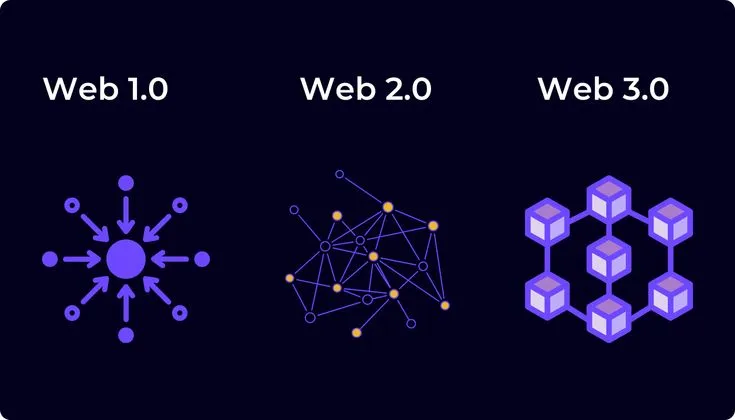
According to the team of experts at Tan Phat Digital, the transformation of the global information network from a static library to an interactive ecosystem and now a decentralized ownership economy marks the most important turning point in the history of information technology. This process is not simply an upgrade in bandwidth or user interface, but a comprehensive restructuring of trust infrastructure, data ownership and value transfer methods in the digital space. In that context, Blockchain serves as the implementation layer for the Web3 vision, allowing transactions and interactions to take place without the need for traditional intermediary entities.
Historical progression and decentralization of Internet generations
The Internet does not emerge as a complete entity but evolves through distinct stages, each stage solving a core problem of contemporary society. From connecting information to connecting people, and now connecting value.
Web 1.0: The era of static information and the beginning of global connectivity
The first phase, often called Web 1.0 or "Read-Only Web", lasted from about 1990 to the early 2000s. During this period, the Internet served as a mail giant electronic institute where organizations and a small group of individuals create content for a broader but passive audience. Tim Berners-Lee, who laid the foundation for the World Wide Web in 1989, envisioned a solution to automate the sharing of information between scientific organizations, but the actual results far exceeded the original goal.
Websites of this period were mainly built in static HTML language, with little interaction. Users access the Internet to search for information, read news or look up data without the ability to respond or create personal content.
Web 1.0 specification and user experience:
Nature of content: Static, mainly basic text and images.
Core protocol: HTTP, HTML, TCP/IP.
User role:Passive consumer.
Update model:Manual update by webmaster through editing source code.
Typical example: Yahoo! Directory, GeoCities, Britannica Online.
Web 2.0: The explosion of interactivity and social networking
The shift to Web 2.0, or the "Read-Write Web", began around 2004, driven by the popularity of smartphones and cloud computing. This is an era where users become the main content creators (User-Generated Content) through platforms like Facebook, YouTube and TikTok.
However, this convenience comes with data being concentrated in the hands of large corporations (Big Tech). These entities possess absolute control over users' personal data and privacy through closed algorithms.
Web3: A Vision of a Decentralized and Owned Internet
Web3, or the "Read-Write-Own Web", represents the generation where users have true control over their identities and assets. The term was popularized by Gavin Wood in 2014 to describe a Blockchain-based ecosystem that eliminates dependence on central servers.
Detailed comparison between Web generations:
Web 1.0 (Read-only): Distributed but static network structure; identification by each individual website; stored at local server; executes server-side code.
Web 2.0 (Interactive): Platform-centric architecture (Siloed); Identification via central account (Google/FB); centralized cloud storage; executed via API and cloud services.
Web3 (Property): Decentralized structure (Decentralized); identification via personal wallet (Self-sovereign); Blockchain & P2P storage (IPFS); executed via Smart Contracts.
See more: What is a Smart Contract?
Blockchain: The infrastructure of decentralized trust focus
Blockchain is not simply a storage technology; it is a protocol that establishes consensus without the need for a central operator. For Web3, Blockchain acts as a "state layer" that immutably stores all evidence of ownership.
Operating mechanism and types of Blockchain
Data on the Blockchain is packaged into "blocks" and linked by encryption. If the information is changed, the hash will not match and the network will immediately reject it. This ledger is synchronized across thousands of nodes, making the system resistant to censorship.
Blockchain system classification:
Public Blockchain: Everyone can participate, there is no single administrative entity (Example: Bitcoin, Ethereum).
Private Blockchain (Private): Only the identified group has access managed by an organization (Example: Internal banking system).
Federated Blockchain: Administered by a group of partners or organizations (Example: Multi-party supply chain).
See also: What is MetaMask?
Definition of terms: Web 3.0 and Web3
Many people confuse these two concepts, but in fact they have different origins each other:
Web 3.0 (Semantic Web): Tim Berners-Lee's vision focuses on AI and metadata to help computers "understand" information, towards efficiency and intelligence.
Web3 (Decentralized Web): Gavin Wood's vision is based on Blockchain and cryptography to return ownership to users, towards personal and economic freedom Token.
Key technical components
WebAssembly (Wasm): Binary format allows code execution at near-native speed, faster than traditional Ethereum virtual machine, supports many programming languages such as Rust, C++.
IPFS (InterPlanetary File System): Non-native file storage system Focusing on "Content Addressing" instead of server location, ensuring data is not deleted or modified illegally.
Vietnam in the Blockchain era
Vietnam has quickly risen to lead the world in the level of acceptance of cryptographic assets. Tan Phat Digital records impressive indicators in 2025:
Crypto-asset acceptance ranking: Ranked 5th globally.
Capital flow into the ecosystem: Estimated to reach more than 220 billion USD (2024-2025 period).
Number of owners owning digital assets: More than 17 million people.
Need for specialized human resources: It is forecasted that 200,000 experts will be needed by 2028.
Risks and Future Vision
Blockchain still faces challenges from Quantum Computers, capable of breaking cryptographic algorithms currently. The solution is to transition to Post-quantum Cryptography (PQC) based on a more complex mathematical structure.
Towards Web 4.0 and Web 5.0:
Web 4.0 (Symbiotic Internet): The era of AI, IoT and neural interfaces blurs the lines between the real and the virtual.
The Web 5.0 (Emotional Internet):Computers have the ability to identify and respond to human emotional states, combined with absolutely decentralized identification.
10 Typical Blockchain Application Case Studies in Vietnam
Below are practical applications compiled by Tan Phat Digital, demonstrating the power of blockchain technology in solving international problems family:
1. Blockchain integration on VNeID identification applicationThe Ministry of Public Security has deployed Blockchain integration to manage traceability of chemicals and precursors and implement decentralized identification and authentication (DID/VC). This helps improve security, transparency and data safety in public services.
2. Agricultural product traceability platform Agridential.vnDeveloped by Vietnam Blockchain Corporation (VBC), this system has digitized the supply chain of rice, Sagrifood pork and OCOP products in Ca Mau. Consumers can scan the QR code to know the exact production log from farm to fork.
3. Sky Mavis and Axie Infinity - The world's GameFi unicorns The Vietnamese team's game project has reached a value of billions of dollars, creating the "Play-to-Earn" model. Despite security challenges, Sky Mavis raised capital to repay users and continue to develop the Ronin Network ecosystem.
4. Kyber Network - Decentralized Exchange (DEX) Founded by Loi Luu and Victor Tran, Kyber is one of the largest DeFi ecosystems on Ethereum. The project has successfully raised capital of 52 million USD and provided liquidity for a series of global financial applications.
5. Aura Network - Blockchain Ecosystem for Real Assets (RWA)Focused on tokenizing intellectual property (IP) and real assets, Aura Network helps businesses create and trade NFTs efficiently. The project receives strong technical support from FPT Software.
6. Ministry of Education's national diploma and certificate system applies Blockchain to store and authenticate electronic diplomas, helping to prevent diploma fraud. Employers can quickly look up the authenticity of a degree through a unique identifier.
7. Piloting a Carbon credit exchange in VietnamThe Government aims to operate a pilot carbon exchange by the end of 2026. Blockchain is used to track, report emissions and trade credits in a transparent manner, supporting the Net Zero 2050 goal.
8. Vietnam Blockchain Multi-Chain Service Network (VBSN) 1Matrix Company's "Make in Vietnam" product was honored as a strategic product in 2025. VBSN provides interconnected infrastructure for ChainTracer tracing services, diploma authentication at the Academy of Cryptography and intellectual property rights management.
9. Blockchain in finance: Peer-to-peer lending (P2P Lending) Blockchain solutions help automate smart contracts, reduce operating costs by 60-70% and increase transparency by 40% compared to traditional lending models, helping investors better control capital flows.
10. Payment and International Trade Finance (Trade Finance)Many banks in Vietnam such as VietinBank and TPBank have piloted the use of Blockchain to process international payment transactions and L/C. This technology reduces processing time from days to hours and saves significant transaction costs.
10 Frequently Asked Questions (FAQs) about Web1, Web2, Web3 and Blockchain
1. What is Web3 and why is it called the "Owned" revolution? Web3 is the third generation of the Internet built on decentralized principles. The biggest difference is the right to "Own". Instead of letting data and digital assets be controlled by technology giants (Web2), Web3 allows users to directly own their identities, data and assets through Blockchain without the need for intermediaries.
2. Are Web3 and Web 3.0 the same? Although often used interchangeably, they have different origins. Web 3.0 (Semantic Web) is Tim Berners-Lee's vision of a network of computer-understandable data (thanks to AI/Metadata). Web3 is a term coined by Gavin Wood, emphasizing decentralized structure, cryptography and user ownership based on Blockchain.
3. How does Blockchain work in Web3? Blockchain serves as the "backbone" or trusted infrastructure layer. It records every transaction and interaction into a public, transparent, and immutable ledger. Thanks to Blockchain, Web3 is "trustless", meaning users do not need to trust an organization but trust the encryption algorithms.
4. What does Resolution 05/2025/NQ-CP mean for users in Vietnam? This is a "historic opening step" that allows piloting the crypto asset market in Vietnam for 5 years (from September 2025). The resolution creates a safe legal framework, helping people legally invest in crypto assets, minimizing the risk of fraud and foreign currency loss to international exchanges.
5. Why is WebAssembly (Wasm) important for Web3 development? WebAssembly allows running complex applications in the browser at the same speed as software installed directly on the computer (10-100 times faster than JavaScript). In Web3, Wasm helps smart contracts (Smart Contracts) operate more efficiently, save costs and allows programmers to use many powerful languages such as Rust or C++ .
6. How is data storage in Web3 different from traditional cloud storage? Web3 uses decentralized protocols like IPFS instead of centralized servers from Google or AWS. In IPFS, data is broken down and distributed across thousands of computer nodes. Files are fetched based on "content" (hash) rather than server location, helping to resist censorship and ensure data is not illegally deleted.
7. How to ensure the safety of Blockchain before the rise of quantum computers? The biggest threat from quantum computers is the ability to break current cryptography. The solution is to upgrade to Post-quantum cryptography (PQC) – extremely complex mathematical algorithms that even quantum computers cannot solve. Projects like QRL or NIST standards (like CRYSTALS-Kyber) are pioneering in this area .
8. How is Web 5.0 different from Web3? Web 5.0 (as per Jack Dorsey's vision) aims to bring about absolute decentralized identification (DID) without relying too much on public blockchains, which are still somewhat centralized. In addition, Web 5.0 is also defined as the "Emotional Internet", where AI can identify and respond to human moods.
9. How much human resources does Vietnam's Blockchain industry need? According to the TopDev 2025 report, Vietnam will need about 200,000 more experts in the fields of Blockchain, AI and Fintech in the next 3 years. Positions go beyond just programmers and extend to on-chain data analysis, smart contract moderation, and crypto asset legal experts.
10. What should beginners do to learn about Web3 and Blockchain? The advice is to learn from reputable sources, participate in communities like Discord, Reddit or basic courses from Binance Academy or Blockchain academies in Vietnam. Practicing using personal wallets (like MetaMask) and testing decentralized applications (dApps) is the best way to grasp this technology.
The Internet is strongly evolving towards a decentralized model, where the power belongs to the users. For Vietnam, this is a golden opportunity to make a breakthrough. According to experts at Tan Phat Digital, individuals and businesses should proactively equip knowledge about Blockchain, invest in high-quality human resources and prepare post-quantum security solutions early to lead in the future digital economy.
Share


