Zero-Knowledge Proof (ZKP): Security Architecture and Open Era of Blockchain Technology
The evolution of modern cryptography has marked an important turning point with the birth and application of Zero-Knowledge Proof (ZKP). As decentralized systems face privacy and performance challenges, ZKP is not simply a security tool but an architectural pillar that allows for a compromise between the transparency of public ledgers and the need to secure personal data. This technology represents a paradigm shift, moving from trusting centralized entities to trusting irrefutable mathematical proof. This is also the core viewpoint that Tan Phat Digital always emphasizes when analyzing trust infrastructure in the digital era.
Philosophical foundation and Development history of ZKP
The concept of Zero-Knowledge Proof comes from the need to solve a basic problem in information theory: How can an individual prove his or her knowledge of a secret without having to reveal the secret itself? Before the advent of ZKP, information authentication often required direct access to raw data. For example, to prove access to an account, a user must provide a passcode to the system, which unintentionally creates a security weakness if that system is compromised.
The theoretical framework for ZKP was first proposed in 1985 by Shafi Goldwasser, Silvio Micali and Charles Rackoff in the landmark paper "The Knowledge Complexity of Interactive Proof Systems". At the time, this idea was considered paradoxical and purely theoretical. However, the development of cloud computing and especially blockchain technology has turned ZKP into a practical solution. From early interactive proof systems that required multiple rounds of communication between the Prover and Verifier, the technology has evolved into Non-Interactive forms, allowing a single proof to be published and verified by anyone without the presence of its creator.
Definition and Basic Operating Mechanism
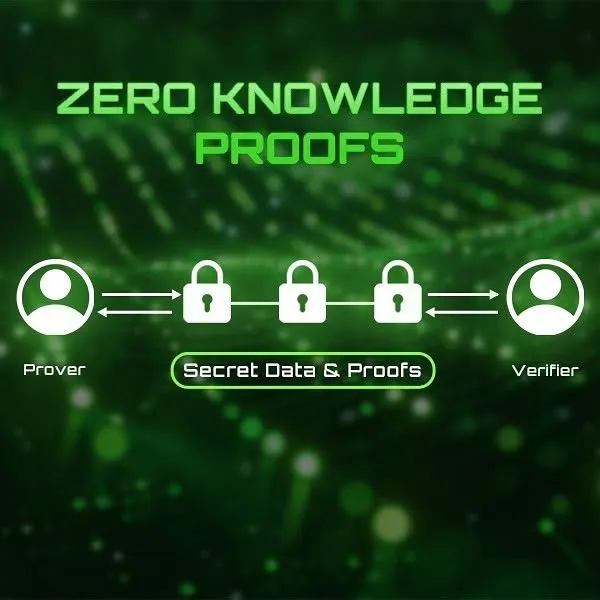
At its core, Zero-Knowledge Proof is a cryptographic method that allows the proving party to convince the verifying party that a statement is true without conveying any information other than the truth of the statement itself. To illustrate, consider the typical example of age verification. In the traditional system, users must present an ID card containing their date of birth, address and real name. With ZKP, users only need to provide a mathematical proof that they are over 18 years old. The verifier will check this proof through an algorithm and get a "True" or "False" result without ever knowing the exact date of birth of the user.
In a blockchain environment, this mechanism allows transactions to be validated without making sensitive details public. A user can prove they possess enough balance to make a transaction and that the transaction complies with the rules of the network (correct signature, no double spending) without revealing the wallet balance or the real identities of the sender and recipient.
Three core properties shape the security of ZKP
A protocol is recognized as valid Zero-Knowledge Proof if and only if it simultaneously satisfies three computational properties study rigorously. These properties ensure that the system cannot be manipulated by attackers and that user privacy is absolutely protected.
Completeness
Completeness stipulates that if the claim is true and both the prover and verifier are honest and follow the protocol, the verifier will always be convinced by the evidence presented. Mathematically, the probability of a true proof being rejected by an honest verifier must be zero. This ensures system availability, allowing legitimate users to always be able to exercise their rights.
Soundness
Correctness is a barrier to preventing fraud. It asserts that if the claim is false, no fraudulent prover can convince the verifier that the claim is true, except by a negligible probability. In modern systems, this property is often extended to "Knowledge Soundness", meaning that an attacker cannot create valid proof unless they actually possess the secret knowledge (witness) behind the claim. This eliminates the possibility of guessing or reconstructing evidence from old data.
Zero-Knowledge
This is the identity property of the protocol. It ensures that the verifier does not gain any knowledge other than the authenticity of the statement. To demonstrate this property, mathematicians use a concept called "Simulator". If a simulator can produce proofs that look exactly like the real proof without knowing the secret, it proves that the real proof does not contain any secret information. All sensitive information is hidden behind complex calculations, making it computationally impossible to reverse the process to find the raw data.
Technical analysis of key ZKP technology families
In today's blockchain ecosystem, the two main protocol families leading the way are zk-SNARK and zk-STARK. The difference between them lies in cryptographic assumptions, performance, and future scalability.
zk-SNARK: Conciseness and Verification Efficiency
zk-SNARK (Zero-Knowledge Succinct Non-Interactive Argument of Knowledge) is the most popular form of ZKP, widely adopted due to its "Succinct" (shortness). SNARK proofs are very small in size, typically just a few hundred bytes, allowing them to be easily embedded into blockchain blocks without significantly increasing storage costs or gas fees.
However, traditional zk-SNARKs require an initial setup phase called "Trusted Setup". According to observations from Tan Phat Digital, organizing multi-party ceremonies (MPC ceremonies) has become the gold standard to ensure the safety of this process, avoiding leaving behind "toxic waste" that can be used to tamper with evidence.
Detailed comparison of zk-SNARK series:
Groth16 series:
Evidence size: Extremely small Compact, usually in the range of 200 - 300 bytes.
Trusted setup: Requires separate setup for each specific circuit.
Verification time: Extremely fast and unchanged regardless of computational complexity.
Cryptobase: Based on Elliptic curve (ECC).
Flow PLONK:
Proof size: Slightly larger than Groth16, about 400 - 800 bytes.
Trust setting: Universal (one-time setup can be used for many different circuits).
Verification time: Very fast, suitable for a variety of applications.
Cryptobase: Combination of ECC and other Polynomial Commitments.
zk-STARK: Transparency and Quantum Resistance
zk-STARK (Zero-Knowledge Scalable Transparent Argument of Knowledge) represents an important step forward by completely eliminating the trust establishment phase. Instead of relying on difficult Elliptic curve problems, STARK uses collision-resistant hash functions. This offers two big advantages:
Transparency: There is no risk of "toxic waste" as every parameter is based on public randomness.
Quantum resistance: Hash functions such as SHA-256 are currently considered secure against future attacks from quantum computers, while ECC can be broken breaks.
Although STARK has a significantly larger proof size (several tens to several hundred KB), its proof generation time grows very slowly relative to computational complexity, making it extremely efficient for systems that need to process millions of transactions per second.
Breakthrough application in scalability: zk-Rollups
Scalability is the major barrier towards widespread adoption of Ethereum. zk-Rollups has emerged as an optimal Layer 2 solution, using ZKP to compress data and increase network throughput without compromising Layer 1 security.
Compression and Periodic Authentication
A zk-Rollup works by moving the majority of transaction execution and state storage off-chain. Transactions are grouped into a batch and processed by an entity called a Sequencer. After processing, the Sequencer will create a Validity Proof proving that all transactions in that batch are correct according to the network's rules.
Instead of having to check each individual transaction, the Ethereum mainnet only needs to verify this single proof. If the proof is valid, the network state on Layer 1 will be updated. This process significantly reduces the computational burden on main network nodes, allowing Ethereum to process thousands of transactions per second instead of just 15 transactions currently.
Architecture of components in the Rollup system
The operation of a zk-Rollup requires the smooth coordination of many complex technical components:
Sequencer and Prover: Sequencer receives transactions from users and sorts them. The Prover (usually a cluster of powerful servers) receives data from the Sequencer to perform cryptographic operations and generate SNARK or STARK proofs.
Verifier Contract on Layer 1: This is a smart contract containing proof verification logic. It acts as a filter, accepting only state changes that are mathematically proven to be correct.
Data Availability Layer: To ensure decentralization, zk-Rollups must still post a summary of transaction data to Layer 1. This ensures that even if the Sequencer disappears, anyone can use this data to reconstruct the entire state. of Layer 2.
The advantage of zk-Rollups compared to Optimistic Rollups is the instant "Finality" (transaction completion). In Optimistic Rollups, users have to wait about 7 days to withdraw funds to the main network. With zk-Rollups, as soon as the proof is verified, the transaction is considered final and as secure as a transaction on Layer 1.
Financial Privacy and Zcash Case Study
Zcash is the first and most successful blockchain project to deploy zk-SNARKs to protect financial privacy at scale. While traditional blockchains like Bitcoin make every transaction detail public, Zcash offers a Selective Transparency model. Tan Phat Digital considers this a breakthrough that helps reconcile personal privacy and state management requirements.
Protocol evolution: From Sprout to Orchard
The history of Zcash is a journey of continuous optimization of cryptographic performance. Initially, creating an anonymous transaction (shielded transaction) requires huge computing resources and takes a long time, causing low acceptance rate.
Sprout phase: Using BCTV14 proof system, requires huge trust setup and proof generation time takes minutes.
Sapling phase: Switch to Groth16, significantly reduced proof generation time is down to a few seconds and requires minimal memory, allowing implementation on mobile devices.
Orchard Phase and Halo 2 System: This was the biggest breakthrough when Zcash switched to Halo 2. This system uses a recursive proof composition architecture, allowing one proof to verify the correctness of another proof. More importantly, Halo 2 completely eliminates the need to establish initial trust, completely resolving concerns about "toxic waste".
Shielded Transactions Mechanism
In a Zcash shielded transaction, details such as sender and recipient addresses and balance are hidden in an encrypted "note". The system uses Nullifiers to prevent double spending without revealing which notes are being used. The zk-SNARK proof confirms that the total value of input notes is equal to the total value of output notes without revealing the actual number. Zcash also provides "Viewing Keys", which allow users to share permissions to view transaction details with regulatory or auditing agencies when necessary, ensuring legal compliance.
See more: Is Blockchain safe?
Applications in the Supply Chain: Lessons from Walmart
Walmart has become a symbol symbolizes the application of ZKP outside the financial sector, specifically in food supply chain management. Tan Phat Digital believes that this system is the clearest demonstration of ZKP's power in optimizing business processes while ensuring security for suppliers.
Optimizing Traceability and Food Safety
Walmart has collaborated with IBM to build a blockchain-based system, where every step from farm, processing plant to warehouse is recorded. ZKP is integrated to allow entities to demonstrate that they have performed quality checks and complied with standards without having to reveal trade secrets, such as recipes or details about third-party shipping partners.
Efficiency index achieved after applying ZKP and Blockchain:
Traceability time: Drastically reduced from 6 days 18 hours to just 2.2 seconds.
Product recovery time: Optimized from 72 hours to 14 minutes in emergency situations.
Document processing costs: Reduced by up to 82% by eliminating cumbersome manual paperwork processes check.
Supplier audit time: Reduced by up to 96%, helping to free up human resources for other important tasks.
This system has helped Walmart not only protect consumer health but also increase economic efficiency. Food waste rates decreased from 12.7% to 10.4% thanks to selective recall instead of blind recall across the entire area.
The rise of zkEVM and zkVM: The future of ZK programming
A major challenge for developers is that building ZK circuits requires extensive knowledge of mathematics. To solve this problem, Zero-Knowledge virtual machines (zkVM and zkEVM) were born.
zkEVM: Ethereum compatibility is a top priority
zkEVM is designed to execute Solidity smart contracts directly while still generating ZK proofs for each execution step. The goal is to enable existing dApps on Ethereum to migrate to Layer 2 without modifying the source code. Leading projects such as Polygon zkEVM and zkSync Era are focusing on optimizing Ethereum Opcodes so that they can be effectively proven using ZK.
zkVM: General Computing and Outstanding Performance
Unlike zkEVM, zkVM (like RISC Zero and Succinct SP1) does not strive to be compatible with Ethereum. Instead, they are based on standard computer instruction sets such as RISC-V. This allows developers to use popular programming languages like Rust or C++ to write any program and then create a ZK proof for that program.
zkVM offers scalability far beyond financial transactions. It can be used as a "ZK-Coprocessor", where a blockchain delegates heavy computational tasks to zkVM to perform off-chain, then only receives back a compact proof to confirm the result.
See also: What are Layer 1 and Layer 2?
Hardware acceleration: Solving the computational bottleneck
Although ZKP brings huge benefits large, but generating evidence (proving) is an extremely resource-intensive process. A simple calculation can take a few milliseconds to perform, but it takes seconds or even minutes to generate a ZK proof on typical CPUs.
GPU and ASIC Solutions for Prover
To achieve real-time processing, the industry is turning strongly to specialized hardware. Algorithms such as Multi-Scalar Multiplication (MSM) and Number-Theoretic Transform (NTT) are extremely suitable for parallelization on graphics chips (GPUs). Recent studies show that using GPUs can speed up proof generation by 200 times compared to CPUs.
In addition to GPUs, specialized chips (ASICs) are being developed to maximize power consumption and performance. Projects like NoCap have introduced vector processing machine architectures that can generate proofs up to 586 times faster than a 32-core CPU. The advancement of hardware, according to Tan Phat Digital's analysis, will be the key to bringing ZKP into everyday applications, where users cannot wait more than a few seconds for a transaction.
Decentralized Identity and Privacy in Web3
ZKP plays a central role in building a self-sovereign identity system (Self-Sovereign Identity). Solutions like Polygon ID and zkPass give users complete ownership of their personal data.
SSI and zkPass Model
In this model, users receive verifiable certificates from reputable sources. When needing to prove an attribute (e.g. being over 18 years old), the user simply generates a ZK proof from that certificate. The zkPass project takes this concept further by using the zkTLS protocol, allowing users to extract data directly from HTTPS websites and create ZK proofs without exposing credentials or raw data.
The ZKP Ecosystem in Vietnam and the International Community
Vietnam is gradually asserting its position in this high-tech field with the introduction ofZKP Labs. It is a non-profit organization dedicated to establishing a ZKP research and development environment in Southeast Asia. ZKP Labs focuses not only on training engineers to simply write code but also aims to build core proof systems through activities such as Vietnam Rust Hackathon or o1js workshops.
On a global scale, organizations such as ZKProof are working to standardize ZK protocols. The cooperation between large corporations such as Microsoft, Google and Amazon with blockchain projects also shows that ZKP is becoming a new security standard in the digital economic era.
Frequently Asked Questions (FAQ) about Zero-Knowledge Proof
Below is a summary of the most common questions to help readers have a more comprehensive view:
1. Is ZKP a new technology? The theory of ZKP has existed since 1985. However, it has only really exploded in the past 10 years thanks to the development of blockchain technology and the urgent need for privacy.
2. What is the difference between zk-SNARK and zk-STARK? Simply put, SNARK is compact and verifies extremely fast but requires an initial trust setup process. STARK is larger but more transparent (no need to establish trust), quantum resistant, and better scalable for extremely complex calculations.
3. Can ZKP be used outside of blockchain? Sure. ZKP has great potential for applications in healthcare (sharing patient data without revealing identity), electronic voting, and network security (authenticating passwords without storing passwords on the server).
4. Why is zk-Rollups more secure than other Layer 2 solutions? Because zk-Rollups uses mathematical proofs (Validity Proofs) to ensure the correctness of every transaction as soon as they are submitted, instead of relying on honest assumptions and challenging waiting times like Optimistic Rollups.
5. Does generating a ZK proof take a lot of energy?Yes, generating a proof requires significant computing power. However, new techniques and specialized hardware are helping to reduce energy consumption and significantly increase system performance.
Typical Case Studies on practical ZKP applications
Below are 10 typical Case Studies showing the power of ZKP in solving privacy, security and performance problems on a global scale and in Vietnam.
1. Walmart & IBM: Speedy food traceability Walmart has used ZKP combined with the Hyperledger Fabric blockchain to track food items such as mangoes and green vegetables. By inserting ZKP proofs, suppliers can confirm quality information without revealing trade secrets. As a result, traceability time has been reduced from 6 days and 18 hours to just 2.2 seconds.
2. Zcash (ZEC): Absolute financial privacy Zcash is the pioneering project that uses zk-SNARKs to create shielded transactions. Users can send money without revealing their wallet address or balance, while the network validates the transaction's validity through mathematical proofs.
3. Mina Protocol: The world's lightest blockchain Mina uses recursive ZKP (recursive proofs) to compress the entire blockchain history into a fixed-sized proof of only 22 KB. This allows any device, including smartphones, to run a full network node without needing to store hundreds of gigabytes of data.
4. Polygon ID & zkPass: Decentralized Identifiers (DID)These solutions allow users to prove personal attributes (like being over 18 years old or residing in a country) without revealing their date of birth or ID number. zkPass uses the zkTLS protocol to privately extract authentication data directly from HTTPS websites.
5. NDAChain (Vietnam): National Blockchain Infrastructure NDAChain built in Vietnam integrates the ZKP mechanism to protect user privacy in digital government and digital economy applications. This platform supports information verification without revealing the original data, ensuring compliance with international standards such as GDPR.
6. De Beers: Ensuring conflict-free diamond provenanceDe Beers Group uses the Tracr blockchain to track the journey of diamonds from mine to retail store. ZKP helps parties in the supply chain prove the authenticity and origin of gemstones without having to reveal sensitive business information to competitors.
7. Voatz & Agora: Transparent and Confidential Electronic VotingThese companies have deployed ZKP in their online voting systems to ensure vote integrity. ZKP helps verify that votes have been counted correctly just once, without revealing the voter's identity or their specific choices.
8. ZKML with snarkGPT: Artificial Intelligence (AI) Validation snarkGPT is an example of ZKML (Zero-Knowledge Machine Learning), allowing users to verify that a specific AI model (like GPT-4) performed the resulting computation without requiring the model owner to make the weights public or the proprietary source code.
9. EY (Ernst & Young): Secure Health Information Exchange EY has developed a health data exchange solution for hospitals using ZKP. The system allows doctors to access necessary diagnostic results without violating patient privacy or revealing entire sensitive medical records.
10. Abu Dhabi National Oil Company (ADNOC): Automating the oil and gas industry ADNOC partners with IBM to use blockchain to track oil from well to customer. ZKP is applied to automate transactions and payments in complex supply chains while keeping separate commercial terms between partners private.
Frequently Asked Questions (FAQ) about Zero-Knowledge Proof
Below is a summary of the most common questions to help readers have a more comprehensive view:
1. Is ZKP a new technology? The theory of ZKP has existed since 1985. However, it has only really exploded in the past 10 years thanks to the development of blockchain technology and the urgent need for privacy.
2. What is the difference between zk-SNARK and zk-STARK? Simply put, SNARK is compact and verifies extremely fast but requires an initial trust setup process. STARK is larger but more transparent (no need to establish trust), quantum resistant, and better scalable for extremely complex calculations.
3. Can ZKP be used outside of blockchain? Sure. ZKP has great potential for applications in healthcare (sharing patient data without revealing identity), electronic voting, and network security (authenticating passwords without storing passwords on the server).
4. Why is zk-Rollups more secure than other Layer 2 solutions? Because zk-Rollups uses mathematical proofs (Validity Proofs) to ensure the correctness of every transaction as soon as they are submitted, instead of relying on honest assumptions and challenging waiting times like Optimistic Rollups.
5. Does generating a ZK proof take a lot of energy?Yes, generating a proof requires significant computing power. However, new techniques and specialized hardware are helping to reduce energy consumption and significantly increase system performance.
6. Compare ZK-Rollups and Optimistic Rollups in terms of speed? ZK-Rollups provides instant finality (about 15-30 minutes) as soon as evidence is sent to Layer 1, while Optimistic Rollups requires about 7 days of waiting to process potential fraud challenges.
7. What is ZKML and why is it important in the AI era?Zero-Knowledge Machine Learning (ZKML) enables verification that an AI model (such as a medical diagnosis or credit scoring) performed its calculations accurately as promised, without exposing sensitive input data or proprietary model parameters.
8. Why does Mina Protocol's blockchain maintain a fixed size of 22KB? Mina uses recursive ZK proofs, where each new block contains a compact snapshot of the entire previous network state, allowing any mobile device to become a full network node.
9. What is the legal status of privacy coins like Zcash in 2026?In early 2026, the SEC concluded its investigation into the Zcash Foundation without recommending action, reinforcing confidence in the legal compliance of Zcash's selective disclosure features.
10. What are the main differences between zkEVM and zkVM for programmers? zkEVM prioritizes compatibility with Ethereum (Solidity), making dApp migration easy; while zkVM is a generalized virtual machine based on RISC-V, allowing the use of languages such as Rust or C++ to write any application logic.
11. What are the benefits of Ethereum zkEVM's 16-second milestone?Ethereum zkEVM performance reached 16 seconds in early 2026, a 45x improvement in speed and cost compared to before, making L1 a truly secure and efficient payment layer for large-scale transactions.
12. How does ZKP help with medical record security? ZKP allows sharing of diagnostic results needed for treatment or research without revealing the entire medical history, ensuring strict compliance with privacy regulations such as HIPAA.
13. Is hardware acceleration (ASIC/GPU) really necessary for ZKP?Yes, because generating ZK proofs can be 5-6 times slower than regular computation. Devices like GPUs provide a 200x speedup, while specialized ASIC chips (like NoCap) can be up to 586x faster than a 32-core CPU.
14. Are there any typical ZKP projects developed by the Vietnamese community? Vietnam currently has ZKP Labs that is training engineers specializing in ZK and the NDAChain project integrating ZKP to protect user privacy on the national digital infrastructure platform.
15. What is zkTLS and how does it help connect Web2 to Web3?zkTLS (like the zkPass project) allows users to extract authentication data from existing HTTPS sites (like banks, social networks) and create ZK proofs for use in Web3 without exposing personal credentials.
Zero-Knowledge Proofs (ZKP) have come a long way from being a mathematical concept. abstract learning to become the "holy grail" of security and scalability in the blockchain era. The ability to prove the correctness of information without revealing the information itself has opened new frontiers for data autonomy.
For businesses and developers, embracing ZKP – as advised by Tan Phat Digital – is no longer an option but an inevitable requirement to build trust in an increasingly complex digital world. From Zcash's anonymous financial transactions to Walmart's lightning-fast traceability, ZKP is gradually reshaping the architecture of global trust.
Share


