Conversion Deficit Crisis
Content Marketing has long been considered a strategic investment channel to attract potential customers and build brands. However, the alarming reality is that the majority of content produced, despite large investments in time and cost, does not bring adequate conversion results. This phenomenon is called "Conversion Deficit". Content only creates "vanity traffic" or surface metrics (vanity metrics) such as views and likes, without driving final business actions (sales, leads, sign-ups).
In-depth analysis shows that the problem is not in bad Content, but in the teams unintentionally making basic mistakes that cause great strategic, technical, and operational losses. These mistakes create friction points in the customer journey, erode trust, and ultimately, prevent conversions.
This report breaks down the 20 most common mistakes, divided into five strategic pillars. Overcoming these gaps is a prerequisite for turning Content Marketing from a cost center into a revenue-generating asset.
PART I: STRATEGIC ERRORS AND POSITIONING (The Strategy Gap)
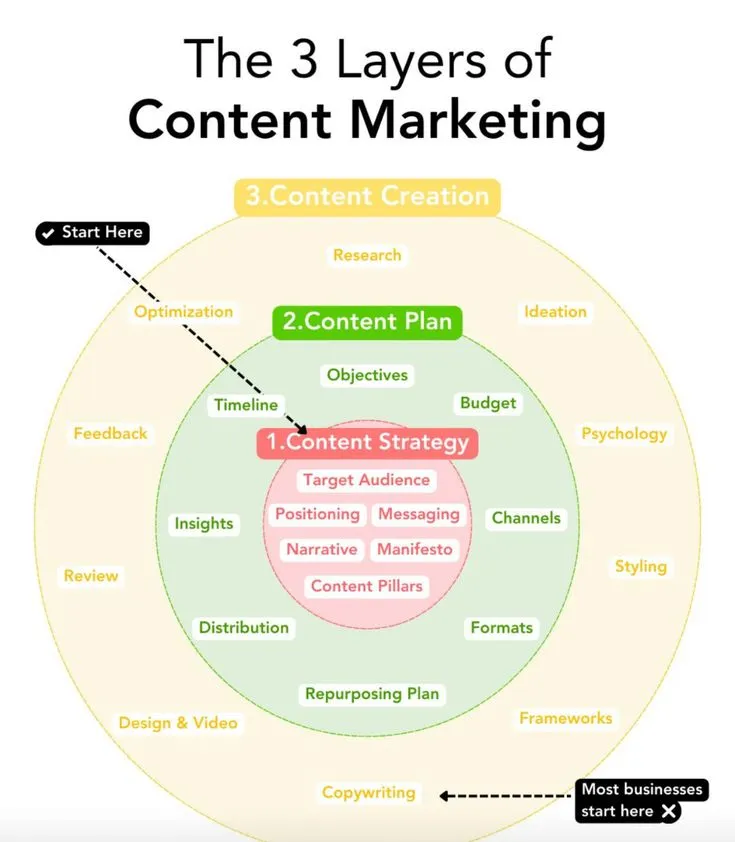
Most Content Marketing fails right from the planning stage, when content is created sporadically, not tied to business goals. potential customers' business or purchasing journey.
1. The Vague Goal Trap
Many Content Marketing campaigns start with vague goals like "increase brand awareness" or "increase traffic." This lack of clarity makes it impossible to determine which assets actually have financial value. When Content Marketing is not measured by real business metrics like ROI, Lead-to-Opportunity Conversion, or customer lifetime value (LTV), managers can only rely on vanity metrics like likes or shares. Reliance on these surface indicators seriously distorts budget allocations. If a team continues to invest in channels and content types that generate a lot of views but don't contribute to revenue, it's a sign of strategic measurement maturity.
2. Ignoring Target Audience and User Intent (Ignoring Intent)
Quality content must be content that solves the reader's problem at the time they need it. A common mistake is creating generic content, written for everyone but not touching anyone's needs. This happens when the Content team ignores in-depth analysis of personas and Search Intent. Without a clear understanding of the questions potential customers ask at each stage of the buying journey, the content won't be relevant enough. This lack of relevance not only reduces engagement rates, but also makes conversations with the Sales team less effective, because Sales lacks context and information about the lead's behavior.
3. Unbalanced Focus Between TOFU, MOFU, and BOFU (The BOFU Neglect)
This is one of the strategic mistakes that causes the biggest financial losses. Companies often spend most of their resources (even 80% of their budget) producing Top-of-Funnel (TOFU) content for educational and awareness-building purposes (blog posts, infographics). However, they leave out Bottom-of-Funnel (BOFU) content, which includes documents that directly support decision making such as Case Studies, Product Demos, Competitive Comparisons, and Pricing Pages.
Ignoring BOFU means wasting the maximum potential customers who have been nurtured through TOFU and MOFU. BOFU content is designed to persuade, focusing on highlighting the product's value, providing social proof, and addressing the customer's ultimate objections. Marketers often misunderstand that BOFU content must attract new visitors, but the real goal is to maximize the rate at which existing visitors become leads. Without strong BOFU content, 95% of captured leads will be left alone, without the tools to convert them into sales. Therefore, experts recommend building BOFU first to ensure a conversion mechanism is in place before promoting TOFU traffic.
4. Running After Quantity, Forgetting Content Quality (Quantity Over Value)
In an effort to maintain a continuous presence, many content teams fall into the trap of continuously producing content (content churn). Content is created at a high rate but lacks the necessary depth, originality and expertise. Shallow, predictable content that doesn't add value compared to the competition not only frustrates readers but also fails to establish Topical Authority. This strategy is not sustainable and only creates information chaos. Instead of creating more, effective strategy requires building smarter by focusing on E-E-A-T (Expertise, Experience, Authoritativeness, Trustworthiness) quality.
5. Content Is Too Promotional, Lacks Independent Value (The Sales Pitch Problem)
This mistake occurs when the Content team cannot maintain a balance between education and promotion. Readers, especially at the top of the funnel (TOFU/MOFU), are looking for solutions and valuable information, not a sales pitch. When every article, video, or case study turns too blatantly into a sales pitch, it disrupts the nurturing experience. BOFU content, while highly persuasive, must still provide independent value, such as providing insights on how to solve problems with the brand's solution, instead of just a list of product features. Focusing only on the "what" (features) without the "why" (benefits and ROI) will reduce conversion motivation.
PART II: TECHNICAL SEO/UX ERRORS – FRITION POINTS PREVENTING ACTION (Friction Points)
Technical and user experience (UX) issues create physical and psychological barriers that cause readers to leave the page before taking action to convert.
6. Not Optimizing Basic SEO, Making Content "Invisible" (Basic SEO Failure)
Content has great quality but if not optimized for search engines, it will never reach its target audience. Ignoring SEO fundamentals such as keyword research, On-page optimization (title tags, meta descriptions, H2/H3 tags), and internal linking is a serious mistake. Content teams that aren't SEO optimized are acting like "opening a great restaurant where no one can find it." Failure to optimize these factors significantly reduces the content's ability to rank, leading to wasted production effort.
7. Not Building Topical Authority and E-E-A-T
In the modern search environment, gaining Topical Authority coverage is a high-level strategy for demonstrating expertise. Topical Authority isn't just about having lots of content; It is about building a comprehensive and tightly linked content system around a specific topic, covering all related aspects.
A practical strategy to demonstrate this is to implement the Pillar Content and Topic Cluster model. A pillar page is a comprehensive guide that covers the main topic, linking to detailed articles (cluster content) on sub-topics. On the contrary, cluster articles must also link back to the pillar article. This cross-linking structure sends a clear signal to search engines that the brand is a trustworthy and authoritative reference (Authoritativeness) in that field. This directly reinforces Google's E-E-A-T (Experience, Expertise, Authoritativeness, and Trustworthiness). The content must be clear who created it, by providing a detailed author biography with expertise to confirm Expertise.
8. The Speed Killer
Page load speed is not a secondary UX factor; đó là một rào cản chuyển đổi trực tiếp và là nguyên nhân hàng đầu gây tổn thất doanh thu. In a market like Vietnam, where 76.2% of people actively use social networks and consume content primarily via mobile, a mobile-first experience is a must.
Data shows the clear financial impact of speed:
Conversion Rate (CR) Decline:Pages that load in 2.4 seconds have a conversion rate of 1.9%. However, if the load time increases to 4.2 seconds, the CR drops below 1%. If slow to 5.7 seconds, CR is only 0.6%. Walmart found that for every 1 second improvement in load time, sales increase by 2%.
Increase Bounce Rate: A delay of just 1 second in load time can lead to a 7% decrease in conversions. Google also found that when load time increases from 1 second to 5 seconds, the probability of bounce rate increases by 90%.
Optimizing for speed is a high-ROI CRO action, as it prevents wasted advertising dollars spent bringing users to the page.
9. Poor On-Page User Experience (UX) (Navigation and Layout)
Poor website design, messy layout, or complicated navigation creates cognitive friction, causing readers to tire and leave before converting. A strong UX strategy can increase conversion rates by up to 400%. Conversely, 88% of users will not return to a website after a bad experience.
Common UX mistakes include:
Lack of Visual Hierarchy: Users cannot quickly identify the most important information.
Content is too dense (Wall of Text): Do not use headings, bulleted lists, and whitespace to make the content scannable.
Complicated navigation: A confusing menu system (should be limited to 5−7 items) makes it difficult for users to find relevant information.
Inconsistent or unfriendly design can cost businesses 35% of their revenue, an estimated $1.4 trillion in lost revenue annually due to bad UX.
10. Vague or Inconsistent Call to Action (CTA)
CTAs are conversion catalysts, but many content fails to guide users to action. Vague CTAs like "Click Here" or "Submit" don't convey value or what the next action is.
The more serious mistake is the lack of consistency between the ad (or preceding content) and the landing page. If the ad's message doesn't match the offer and CTA on the landing page, users will be confused and bounce rates will increase. Studies show that landing pages with just a single offer and a clear CTA achieve a 13.5% conversion rate, compared to pages with multiple offers. This proves that focus is the key to leading users to action. Notably, more than 70% of small businesses often neglect to include clear CTA buttons on their website.
11. Intrusive Conversion Killers
Although Pop-ups and ads are effective lead collection tools, when they are annoying or appear at the wrong time, they become "conversion killers". Auto-playing ads, pop-ups that take up the entire screen, or registration windows that appear as soon as the user enters the page all disrupt the experience.
Consumer reaction to intrusive ads is very negative. 91% of shoppers will not make a transaction with brands that serve ads they consider intrusive. 70% of consumers feel advertisers do not respect their digital experience. This behavior not only reduces CR but also erodes trust and brand, motivating users to install ad-blockers.
To fix this, Pop-ups should use smart triggers, such as displaying after the user scrolls 35% of the page or based on exit-intent. In addition, reducing the number of information fields in the Pop-up form also helps increase conversion rates, because long, complicated forms make users feel intimidated.
12. Not Updating and Re-Optimizing Old Content (Stagnant Content)
Content, even if initially high quality, will gradually become outdated in terms of data, technical SEO, or relevance. Letting old content stagnate not only gradually reduces conversion performance and organic traffic, but also reduces the Trustworthiness of the site, going against the E-E-A-T principle.
Effective content marketing requires a continuous optimization strategy. Content teams should perform Content Audits periodically (usually quarterly) to:
Update statistics.
Re-optimize SEO (add new keywords, improve internal linking).
Add CTAs relevant to current offers.
This helps maintain accuracy and authority, ensuring that content remains an asset. long-term asset, not a tool with only immediate value.
PART III: ENGAGEMENT AND TRUST BUILDING (Engagement and Trust Deficits)
Trust is a central factor in conversion, especially in online transactions in markets like Vietnam, where suppliers often struggle to build integrity and assurance with customers. Content fails when it lacks emotional elements, social proof, and interactivity.
13. Not Highlighting the Impact of Storytelling (The Narrative Vacuum)
Content only focuses on facts and figures but ignores the power of the story. People tend to connect and remember information better when it is packaged in a story. When brands can't tell a compelling story (about their origin, their mission, or their successful customer journey), they fail to create an emotional connection.
Data shows that Storytelling is an extremely effective CRO tool:
Storytelling improves conversion rates by about 30%.
More importantly, telling a story that goes along with the product can increases consumer perceived product value by up to 2,706%.
Storytelling helps increase information retention from 5-10% (based on statistics alone) to about 67%. Brands with authentic stories motivate 15% of consumers to make an immediate purchase.
14. Not Leveraging User-Generated Content (UGC) (Lack of Social Proof)
In the digital era, 70% of individuals intentionally avoid advertising. Paid media is gradually losing its influence. In contrast, User Generated Content (UGC) – including reviews, testimonials, customer photos and videos – acts as "social proof", reinforcing authenticity and trust.
The impact of UGC on conversions is phenomenal:
UGC increases conversion rates by 161% when integrated on e-commerce product pages element.
70% of consumers consider UGC reviews or ratings before making a purchase, and 84% of Millennials are influenced by UGC.
The lack of UGC leaves brands lacking the most important proof: actual customer satisfaction. UGC not only drives conversions but also builds community loyalty, like the example of Lego Ideas.
15. Lack of Content Personalization (One-Size-Fits-All Messaging)
Personalized content ensures the message hits the right user needs and stages, eliminating friction caused by irrelevant messages. Sending the same CTA or email to customers at the TOFU (awareness) and BOFU (decision) stages is wasteful and annoying.
Advanced technology, especially Artificial Intelligence (AI), is helping to personalize content at scale, with the ability to increase engagement by 80%. By leveraging intent data and content engagement behavior, brands can create MOFU bridges to guide leads through the funnel more effectively and quickly.
16. Skip Interactive Content (Passive Viewing)
Interactive content (e.g. quizzes, calculators, polls, interactive infographics) is a powerful tool for converting users from "watching" to "engaging." When users engage with content, they spend more time on the page and provide valuable data about their needs and pain points.
Ignoring interactive content is missing an important opportunity to collect intent data at the MOFU stage. Interactive content also acts as an effective lead magnet, as it provides immediate personalized results to users, building trust and interest to move them further toward conversion.
17. Ignoring Video Format – Strong Conversion Channel (Neglecting Visual Storytelling)
In the mobile-first era, ignoring video format, especially short-form vertical video, is a big strategic mistake. Not only does video dominate attention on platforms like TikTok, Reels, and YouTube Shorts, but it's also a more powerful conversion tool than text.
In terms of conversion performance, video testimonials have the ability to increase conversion rates by 80% compared to text testimonials. YouTube Shorts has demonstrated superior performance compared to TikTok in advertising, achieving a 60% higher Click Through Rate (CTR) and 186% higher Conversion Rate.
Especially in the market, brands need to prioritize short video content, adapt to vertical format and focus on micro- and mid-tier influencers. These influencers often bring authenticity and engagement rates higher than traditional stars, which audiences appreciate.
PART IV: OPERATIONAL & CONTENT LIFECYCLE Failures
Even when content is created with good intentions, a lack of distribution plan, inconsistent publishing schedule, and no continuous optimization process will degrade its effectiveness.
18. Lack of Content Distribution Strategy (Distribution Silos)
Many Content teams focus 90% of their effort on production and only 10% on distribution. High-quality content, if not promoted effectively, will just be a buried document on the blog. This mistake is caused by operating in a "silo," where Content Marketing is not integrated with other channels (Social Media, Email Marketing, Paid Ads).
A comprehensive distribution strategy needs to ensure content is optimized for each channel (e.g., using micro-content on social, deep linking in emails, and allocating advertising budget to TOFU content that has the potential to attract leads). Without a 30-day delivery plan for each content asset, conversion performance will be limited by organic organic traffic, which takes a long time to build.
19. Irregular Posting, Inconsistent Content (Inconsistent Publishing)
Inconsistency in the publishing schedule will disrupt the audience's content consumption habits. Additionally, irregular posting hinders SEO efforts, because search engines favor sites with a constant stream of fresh content.
Consistency is not just frequency, but also topic consistency (Topical Consistency). This inconsistency hinders building Topical Authority, making it difficult for brands to be seen as experts in a particular field. Therefore, maintaining a strict Content Calendar and pursuing a consistent writing style is imperative.
20. Repurposing Failure
A high-quality pillar content (e.g., a long report) should be repurposed into multiple smaller assets (e.g., 10 social posts, 5 short videos, 1 infographic, 3 nurturing emails). Not repurposing content is a huge waste of resources. This forces the Content team to constantly create new material from scratch, rather than expanding the reach and enhancing the value of existing core content.
PART V: MEASUREMENT & Alignment Gaps
These last two mistakes are organizational operational errors, affecting the ability to optimize and close the revenue loop.
21. The Smarketing Disconnect (The Smarketing Disconnect)
The Smarketing Disconnect (the “Smarketing Disconnect”) is the biggest organizational barrier to content transformation. This misalignment stems from differences in KPIs: Marketing is rewarded for generating leads (based on traffic, CTR), while Sales is evaluated for closing deals and meeting quotas.
The consequence of this misalignment is wasted leads and a back and forth of blame: Marketing blames Sales for not pursuing leads, while Sales considers the leads Marketing sends as "unqualified".
Companies with complete alignment between Marketing and Sales (Smarketing) achieve outstanding business results:
The likelihood of exceeding revenue goals is 2.3 times higher.
24% faster growth.
27% higher profits within three years.
To fix it, it is necessary to establish a Service Level Agreement (SLA) and a common definition of MQL (Marketing Qualified Lead) and SQL (Sales Qualified Lead). It is necessary to organize regular Smarketing meetings (weekly/monthly) to share feedback on lead quality and synchronize content strategy.
22. Not Measuring Real ROI and Ignoring A/B Testing (Lack of Iterative CRO and True ROI Measurement)
Many companies, especially small and medium-sized enterprises (SMEs), measure Content Marketing success by surface metrics like views or likes, instead of core business metrics like sales or customer retention. The lack of a clear attribution model prevents them from knowing which content is truly profitable, leading to inefficient budget allocation.
Furthermore, much content is not optimized after publication. Not performing continuous A/B Testing on conversion factors (like titles, CTAs, form placement, copy) is a big mistake. A/B Testing is more than just a testing tool; it is the foundation of Conversion Rate Optimization (CRO), which allows decisions to be made based on statistical data. By continuously testing and eliminating ineffective variations, businesses can increase revenue and simultaneously reduce customer acquisition costs (CAC).
The ability to measure real ROI ($Income - $Expenses) / $Expenses) is necessary for Content Marketing to be considered a profitable investment.
PART VI: CASE STUDIES AND FREQUENTLY ASKED QUESTIONS (FAQs)
Case Study: The Transformative Power of Trust (Trust-Driven Conversion)
Many brands fail because they focus on features instead of building trust. Data shows that when Content touches emotions and is authentic, the conversion rate increases dramatically:
Storytelling: Putting a story into Content not only helps users remember information 22 times better, but can also increase conversion rate (CR) by 30% and increase the perceived value of the product by up to 2,706%.
User-Generated Content (UGC): Social proof from real customers is the most powerful conversion factor. Integrating user reviews, images, or videos on ecommerce product pages has been shown to increase Conversion Rates by 161%. 70% of consumers rely on UGC reviews before making purchasing decisions.
Frequently Asked Questions (FAQ)
1. What is E-E-A-T and why is it important for conversions?
E-E-A-T stands for Experience, Expertise, Authoritativeness, and Trustworthiness. It is Google's standard used to evaluate the quality and authority of content. E-E-A-T is especially important because it:
Increases SEO Rankings: Authoritative content is more likely to rank higher in SERPs.
Builds Trust: Trust is the foundation of all conversions. When readers feel the content is written by an experienced expert (Expertise & Experience), they are more likely to trust and act on the CTA.
2. How is BOFU (Bottom-of-Funnel) content different from TOFU (Top-of-Funnel) content?
The difference lies in User Intent and Goal:
TOFU Content:
Goal: Build awareness and attract traffic broad.
Intent: User is looking for general information and recognizes a problem.
Example: Definition blog posts, educational infographics.
For example: Case Studies, Product Demos, Feature comparison tables, Testimonials.
3. How to apply Storytelling to dry content (like B2B)?
Storytelling in B2B is not necessarily about telling fairy tales. Instead, focus on:
The Customer Story: Turn the Case Study into a story about the Customer journey through the problem, rather than just a list of product features.
Soulful data: Use data and statistics to reinforce the story, helping to increase the ability to remember information 22 times.
Problem - Solution scenario: Put readers in a specific situation (Problem), then lead them to your solution (Solution) in a logical and emotional way
Content Marketing does not fail because we create little content, but because we create too much content but lack strategy, measurement and user understanding. The 22 mistakes above are not just technical errors; They are gaps in content thinking that cause businesses to lose conversion opportunities every day. When identified and fixed, content will become a "profitable asset" that helps attract the right people, nurture the right needs and naturally lead them to action.
Modern marketing requires content to be smarter, more systematic and focus on quality - instead of quantity. Businesses that understand this and seriously invest in a sustainable content strategy will always have an outstanding competitive advantage: a loyal readership, a stable conversion system and a long-term trusted brand.
3-Step Content Marketing Transformation Roadmap
1. Fixing the Foundation
Strategic Focus: Eliminate technical and UX barriers.
Priority Actions:
Optimize Mobile-First Page Load Speed.
Simplify navigation and registration form.
Make sure the CTA is clear, focused on a single offer.
Expected Impact: Prevent traffic leakage and maximize advertising spend.
2. Building Credibility and Trust (Building Trust)
Strategic Focus: Reinforce authenticity and authority.
Priority Actions:
Implement Pillar Content and Topic Cluster models to build Topical Authority/E-E-A-T.
Integrate UGC and Video Testimonials.
Apply Storytelling to increase CR by 30%.
Intended Impact:Increase credibility and boost emotions, turning readers into advocates.
3. Closing the Revenue Loop
Strategic Focus: Align the organization and apply continuous optimization.
Priority Actions:
Build BOFU content first (Case Studies, Demos).
Setting up Smarketing: General definition of MQL/SQL and monthly synchronization meeting.
Perform continuous A/B Testing on core conversion factors.
Intended Impact: Ensure every lead is nurtured and converted into actual revenue.
To transform these strategic and technical mistakes into a competitive advantage, you need a partner with expertise in CRO and SEO. Modern Content Marketing is not just about writing, but about building a data-based conversion system.
Let Tan Phat Digital help you review and optimize the entire Content Marketing cycle, from building Topical Authority (item 7) to establishing a realistic ROI measurement mechanism (item 22).
Don't let 95% of potential customers be wasted due to lack of BOFU and UX strategies poor. Contact Tan Phat Digital now to receive a free Conversion Content Audit Report and start turning your Content into a profitable asset.
Share