I. Strategic Overview: The New AI Quote Economy
I.A. Paradigm Shift: From Ranking (SEO) to Citations (LLMO)
The rise of large language models (LLM) like ChatGPT and AI assistants has driven a fundamental shift in the user information discovery journey. Instead of sifting through traditional lists of ranked links, consumers are increasingly turning to AI tools to get direct, aggregated, and conversational answers.
This change redefines the goal of content: the goal is no longer just to get a click from a search result but to become an authentic citation for AI responses. This creates a new requirement for optimization, called Large Language Model Optimization (LLMO).
This report synthesizes findings from an in-depth study by SE Ranking, analyzing more than 129,000 domains and more than 216,000 pages across 20 industries, to determine which specific signals make ChatGPT choose to cite a website. These findings challenge many assumptions about SEO for AI, and highlight that sustained authority and reputation signals still prevail.
I.B. Sophistication and Methodology: Correlation versus Causation in LLM Signals
ChatGPT's choice of sources is not a random process; it is a complex trust verification mechanism. Citations act as a monitoring mechanism for users, allowing them to examine the LLM's response and determine whether it matches their expectations and arguments.
Extensive analysis shows that ChatGPT is using very similar signals to Google, but with some new priorities. The significant correlation between Google organic search rankings and citations from ChatGPT is a prime example. Pages ranking from positions 1 to 45 on average in Google organic search received an average of 5 citations, while pages ranking from 64 to 75 saw only 3.1 citations.
This shows that LLM is considering high visibility on Google as a proxy measure of verified trustworthiness. AI models do not invent new trust metrics; they are effectively leveraging decades of web quality assessments (i.e. Google's index and ranking signals) to filter out trustworthy content. This implies that foundational SEO is still a must, not an option, for success in LLMO.
II. Foundational Pillars: Strong Domain Authority (Factors 1-5)
The following five factors serve as the primary screening mechanism, determining a site's eligibility for citation consideration by ChatGPT. Reputation is a key factor to get cited by ChatGPT.
Factor 1: Backlink Profile Strength (Number of Referring Domains)
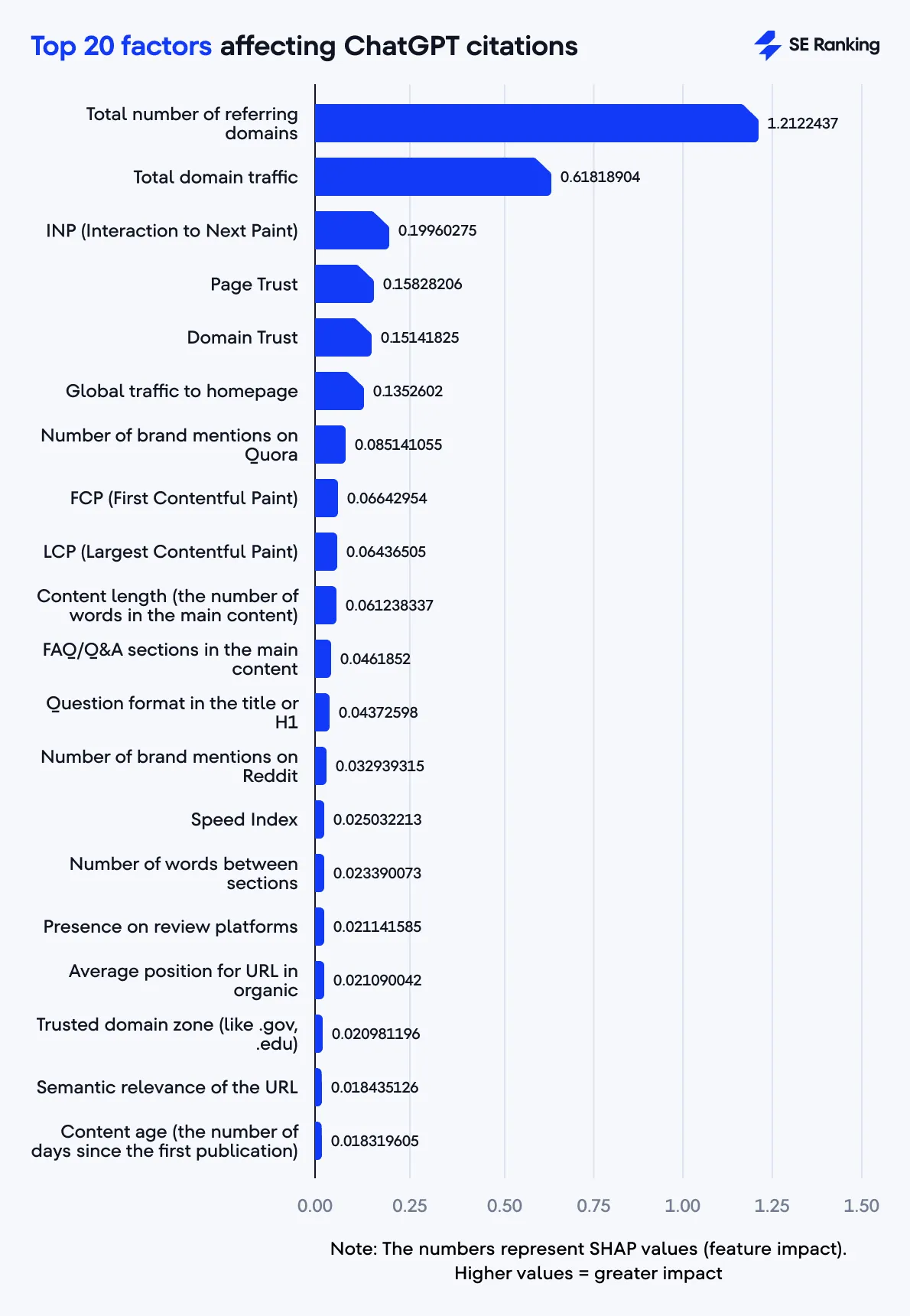
Backlinks are determined to be the strongest factor for ChatGPT's citations. Sites with a high number of linking domains (RDs) always outperform weaker link profiles. Quantitative analysis demonstrates that the LLM ecosystem is not independent of the web graph. Link equity serves as a key signal of trust and authority, acting as a historical vote of confidence.
Factor 2: High Overall Domain Trust Score
Websites with high Domain Trust Scores (e.g., 90+) are nearly four times more likely to be cited. This quantitative result confirms that LLM requires strong, measurable evidence that the wider web trusts the source. This converts the abstract concepts of Experience, Expertise, Authority, and Trustworthiness (E-E-A-T) into a quantifiable metric that AI can use.
Factor 3: Significant Organic Domain Traffic
Domain traffic ranks second in importance. However, the analysis shows that a notable correlation only appears after the domain passes the threshold of 190,000 monthly visits, reaching an average of 8.5 citations for domains with more than 10 million visits. Traffic acts as a behavioral validation, indicating useful and satisfying content, a signal of sustained quality.
Factor 4: High Organic Google Ranking
The correlation between a URL's average ranking in Google organic search and ChatGPT citations is clear. This signal strengthens the symbiotic relationship between SEO and LLMO. If content performs well under Google's quality assessment, the likelihood of it becoming a source of LLM citations increases.
Factor 5: Contextual Relevance Is More Important Than Absolute Dominance
While authority is an input filter, LLM visibility depends more on contextual relevance and informational accuracy than on absolute authority. Absolutely high authority metrics (like high DR/DA) may show a weak or negative correlation if the content is not contextually relevant to the query.
Quantitative Impact of Authority Measure on ChatGPT's Citation Rate (List Comparative Analysis)
Referring Domains (RDs):
Lowest range (Under 2,500 RDs): Average 1.6 - 1.8 citations citations.
Highest Range (Over 350,000 RDs): Average 8.4 citations.
Citation Impact Power: Strongest Correlation (Primary Filter).
Citation Impact:High Correlation (Behavioral Confirmation).
Natural Google Ranking:
Lowest range (Positions 64–75): Average 3.1 citations.
Highest range (Positions 1–45): Average 5.0 citations.
Citation Impact Power: Correlation Strong (Quality Representative).
III. Trust Multiplier: E-E-A-T and External Validation (Factors 6-10)
AI models look for external signals to prove a site's actual authority and reputation. These elements provide essential social proof for LLM.
Element 6: Provable E-E-A-T Signals and Case Studies
E-E-A-T (Experience, Expertise, Authoritativeness, and Trustworthiness) is the core foundation on which AI systems evaluate trustworthiness and authority. Authority in the AI era extends beyond the website: it requires content to be anchored in official guidance, then supplemented with unique research and expert videos.
Integrating Real-Life Evidence (Case Studies): In professional fields, analyst firms and experts sharing case studies of real-world testing and results are often identified by the LLM as a source of authority. Bringing in experts to write or review, cite research, and keep content fresh is indispensable.
Author transparency is an important credibility criterion, requiring the author's name, biography, or contact information to be provided.
Factor 7: Community Validation through Mentions on Reddit and Quora
Domains that are mentioned a lot on Reddit or Quora are 4 times more likely to be cited. AI seems to consider community discussions and reviews as strong trust signals. This shows that LLM recognizes that influential communities like Reddit host authentic, in-depth discussions.
Factor 8: Presence on Industry Review Sites and Directories
For transactional or B2B queries, presence on sites like G2, Capterra, and Trustpilot tripled the chances of being cited. AI synthesizes educational content with peer reviews to form comprehensive insights.
Factor 9: Frequency of Updates and Freshness of Content
Newly updated content (within 3 months) almost doubles the chance of being cited. This is critical to addressing the Factual Accuracy challenge facing LLM. AI models need proof that the content is not only historically accurate but also trustworthy today.
Element 10: Transparency about Ownership and Funding
Transparency is an important credibility criterion that LLM attempts to infer. Especially for "Your Money or Your Life" (YMYL) topics, clear disclosure of ownership and funding helps reinforce the underlying Trustworthiness signal.
IV. Structuring Content for Easy LLM Extraction (Elements 11-15)
These elements focus on optimizing content for machine parsing, ensuring accuracy and least-friction truth extraction.
Element 11: Implementing Answer Capsules Capsules)
Answer capsules are the strongest commonality on the site, appearing in 72.4% of cited posts. These capsules are often placed immediately after the title, providing a direct, confident statement and prioritizing the truth. It's important to minimize linking within this capsule text — especially omitting internal and external links — as this correlates with higher referral rates from ChatGPT.
Factor 12: Highlight Original and Owned Data
Original data or brand-owned insight is the second strongest differentiator, appearing in 52.2% of cited pages. In a content-saturated landscape, exclusive insight minimizes duplication and maximizes citation potential because it validates the content's unique value and expertise. To optimize complex data extraction, using explicit data structures (such as JSON schema) can significantly reduce extraction errors.
Factor 13: Comprehensive Content Depth (Long-Form)
Long-form pages, over 2,900 words in length, attract significantly more citations (5.1x vs. 3.2x for shorter content). Long-form, in-depth content allows LLMs to synthesize information from diverse evidence, supporting "deep dive" tasks that require detailed, rigorous attribution.
Factor 14: Optimal Body Length, Hierarchical Structure, and Question-Like Titles
Clear structure helps page interpretation models and significantly boosts citations. Specifically, content sections (word count between headings) between 120–180 words in length performed best, driving citations up 70% compared to extremely short sections.
Leverage Question-Form Titles and Focused FAQs: LLM looks for concise, accurate answers that match the user's query.
FAQ Strategy: Only add FAQs to high-intent pages or places that can address key pain points.
Short: Make sure your answer is short, to the point, and useful.
Element 15: Data Format (Lists and Tables)
The use of numbered lists (when order is important) and bulleted lists (when order is less important) is necessary. Similarly, tables should be used to compare multiple data points. Structured formatting improves the likelihood that content will be processed systematically by LLM document parsing tools.
Content Optimization vs. Citation Objective (Comparative List Analysis)
Answer Capsules (Answer Capsules):
LLM Optimization Objective (AIO): Maximize Direct Response Extraction and Aggregation.
Supporting Mechanism/Data: 72.4% of articles cited use; Minimum link priority.
Citation Impact: Extract High Confidence.
Owned Data:
LLM Optimization Objective (AIO): Provide Unique, Verifiable Claims of Fact.
Supporting Data/Mechanisms Support: 52.2% of cited articles contain exclusive information.
Support:Optimal length 120–180 words; clear hierarchy.Citation Impact: Low Friction Processing.
Data Format:
LLM Optimization Objective (AIO): Ensures Less Ambiguous Detail Extraction.
Supporting Mechanism/Data: Conciseness in listing books/boards; clear title.
>2,900 highly cited words.Citation Impact: Comprehensive Scope.
V. LLM Technical Hygiene and Crawlability (Factors 16-18)
These are the operational requirements necessary to ensure LLM crawlers can access and perceive the site as high quality.
Factor 16: Page Speed and Core Web Vitals (INP, LCP, CLS)
Page load speed has a big impact on a website's AI visibility. A website that loads slowly is considered less authoritative and less likely to be cited. Poor speed can prevent AI models from fully indexing content when performing web scraping. Optimizing Core Web Vitals (LCP, INP, CLS) is fundamental, as they are the core ranking factors that AI systems look for to reward great user experiences.
Element 17: Clear Site Structure and Crawling Ability
LLM Visibility requires a solid technical foundation. This includes maintaining a clean, logical site structure with clear hierarchies, a comprehensive XML sitemap that is updated regularly, and no technical barriers (like excessive bot blocking) that might hinder AI crawlers.
Element 18: Mobile Optimization and HTTPS Security
Mobile optimization and HTTPS security are required platform standards. Deficiencies in these factors signal low levels of trust and poor user experience, immediately disqualifying the source from high-quality AI assessments.
VI. Distinguishing Strategy from Rumor and Prefix Hygiene (Elements 19-20)
An effective LLMO strategy requires focusing resources on factors that have real impact, while ignoring tactics that have proven ineffective.
Element 19: Ignoring LLMs.txt and Schema General FAQ General
SE Ranking's research shows that the LLMs.txt file, a file recommended to guide AI crawlers, has no impact. Major AI services, including Google, OpenAI, and Anthropic, do not use this protocol, making it ineffective. Similarly, FAQ schema markup shows limited correlation with citations. This reinforces the point that LLM relies on natural language processing and sophisticated content structure (Element 14), not simple directives or markup to extract answers.
Factor 20: Avoid Over-Optimization (Title, URL) and Prefix (Meta) Optimization
Over-optimization of URLs and titles can harm citations, as AI prioritizes clear topic signals over keyword stuffing. Excessive keyword manipulation, designed for legacy pattern matching algorithms, signals lower quality and hinders LLM's ability to confidently extract core topics.
Prefix Optimization (Meta Tags, Keywords, Excerpt):
Meta Keywords Tags: Completely ignored by modern AI systems, similar to how they are ignored by Google, and does not benefit LLMO.
Meta Description (Excerpt): Although not a direct citation factor, a clear, compelling description helps improve click-through rates (CTR) from traditional search results, thereby indirectly supporting Traffic (Factor 3), a trust signal that AI values.
Title and URL: Focus on clarity, brevity and contextual relevance.
VII.A. 20-Point LLM Citation Checklist (Nested List)
Strong Authority (Trust Foundation)
Backlink Profile Strength (RD Count)
High Overall Domain Trust Score
Significant Organic Domain Traffic
High Organic Google Ranking Positions (Representative)
Optimizing Contextual Relevance
E-E-A-T Signals (Expert, Case Study)
External Validation (Social Proof)
Author Transparency
Community Validation via Reddit/Quora
Presence on Industry Review Sites
Transparency about Ownership and Funding
Content Accuracy (Extractability)
Implementation of Answer Capsules
Marking Original and Proprietary Data
Comprehensive Content Depth (>2,900 words)
Optimal Content Structure & Question-Format Titles
Data Format (Lists and Tables)
Technology & Novelty (Transportation Hygiene Action)
Updating Physical Content (Refresh Cycle)
Page Speed and Core Web Vitals (INP/LCP)
Clean Site Structure and Crawlability
Mobile Optimization and HTTPS Security
Strategic Focus (Refutation of Rumors)
Avoid Over-Optimization & Prefix (Meta) Optimization
VII.B. Post-Cite Conversion Optimization
LLMO's ultimate goal is to drive valuable traffic to your website and convert them. ChatGPT citations place your brand in a highly reputable position. Therefore, it is essential to optimize the landing page for the user's next journey.
CTA Strategy:
Clear CTA: While AI often cites unlinked direct content (answer capsules), the rest of the page should have well-designed CTAs (e.g. "Download Full Report" or "Request Free Consultation") to lead users from awareness to action.
Importance of Landing Page Experience: Make sure the landing page meets technical factors like Core Web Vitals (Factor 17) and Mobile Optimization (Factor 19) so as not to lose the trust that AI quotes have created.
VIII. The Future of LLMO and Strategic Investment (Enriched Conclusion)
Data analysis from a study of 129,000 domains shows that winning ChatGPT citations is not a quick "AI trick". Instead, it's the result of consistent application of Web Quality fundamentals, underpinned by LLM-specific Trust and Contextual Accuracy signals. ChatGPT's citation model has increased source diversity by approximately 80% in just a few months, showing a trend of continuously improving user experience and output quality.
Strategic Investment Requirements:
Success in LLM Optimization (LLMO) requires orderly strategic capital allocation:
Prioritize Sustainable Authority:Allocate capital primarily to long-term, unfalsifiable factors (Factors 1-6) like quality link building and organic traffic growth.
Invest in Reputation Signals Real:Integrate dialogue marketing and reputation management strategies (Elements 7-10). An active presence on Reddit, Quora, and industry review sites is social proof that AI trusts.
Enforce Content Structure Standards: Invest in editorial processes that ensure accuracy and extractability (Elements 11-15), including training writers on answer capsule formatting, use of proprietary data, and optimal paragraph structure.
LLMO's ultimate goal is to be a trusted source of information, up-to-date, and is so perfectly structured that LLM chooses it with the utmost confidence. Consistent compliance and investment in these pillars will ensure that your website not only ranks high on Google, but also ranks in AI answers, providing a major competitive advantage to businesses seeking sustainable growth, as Tan Phat Digital has been doing through its focus on quality. absolute quality and authority.
Share