PART I: B2B STRATEGY FOUNDATION – THINKING FROM CONTENT TO CONVERSION
1.1. The Modern B2B Market Landscape: The Shift from Creation to Transformation
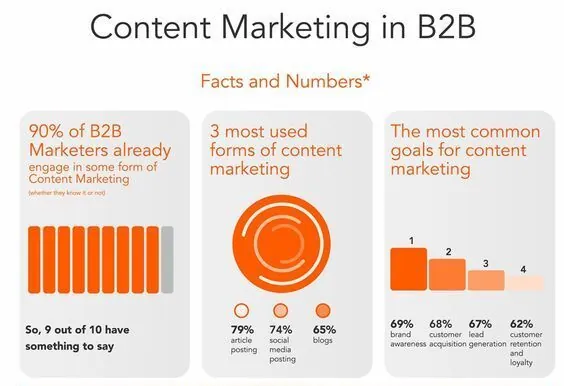
In an increasingly complex business-to-business (B2B) environment, content is no longer just a support tool but has become a strategic asset. The core differences between B2B and B2C lie in the long sales cycle, the involvement of multiple decision makers, and the high need for logic and data to prove investment effectiveness. B2B customers often consume large amounts of in-depth material; According to surveys, 71% of B2B marketers say they download and consume multiple content assets to support the decision-making process.
In terms of return on investment (ROI), Content Marketing has proven to be cost-effective, generating three times more leads than traditional marketing methods and requiring up to 62% less costs. However, the biggest challenge for B2B managers is how to measure and prove the specific ROI of content, while attracting high-quality leads. This requires a data-driven content strategy and clear conversion goals.
1.2. 5-Step Framework for Building a B2B Content Strategy: From ICP to Process Optimization
An effective B2B content strategy starts with a deep understanding of your target audience, built through five fundamental steps:
Understanding Your Target Audience:The foundation of every successful strategy is an understanding of your customers' unmet needs and real problems customers.
Choose Format and Distribution Channel: Decide on core format (video, blog, ebook) and appropriate channel (SEO, email, LinkedIn) based on customer information consumption behavior.
Develop Content Themes: Develop problem-solving topics by surveying customer challenges, researching keywords, and performing content audits to fill gaps content in each stage.
Systematize the Production Process: Establish a clear process from ideation, writing, approval, SEO optimization, to distribution to ensure performance and speed of implementation.
Measure Performance and Optimization: The ability to analyze data is vital to determine which content is performing well and needs to be replicated, or which content needs tweaking Adjust to optimize conversion rates.
Distinguishing between ICP and Buyer Persona: B2B platform requirements
In a B2B context, identifying a target audience needs to go deeper than the individual level. The modern strategic framework requires a clear distinction between two concepts:
ICP (Ideal Customer Profile): Is the ideal company profile that the business wants to serve, based on firmographic data, industry, scale, and potential to create the highest value. ICP is the first step to identifying high-value customers and aligning strategic marketing efforts.
Buyer Persona: Focuses on specific individuals within the target company (decision makers, influencers), describing their motivations, pain points, and behaviors. Persona is built within the ICP framework to personalize messaging and content, helping to develop more specific messaging and content.
An effective B2B content strategy must use ICP for strategic targeting (determining which companies to reach) and Buyer Personas for content personalization (which messages will drive action).
1.3. Digital Platform: What Unlocks Conversion Performance
The success of the 21 tactics presented below depends on a solid digital foundation. A B2B website is not just a place to display information but must be a digital platform optimized for sustainable development.
Tan Phat Digital and B2B Website Standards
Businesses operating in the fields of technology, industry, and specialized services need a professional website platform, ensuring SEO standards, excellent user experience, and a logical information architecture. Optimizing existing systems for better business performance is a foundational cost to maximize the performance of all SEO and conversion efforts. Specialized units like Tan Phat Digital with expertise in SEO standard website design play an important role in building this platform architecture, especially to support advanced SEO strategies like Topic Cluster (Tactic 16).
The Empathy-to-Logic Bridge
While B2B purchasing decisions are logical and driven by ROI, the journey leading to that decision is driven by empathy. B2B content must both use specialized language to create trust and authority (Authority), and must be able to simplify advanced and complex concepts, written at the most understandable level possible without losing professionalism. The goal is for busy executives to quickly grasp core issues without wasting time.
PART II: OPTIMIZING THE CONVERSION JOURNEY (FUNNEL MECHANICS)
Tactic 1: Personalize the Behavior-Driven Nurturing Journey
Personalization is a key trend in B2B 2025, when buyers expect customized experiences. This tactic isn't just about using a first name, it's about using behavioral data (First-Party Data) to deliver the right content at the right time. Supporting tools like Braze (for engagement strategy) and Valona (for content creation) can help analyze and automate content distribution. The main benefit is increased email open and click rates, improved Conversion Rate (CVR) due to communication content at the right time of peak interest.
Tactic 2: Speed-to-Lead Optimization
In B2B, speed of response is vital. The time between when a lead expresses intent to purchase and when the Sales team responds must be optimized. Businesses need to set up smart lead handover triggers, especially when customers perform BOFU (Bottom of Funnel) actions such as filling out a consultation form, downloading comparison documents, or visiting the quote page multiple times in a short period of time. MQL-to-SQL Conversion Rate is the most important indicator to measure the effectiveness of the nurturing and synchronization process between Marketing and Sales.
Tactic 4: Build Content that Solve Problems by Stage and Segment (Content Mapping Mastery)
For content to be highly effective, each asset must be designed to solve the right problem, at the right time for the right person, corresponding to each stage in the buying journey (Buyer’s Journey):
Content Analysis B2B according to the Conversion Funnel (Mapping Matrix)
1. Awareness Phase (Top of Funnel - TOFU):
Main Objective: Evoke problem awareness, educate the foundation.
Suitable Content Format: Education Blog (How-to, foundation), Infographics, Basic Ebook.
Content Example: “Why small businesses need a system CRM?”
2. Middle of Funnel (MOFU):
Primary Goal: Help customers evaluate and compare solutions.
Appropriate Content Format: Checklist Evaluation, In-depth Whitepaper, Analytical Webinar, Comparison Article.
Example Content: “Checklist of 10 selection criteria Choose accounting software”
3. Decision Making Stage (Bottom of Funnel - BOFU):
Primary Goal: Convince action (buy, sign up, trial).
Appropriate Content Format: Case Study, Guided Demo/Trial, ROI Calculator, Custom Quote.
Content Example: “Company Ways” ABC increased ROI 233% after implementing solution XYZ”
PART III: CREATE HIGH-VALUE ASSETS
Tactic 7: Upgrade Content with Contextual Gated Content Upgrades
Gated content upgrade (highly relevant in-depth material embedded directly in the article) is one of the methods The most effective method to increase conversion rates. Unlike generic lead magnets, this upgraded document addresses the reader's context needs, providing additional value right at the moment they are most interested in the topic.
Application formats should be accessible and provide immediate "use value," like quote templates, planning forms, or internal review question sets. This high level of relevance ensures a significant increase in lead capture rates, while reinforcing the brand's expert status by providing practical support tools.
Tactic 8: Instructional Case Studies - Combining Testimonials and Education (Instructional Case Studies)
B2B case studies should be restructured into how-to stories, diving into the process of applying real-world solutions, rather than just a description of achievements. A strong case study often follows a three-action structure (challenge, detailed implementation solution, measurable results).
The convincing factor in case studies lies in combining storytelling with real data: improvement metrics, implementation time, and analysis of overcome mistakes. Instead of just stating the end result, making the process transparent helps potential customers visualize how the solution might apply to their own situation, increasing authenticity and credibility.
Strategy 9: Practical Resources: Forms, Calculation Tools, Actionable Toolkits
B2B customers appreciate highly practical content, helping them save time and easily apply it immediately to their work. Practical resources provide "use value" rather than just "information value."
ROI Calculator
The ROI Calculator is the ultimate BOFU asset. It forces users to quantify the value (Return) that the product/service brings compared to the cost (Price) they have to pay. Building this tool not only provides extremely high purchase intent data to the Sales team but also builds trust based on financial logic. For example, if a marketing solution generates $500,000 in revenue at a cost of $150,000, the ROI is 233% ($2.33 earned for every $1 spent). This tool helps clearly quantify this potential value.
PART IV: DOMINATE SEARCH CHANNEL AND STRUCTURE (SEO AND AUTHORITY)
Tactic 5: Optimize YouTube Video SEO - Exploit Potential Search Channel
YouTube, the world's second largest search platform, is a lead generation channel effective and sustainable for B2B. Videos should focus on intent-based keywords such as product comparisons, feature tutorials, or analysis of common mistakes. This strategy helps expand search channels beyond traditional Google and strengthen brand credibility through consistent, visual content.
Tactic 6: Create Content that Targets Competitor Brand Keywords (Competitor SEO Strategy)
Targeting competitor brand keywords is a tactic to reach customers who are very close to the decision-making stage, clearly showing the intention to find alternatives. Content should be written in the form of an objective comparison, detailed analysis of pros and cons, and focused on highlighting the competitive advantage of your solution. The key is to maintain objectivity, focus on real value, avoid attacks to build persuasion.
Tactic 16: Build a Topic Cluster/Pillar Content Library
In the context of B2B SEO, Google increasingly values strict and systematic content structure. Topic Clusters (including Pillar Content and satellite Content Clusters) is a model to build strong Domain Authority (DA), helping to increase the chances of reaching the top for many long-tail keywords. This tactic helps readers easily discover and connect with information, and improves page retention time.
For Topic Cluster to operate effectively, the website infrastructure must have the correct information architecture. Tan Phat Digital's expertise in SEO standard website design is very important to build this structure, ensuring internal linking is optimized, thereby supporting simultaneous rankings for keywords in the same topic cluster.
Tactic 20: Update Old Content (Content Refresh) - Maintain Authority Status
Optimizing content that has performed well is often more effective and cost-effective than creating new articles. The Content Refresh strategy helps Google understand that the page is still active and provides current valuable information. Businesses should update at least 30-50% of the content, add new data, trends, practical examples, and compare with the top results to ensure it matches search intent. The benefit is to increase rankings quickly and take advantage of existing backlinks and traffic, maintaining credibility as a source of up-to-date information.
PART V: DIFFUSION OF TRUST AND THOUGHT LEADERSHIP
Strategy 3: Take advantage of Employee Advocacy
Content shared by the team HR is a highly reliable form of User-Generated Content (UGC), creating a distributed viral network that is less dependent on advertising budgets. Instead of forcing sharing, businesses should train employees to build personal brands based on actual expertise.
To measure the success of Employee Advocacy, it is necessary to track KPIs beyond Reach and Engagement Rate, including Earned Media Value (EMV) and Social Selling index (LinkedIn SSI) to quantify the ROI of this spread.
Tactic 12: Diffusion of Content through Digital PR - Expand distribution channels beyond the business's platform
High quality content needs to be distributed through community-based platforms, such as industry newspapers, partners, or professional platforms. Publishing professional articles under the name of business leaders (Bylined articles) on reputable platforms is an effective way to increase credibility through third-party validation. This tactic helps content reach new audiences and create high-quality backlinks.
Tactic 17: Organize Online Events with Intent-Based Webinars
Webinars or online seminars are still effective lead generation tactics when the content is in-depth enough and directly addresses urgent problems (Addressing Pain Points) of target customers. Online events are one of the top strategies that B2B marketers plan to deploy. A successful strategy should focus on sharing experiences, practical processes from experts, and reusing event content into many different formats to increase lifecycle.
Tactic 19: Exclusive Research - Create Long-Term Pervasive Media Assets (Original Research)
Conducting exclusive research, mining data from your own customers or markets, is a sustainable way to differentiate and build Thought Leadership status. Exclusive reports help the brand become the main source of information cited by the media and specialized blogs.
Exclusive research has a dual impact: enhancing Thought Leadership and creating natural Backlinks, significantly improving Domain Authority. This content also drives strong Demand Generation, as 55% of B2B buyers highly value and regularly consume this type of research content when evaluating purchasing decisions.
PART VI: MAXIMIZE PERFORMANCE AND MEASUREMENT (PERFORMANCE OPTIMIZATION)
Tactic 10: Deploy Smart Pop-ups Based on User Behavior
Pop-ups are still a powerful conversion tool, but need to be personalized so as not to be annoying. Effective pop-ups should only be displayed when truly relevant to the user's behavior, such as displaying a trial invitation form (BOFU) only when the user visits the pricing page, or views 3 or more product pages in the same session. Pop-ups play a role in supporting the conversion journey rather than disrupting it.
Tactic 11: Create Concise, Shareable Educational Content
In a busy B2B user landscape, breaking down expert information into simple, digestible formats (short 30-60 second videos, data summary graphics, LinkedIn mini-series) is an effective social media approach. Even though it is brief, the content still needs to ensure professional depth and always be linked to a full article or resource to lead viewers to deeper learning.
Tactic 13: Behavioral Retargeting Ads
Retargeting ads in B2B need to be segmented by behavior and level of interaction. New visitors should be approached with branded content, while those who have downloaded in-depth material should be retargeted with demo ads, consultation forms, or case studies related to their industry. Segmentation aligns ad content with actual demand, increasing ad effectiveness and reducing conversion costs.
Tactics 14 & 15: Promote Proven High-Converting Assets
The strategic principle is to optimize ad budgets by only spending on assets that have good internal CVR data (Proven Assets).
- brings in the most leads, email signups, or document downloads through channels like Facebook, LinkedIn.
Tactic 18: Content Collaboration with Brands or Industry Experts
Content collaboration (co-creation) with non-directly competing peer brands (e.g., accounting software and tax consulting services) or independent experts is an opportunity to Expand your followers, share your reputation, and produce more in-depth content. This tactic increases spread thanks to multiple distribution channels and enriches content through many practical perspectives.
Tactic 21: Reusing Content into Many Formats (Content Repurposing)
Reformatting content is a strategy to optimize production costs and ROI. A core content idea can be transformed into many different versions: turning blog posts into presentation slides, infographics, instructional videos, or email series. This tactic helps the brand have a consistent presence on multiple platforms, increasing the lifecycle and investment performance for each content produced.
In-depth B2B Content Marketing ROI Measurement Framework
Measuring ROI in B2B is complicated due to long sales cycles and multiple touch points. Marketers need to focus on KPIs that reflect direct contribution to the pipeline and revenue (Marketing Sourced/Influenced Revenue).
Content Marketing Measurement Framework Contributing to the B2B Pipeline
1. MQL-to-SQL Conversion Rate (MQL to SQL conversion rate):
Definition: The rate at which Marketing Qualified Lead (MQL) converts to Sales Qualified Lead (SQL).
Measurement Objective: Effectiveness of nurturing process and Marketing-Sales alignment.
Strategic Impact: Refine lead criteria and handover process.
2. Content Attributed Revenue:
Definition:Direct or indirect revenue generated from specific content assets.
Measurement Objective: Actual financial contribution of each content asset.
Strategic Impact: Demonstrate ROI and optimize effective content budgets.
3. Customer Acquisition Cost (CAC - Customer Acquisition Cost):
Definition:The marketing and sales cost of acquiring a new customer.
Measurement Objective:The overall cost performance of the content strategy.
Strategic Impact:The objective is to reduce CAC by optimizing lead conversions.
4. Engagement Rate (UGC/Advocacy Content):
Definition: Engagement rate (likes, shares, clicks) on content shared by employees/users.
Measurement Objective: Brand trust and natural spread.
Strategic Impact: Determine the EMV (Earned Media Value) of the Employee Advocacy program.
Data and Tools Integration (MarTech Integration)
To measure complex KPIs such as Content Attributed Revenue and MQL-to-SQL CVR, businesses need a powerful integrated MarTech system (CRM, Marketing Automation). Core conversion tactics like Personalization (Tactic 1) and Lead Handoff (Tactic 2) rely entirely on the ability to sync data between these systems.
PART VII: FREQUENTLY ASKED QUESTIONS (FAQs)
Q1: Is B2B Content Marketing more expensive than B2C? A: Content Marketing B2B in terms of initial production costs may require more diligence, but in the long run, it costs 62% less than traditional marketing and generates three times as many leads. B2B ROI is often more complicated to measure due to longer sales cycles, but lifetime customer value (LTV) is often higher.
Q2: Should priority be given to creating TOFU (awareness) or BOFU (decision making) content? A: The best strategy is balance. TOFU content (like a basic blog) helps build an SEO foundation, attract broad traffic, and create authority. BOFU content (like Case Study, ROI Calculator, Demo) has the highest purchase intent, helping to shorten the sales cycle and convert leads into customers quickly.
Q3: How are ICP (Ideal Customer Profile) and Buyer Persona different in Content Marketing? A:
ICP is the ideal company profile (industry, size, revenue). ICP helps you with strategic targeting (determining which companies to approach).
Buyer Persona is the person profile within that company (position, challenges, motivation) . Persona helps you personalize content and messaging to drive action.
Q4: What is the role of Tan Phat Digital in optimizing Content Marketing strategy? A: Tan Phat Digital specializes in professional website design with SEO standards. The role of this unit is to build a solid digital infrastructure, ensuring information architecture (such as Topic Cluster) is optimized. This is fundamental to maximizing the SEO and conversion performance of every B2B content asset deployed.
B2B businesses cannot build sustainable advantages if they ignore content marketing - an increasingly vital factor in a volatile and highly competitive market. These 21 tactics chart a path from building a solid digital foundation (with the expert support of agencies like Tan Phat Digital in optimizing websites for SEO and content structure), to focusing on high-value conversion assets (Case Studies, ROI Calculator, Proprietary Research) and finally diffusing authority through external channels (Digital PR, Employee Advocacy).
Content).
Content B2B marketing is an integrated process between data, strategic thinking and flexible creativity. Businesses that grasp these principles will create a sustainable content ecosystem, drive organic growth and connect more effectively with target customers, transforming content from a support cost into a measurable revenue-generating asset.
IT'S TIME TO CONVERT CONTENT INTO ACTUAL REVENUE.
If your business is having difficulty measuring content ROI, optimizing MQL-to-SQL conversion rates, or needs to build a solid SEO standard website platform to support a complex Topic Cluster strategy, please:
Contact our team of experts immediately for free and in-depth B2B Content Marketing strategy consultation.
(Or: Contact Tan Phat Digital to optimize the website platform, ensuring all your SEO efforts bring the highest conversion performance.)
Share