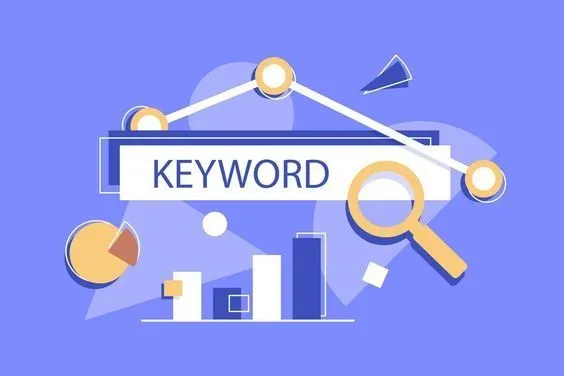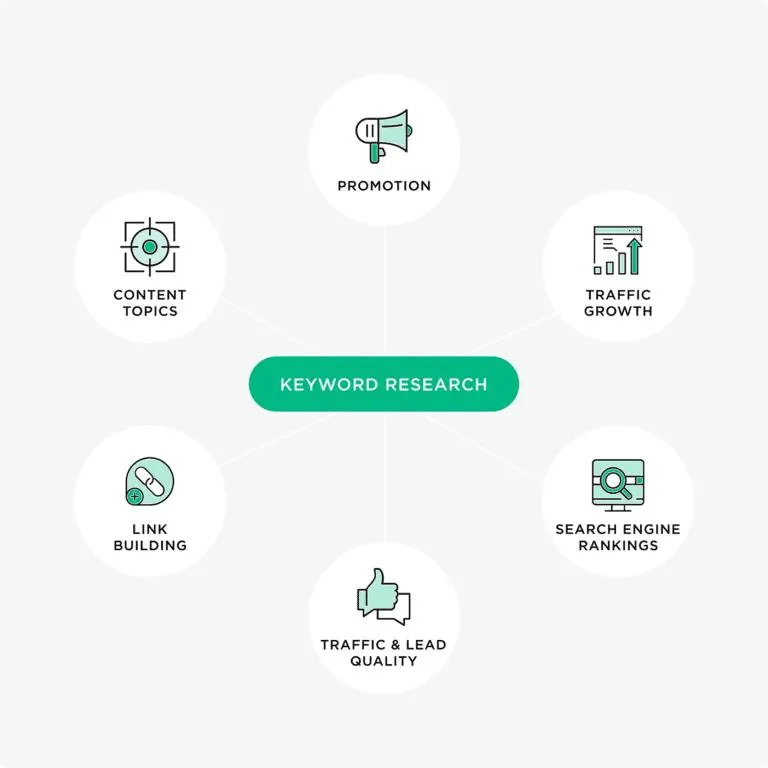
In-depth keyword research is the process of building a customer needs map based on data, not just a list of phrases. It requires a combination of dry data analysis and a deep understanding of user behavior.
This document presents a 6-stage process, diving into the techniques that leading agencies like Tan Phat Digital use to ensure every content campaign delivers the highest ROI (Return on Investment).
I. FOUNDATION PHASE: ESTABLISHING THE SEMANTIC ARCHITECTURE AND SEED KEYWORDS
1. Building a Topic Cluster Architecture
The Topic Cluster model helps strengthen Topic Authority, a core element of Google's E-E-A-T algorithm.
Pillar Content:
Targeting Short Tail Keywords (Short-Tail) or medium.
Has Broad Informational or Commercial Intent, acting as a Hub containing general, in-depth content.
Mainly links to Cluster pages and other Pillars.
Cluster Content (Supporting Content) support):
Target Long-Tail Keywords, with very specific Intent (questions, detailed instructions).
Cover every small aspect of the Pillar topic, providing detailed information that users seek.
Always link back to the Pillar Article via Internal Link, reinforcing credibility for Pillar Content.
2. Advanced Seed Keywords Mining
These are techniques that help you find hidden, high-converting potential keywords that your competitors have not yet exploited.
Reverse Engineering PPC Technique:
Use SEO tools to find keywords that your competitors are running on Google Ads.
Keywords with high CPC (Cost Per Click) are often the transactional keywords with the highest conversion rates. You can use Organic content to "steal" this traffic for free.
Analyze Voice Search and Conversational Keywords:
Search for queries with a natural question structure (“how to…”, “what is the best tool…”).
This is a treasure trove of tail keywords long (usually > 5 words), extremely clear Intent, easy to rank by answering directly in the FAQ or H2/H3 title.
Data Mining from Customer Support Channel:
Extract data from Chatbot logs, support emails, and Live Chat FAQs.
Repeat customer questions are the most realistic Pain Points, helping you identify keywords that have a high match with your product/service.
II. CORE PHASE: IN-DEPTH DECODING SEARCH INTENT
Understanding Intent is imperative so you can produce the content Google wants to see.
1. The 4 Types of Search Intents This is the Know stage in the funnel.
Keyword Signs: Contains words like “what”, “how to”, “why”, “how to”.
Optimal Content Type: Blog Posts, Guides, Infographics, Videos Tutorial.
Navigational Intent:
Intent: User wants to visit a specific website (Go Phase).
Keyword Sign: Contains Brand Name (“Tan Phat Digital website”), Specific product name (“Facebook login”).
Optimal Content Type: Home page, Contact page, Login/registration page.
Commercial Investigation Intent:
Purpose: The user is researching solutions, comparing options before making a decision (Do Research Phase).
Keyword Signs: Contains words like “assessment”, “comparison”, “review”, “top Pros: In-depth Reviews, Comparison Posts, Case Studies, Landing Page leading to Webinar/Demo.
Transactional Intent:
Intent: User is ready to take immediate action (Do Now Phase). These are keywords that bring direct conversions.
Keyword Signal: Contains words like “buy”, “price”, “quote”, “order”, “service”, “free download”.
Optimal Content Type: Product Pages, Category Pages, Landing Pages (Landing Pages) dedicated to conversion.
2. 3C In-depth Analysis (Content Characteristics)
3C analysis is a mandatory step after classifying Intent. It is done by analyzing the first 10 ranking results (Top 10 SERP Analysis).
1. Content Type:The overall appearance of Google's preference for that query.
Analysis Factors: Blog Page, Product Page, Category Page, Video, Forum/Reddit.
Action: If 8/10 results are Category Pages, you must create a Category Page; If you try to use Blog Post, the possibility of ranking will be very low.
2. Content Format:The structure and presentation of content within a page type.
Analytic elements: Step-by-step Guide, Listicle, Opinion Piece, Expert Review.
Action: If keyword “common SEO mistakes” returns 7/10 as Listicle, your content should also be a clearly numbered list.
3. Content Angle: Competitive advantage and unique highlight that content brings.
Analytic factors: Approach angle Cost saving, Fastest speed, Easy for newbies, Exclusive data (Original) Research).
Action: Your content angle must be different. For example, if all your competitors talk about “cheap SEO services”, you should use the “sustainable growth SEO services” angle to target quality.
III. IMPLEMENTATION PHASE: EXPAND AND REFINE THE LIST
After you have Seed Keywords and Intent, you need to expand to thousands of related keywords and filter them.
1. Expansion Techniques
Google Suggests and PAA (People Also Ask):The most effective and free source for finding related questions and queries that Google prioritizes.
Using Wikipedia and Glossary: Wikipedia Tables of Contents provide a detailed hierarchy of technical terms, a treasure trove of words LSI and Entity keys are important.
LSI (Latent Semantic Indexing) keyword analysis: Use TF-IDF (Term Frequency–Inverse Document Frequency) tools to find semantic terms that competitors in the Top 10 are using but you are missing. This helps increase the depth and comprehensiveness of the content.
2. In-depth Filtering Technique
Filtering out unfeasible keywords is very important to optimize resources.
Filtering by CPC/Intent: Prioritize keywords with High CPC (> $3) and low KD (< 20). These are BOFU/MOFU keywords that easily convert.
Filter by Parent Topic: Group long-tail keywords together based on their Parent Topic. This helps you create a single article that can rank for hundreds of query variations (Keyword Consolidation).
Filter by SERP Feature: Exclude keywords whose SERP is saturated by Video Carousel or News Box if you are not competitive on those platforms.
IV. PRIORITY PHASE: SELECTING WINNING KEYWORDS
Decide to invest resources based on a risk and potential matrix.
1. Analyze Volume and Traffic Potential (Volume vs. Potential)
Search Volume: A rough, misleading metric.
Traffic Potential: A more precise metric. It estimates the total traffic a page could receive if it ranked for all relevant Long-Tail and LSI keywords in that Topic Cluster. Always prioritize TP over Volume.
Organic Click-Through-Rate (CTR): Prioritize keywords whose SERPs are less occupied by Google's direct response features (e.g. Featured Snippet, PAA) so that organic CTR does not decrease.
2. Set up a 3x3 Priority Matrix
This matrix combines Business Value and Difficulty (Difficulty) to determine the order of action.
Classification by Difficulty (KD/Authority):
Low Difficulty (< 20 KD): Great opportunity for new websites or SMEs.
Medium Difficulty (20-40 KD): Need to invest in Internal Links and in-depth content (Pillar Content).
High Difficulty (> 40 KD): Should only be targeted after you have high Site Authority, need a strong Backlink and E-E-A-T strategy strong.
Classification by Business Value:
High Value (Transactional): Priority 1 (Immediate Production).
Medium Value (Commercial): Priority 2 (Lead Generation/Farming) maintenance).
Low Value (Information): Priority 3 (Building Authority and Cluster).
V. ADVANCED KEYWORD RESEARCH STRATEGY
To overcome major competitors and maintain growth, it is necessary to apply breakthrough strategies.
1. Barnacle SEO Strategy
Purpose: Take advantage of the reputation (Authority) of large platforms that you cannot compete with directly.
How to do it:
Optimize your business profile (Example: Tan Phat Digital) on Google Business Profile, LinkedIn, YouTube, and major review sites (Clutch, G2, industry forums).
When users search for “reputable SEO company”, they will see your quality profiles on those platforms, thereby driving high-quality traffic to the main website.
2. Semantic SEO (Semantic) and Entity Analysis
This is a technique that helps Google recognize you as a comprehensive subject matter expert.
Entity Analysis:
Ensure your content includes relevant Entities (people, places, concepts) that Google has identified in the Knowledge Graph (Example: Writing about SEO must address refer to Google Algorithm, John Mueller, RankBrain).
This helps increase E-E-A-T scores and content depth.
LSI Keyword Coverage and Synonyms:
Do not repeat main keywords mechanically. Use synonyms and LSI to avoid keyword stuffing.
This helps Google understand the context and broad topic you are talking about.
3. Advanced Content Gap Analysis
Content gap analysis goes beyond keyword comparisons.
3-5 Direct Competitors Analysis: Focus on competitors in the SERP Top 10, not just business competitors.
Identify Intent Gap: Look for keywords that competitors rank for with a content type (e.g. List), when you don't have any content of that type yet.
Focus on "Low Hanging Fruits": Identify keywords that emerging competitors are ranking for (usually Long-Tail, low KD) to attack quickly and effectively.
VI. TAN PHAT DIGITAL'S ROLE IN KEYWORD STRATEGY
Implementing advanced keyword research, especially Semantic SEO and Entity Analysis, requires in-depth tools and experience. Tan Phat Digital provides a comprehensive solution to turn your keyword list into a competitive advantage:
Intent Decoding and the 3Cs of Accuracy: We apply detailed SERP analysis models to ensure your content perfectly matches what Google requires, minimizing the risk of content mismatching Intent.
Building a Dark Semantic Architecture Advantages: Create detailed Keyword Mapping according to the Topic Cluster model, maximize the Internal Link power and Authority of the website.
Take advantage of PPC Mining Data: Exploit keywords with high Transaction Intent from your competitors' Paid Search campaigns, helping you dominate target customers with free Organic costs.
VII. FREQUENTLY ASKED QUESTIONS (FAQ) ABOUT IN-DEPTH KEYWORD RESEARCH
Q1: When should I start building Backlinks for a keyword?
A: You should only start building Backlinks when your content is fully optimized (Onpage & Intent) and is within the position range 11-30. Building Backlinks for incomplete content is a waste of resources.
Q2: How to distinguish between LSI and Entity?
A: LSI are words that are simply contextually related (for example: car -> wheels, engine, seats). Entity are concepts clearly identified by Google in the Knowledge Graph (for example: car -> Mercedes, Toyota, Tesla). In advanced SEO, Entity is preferred because it provides semantic clarity to Google.
Q3: Should I prioritize fixing technical errors (Technical SEO) or producing new content (Content Production) first?
A: Prioritize Technical SEO first. A faulty website platform (speed) Slow loading, poor Mobile-Friendly, Crawl errors) will limit the effectiveness of any Content Production effort, no matter how good your content is.
Keyword research is not a list of boring tasks, but a strategic process that helps you get into the minds of customers. Mastering Query Intent, 3C analysis, and applying advanced strategies like PPC Mining and Content Gap Analysis will be the deciding factor in your sustained growth.
Implementing these in-depth strategies requires patience, resources, and expensive toolsets. If you want to cut down on trial and error, and ensure every keyword is optimized for the highest conversions, consider seeking out an expert partner.
Let Tan Phat Digital help you transform dry keyword lists into revenue growth strategy maps details. Contact us today to receive in-depth advice on Topic Cluster and Content Gap Analysis.
Share