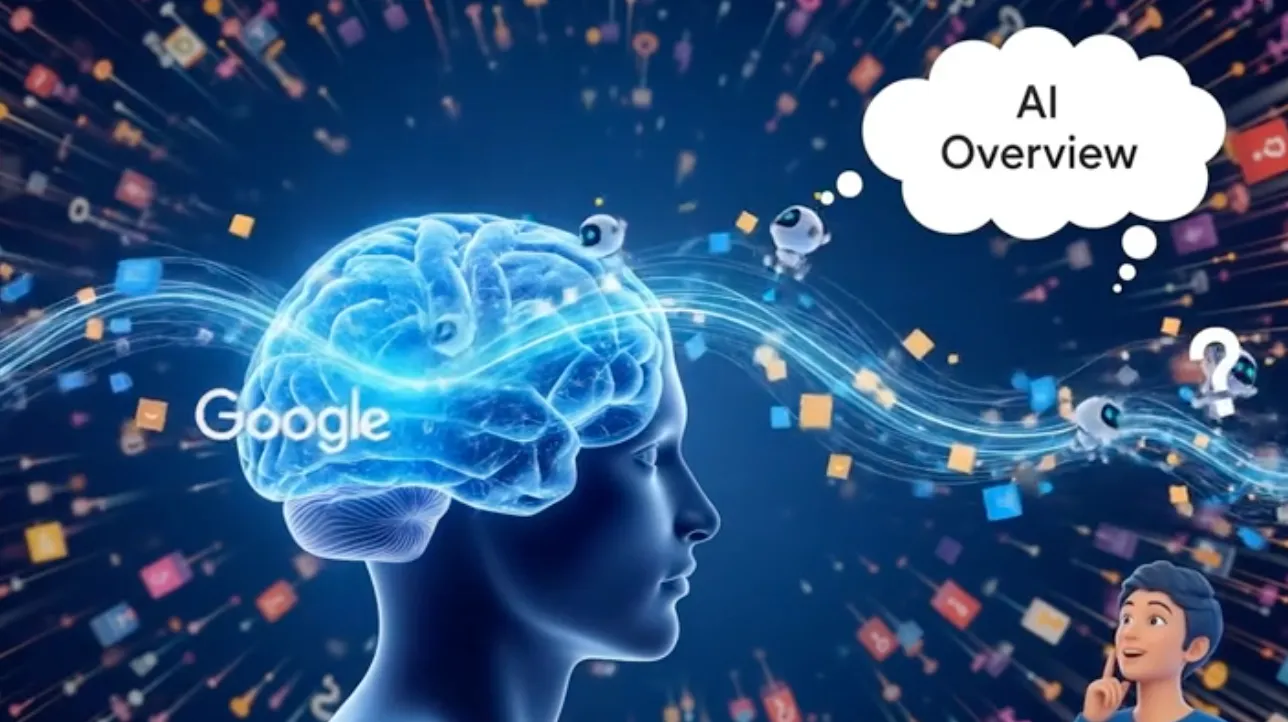
The development of generative artificial intelligence has led to a comprehensive restructuring of the way Google processes and distributes information. For decades, search engine optimization (SEO) has largely revolved around ranking green links on the search engine results page (SERP). However, a new reality has been established: Google is now operating multiple AI systems in parallel. According to observations from the team of experts at Tan Phat Digital, each of these systems possesses unique technical characteristics, data sources and user service purposes. Extensive research across 730,000 AI responses shows that appearing in one system does not guarantee presence in the other, with a citation duplication rate of just 13.7%. This separation forces us to change our thinking from "optimizing for an algorithm" to "building a presence in a knowledge ecosystem".
Technical architecture and operational goals of AI Overviews and AI Mode
To build an effective adaptive strategy, understanding the technical nature of these two systems is a prerequisite. AI Overviews and AI Mode are not different versions of the same tool, but solutions designed for completely different uses.
Comparing system features:
Display location: AI Overviews appears directly on the search results page (SERP), while AI Mode operates in a separate chat interface or dedicated tab application.
Interactivity: AI Overviews are static, one-time feedback; On the contrary, AI Mode allows multi-step dialogue and has the ability to remember contexts very well.
How it works: AI Overviews focuses on summarizing information from high-ranking pages. AI Mode performs multi-layer analysis through Query Fan-out technique.
Data source: AI Overviews are based on indexed data (Pre-indexed), while AI Mode flexibly accesses Live web, Knowledge Graph and real-time data streams.
User goal: AI Overviews serve quick lookups and grasp main ideas. AI Mode is for in-depth research, comparison and solving complex problems.
Underlying technology:AI Overviews uses Gemini speed-optimized version, while AI Mode is powered by Gemini Pro or Ultra with in-depth inference capabilities.
AI Overviews: Static summary and speed optimization
This system acts as an "AI journalist", scanning pages leading websites, identify key points and synthesize them into concise responses. The goal is to help users grasp the essence of the problem without having to make additional clicks. Its feedback is static and users can only interact further through Link Cards that lead back to the source.
AI Mode: Multi-step dialogue and research assistant
AI Mode represents a completely different search experience. At Tan Phat Digital, we realize AI Mode acts as a personal virtual assistant. The biggest difference is the ability to "maintain status" (stateful chat). The system not only relies on static data but also breaks down complex requests into dozens of sub-queries, performing simultaneous searches on many different sources to provide multi-dimensional answers.
Analyzing data separation: Why do the cited sources not match?
Although the two systems often reach agreement on content (86% semantic similarity), they cite completely different data sources. In fact, more than 80% of the time these two systems pull data from separate "knowledge stores".
Resource advantage between the two systems:
YouTube: Very high in AI Overviews, especially instructional queries; reaches the average level in AI Mode.
Reddit: Highly prioritized by both systems thanks to real opinions from real users.
Wikipedia: Absolutely dominates in AI Mode (nearly 29%), while in AI Overviews is only average.
Specialized pages (Medical, Law): Frequently used AI Mode quotes (twice as much as AI Overviews) to ensure high accuracy.
Quora: AI Mode uses this source 3.5 times more than AI Overviews to find in-depth discussions.
Display format: AI Overviews prioritize visual displays (video/images), while AI Mode focuses on detailed text and strong arguments.
The Semantic Revolution: Semantic Goes Beyond Keyword
Semantic similarity of up to 90% sends a powerful message: Google has perfected the ability to understand content at the conceptual level. At Tan Phat Digital, we always emphasize that precise keyword stuffing no longer provides a competitive advantage.
Understanding Entities and Context
Google's AI now works on entities and the relationships between them. For example, when searching for "real estate SEO", AI will analyze a network of concepts such as buyer behavior, local SEO, project legality and investor reputation. If the content logically covers these entities, the website will be considered a Topical Authority.
Multi-channel adaptive strategy from Tan Phat Digital
Operating two different systems requires a multi-layered content strategy. You cannot use a single article for both fronts.
Multi-objective optimization roadmap:
Content length: AI Overviews need to be short and concise (300-500 words). AI Mode requires expertise and comprehensiveness (over 1,500 words).
Article structure: Prioritize Bullet points and FAQ for AI Overviews. With AI Mode, it is necessary to analyze multi-dimensionally and build topic clusters (Topic clusters).
User-oriented: AI Overviews meet the intent of quick search (Know-simple). AI Mode serves the needs of research and comparison (Research/Comparison).
Key factor: AI Overviews need quick extraction ability (Extractability). AI Mode requires authority and completeness (Authority/Completeness).
Optimize for AI Overviews: Short, Intuitive and Actionable
To reach "position zero", Tan Phat Digital recommends that you apply the rule "answer first, explain later". Put your answer concisely in the first 2-3 lines and use ordered ($OL$) or unordered ($UL$) lists to make it easy for the AI to extract data.
Optimize for AI Mode: In-depth, Competent, and Encyclopedic
For AI Mode, the goal is to be a trusted reference source. Build comprehensive Pillar Pages and proactively link with reputable external entities to increase the trust score (E-E-A-T) for your content.
The role of Schema Markup and Entity SEO in the AI era
Schema Markup is the "native language" to talk to AI. It helps eliminate ambiguity by precisely identifying entities such as products, professionals or organizations.
Prioritized Schema Types:
Organization Schema: Establishes institutional identity and brand.
Person Schema: Demonstrates the author's expertise and credibility.
FAQPage Schema: Provides clean question-answer pairs for AI to extract.
Product & Review Schema: Supports display in comparison shopping responses.
Impacts traffic and opportunities for Vietnamese SEOs
While organic click-through rate (CTR) may decrease for simple informational queries, this is a Redistribute potential opportunities.
Forecast of index changes from Tan Phat Digital:
Total clicks (CTR): Strong decrease for simple information, requiring businesses to shift to high-value content.
Traffic quality: Significant increase because users from AI often have high levels of interaction and conversion potential more.
Number of brands displayed: AI Mode mentions 3 times as many brands as AI Overviews, creating a flatter playing field for mid-range brands in Vietnam.
User behavior: Trend of longer searches and deeper conversations, opening up opportunities for long-tail queries.
Tracking and measuring performance productivity
The biggest challenge today is that Google has not yet segregated AI reporting in Search Console. The team of experts at Tan Phat Digital suggests that you combine many methods to measure.
Tracking tool ecosystem:
ZipTie: Suitable for Content leads and Agencies that need to track detailed AI Overviews and optimization suggestions.
SE Ranking: Good choice for businesses managing multiple sites, supporting multi-platform tracking (Gemini, ChatGPT, AIO).
Semrush AIO Toolkit: Integrates position reporting and modern SERP features.
Google Search Console: Used to track overall trends and basic technical errors.
Profound AI: For large businesses that want to deeply analyze conversation behavior and human emotions use.
Action Roadmap
The appearance of AI Overviews and AI Mode is not the end, but a new level of SEO. According to the direction from Tan Phat Digital, to be successful in this era, you need to:
Analyze the current status to know where you are in the AI system.
Restructuring content according to the "Shard" (for AIO) and "Block" model (for AI Mode).
Data engineering with comprehensive Schema Markup.
Diversify content formats, especially YouTube videos.
Maximize focus on Topical Authority instead of single keywords.
In the future, only brands that truly become a "knowledge entity" can develop sustainably. SEO has now become a battle of authority and trust.
Share