I. Strategy Overview: Moving from Personal AI to Collaborative AI
OpenAI's introduction of Group Chat in ChatGPT marks an important strategic shift, moving large language modeling (LLM) beyond its role as a personal productivity tool to become a social collaboration platform. This move not only expands the application scope of ChatGPT but also repositions the product in an increasingly competitive landscape, where AI is converging into workspaces and team communication.
A. Background and Strategic Drivers for Launching Group Chat
ChatGPT is looking to establish a foothold in the collaborative AI market, which has seen the entry of many major players. Companies like Meta have integrated AI capabilities into group chats on Messenger and Instagram, while Anthropic offers a Claude Projects feature focused on multi-user workspaces and document sharing. More importantly, Microsoft Copilot takes advantage of deep integration into the Microsoft 365 ecosystem, providing direct automation and contextualization across business workflows. OpenAI's implementation of Group Chat is a direct response to ensuring ChatGPT remains competitive and relevant in group environments.
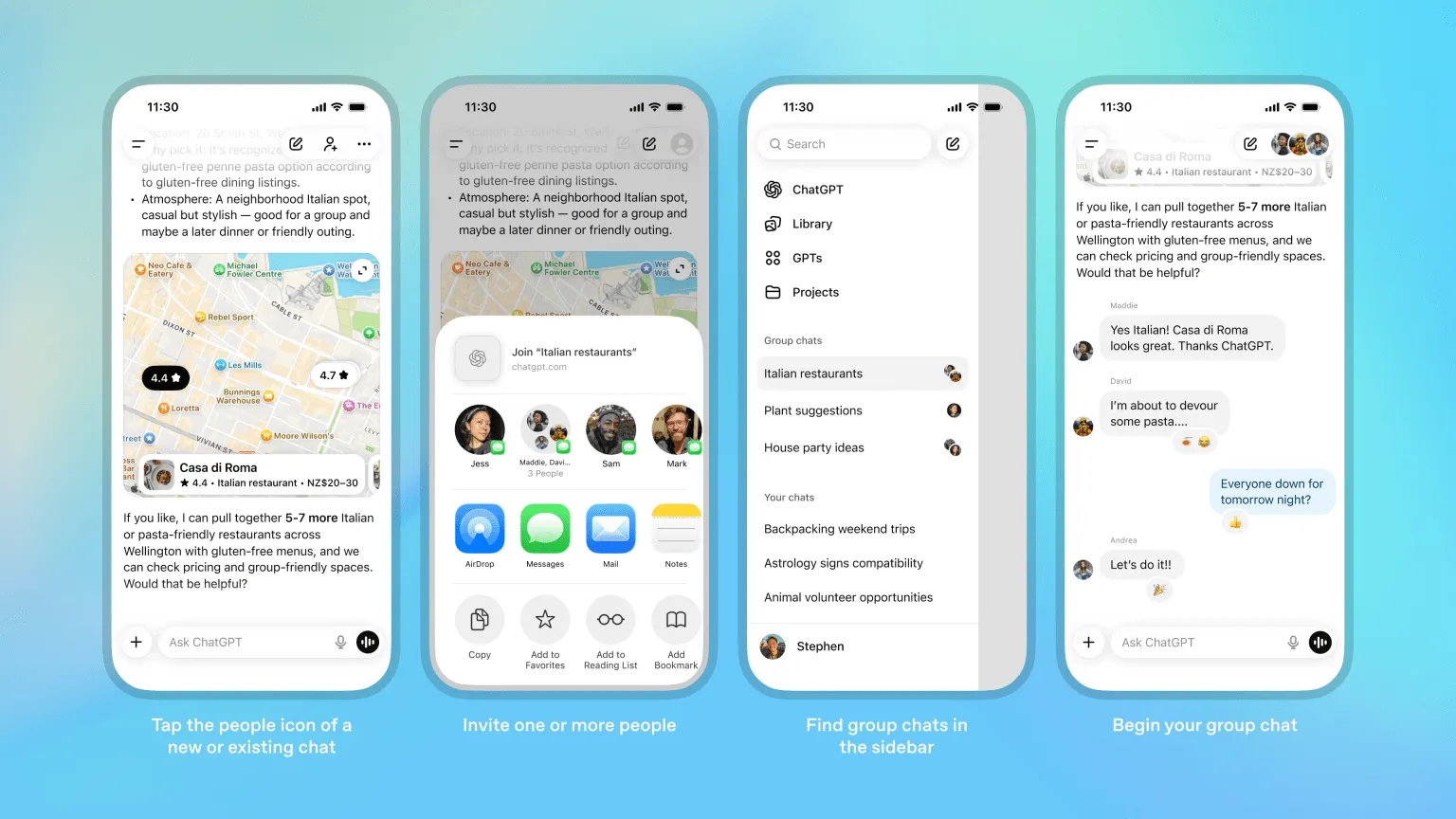
This feature is designed to support a variety of use cases, from work and study collaboration to social decision making like planning trips or dinners. Group Chat allows from one to 20 users to participate in a single chat with ChatGPT via an invitation link generated in the application.
Group Chat's initial pilot phase is limited to four Asia-Pacific markets: Japan, New Zealand, Korea and Taiwan. However, within just a week of the initial announcement, OpenAI announced a global expansion of Group Chat deployment to all logged in users (including Free, Go, Plus and Pro plans), citing "initial feedback from the pilot phase has been positive".
The decision to expand globally at such a rapid pace shows that Group Chat is considered a feature with high technical stability, based on the GPT-5.1 Auto platform, and is especially important in OpenAI's market positioning strategy. The shortening of the pilot period shows that OpenAI is prioritizing time to market and establishing its brand in the collaborative AI space, in response to pressure from Meta in the social AI sector and Microsoft Copilot in the enterprise sector. This confirms the urgent strategic need to transform ChatGPT into a platform that supports multiple users.
B. Access Levels and Usage Limitations Model
The Group Chat feature is available to all user levels of ChatGPT, from Free to Business, ensuring broad reach from the start. However, user experience and collaboration quality differ significantly based on subscription level due to model usage limitations.
Group Chat is powered by GPT-5.1 Auto, an intelligent routing system that automatically selects the best model (Instant, Thinking, or Legacy) for the task being performed. For users on the paid tiers, they benefit from access to more advanced models:
Free Users: Up to 10 messages can be sent with GPT-5.1 every 5 hours and are mainly routed to the Instant or Legacy models, suitable for quick queries.
Plus Users: Get more substantial usage limits, being able to send up to 160 messages with GPT-5.1 every 3 hours. More importantly, they can use the GPT-5.1 Thinking model, which is needed for more complex analysis and reasoning tasks, with a limit of up to 3,000 messages per week.
Business/Pro/Enterprise users: Provided with nearly unlimited access to GPT-5.1 Instant models and high limits to Thinking and Pro models.
This differentiation creates a clear hierarchical experience. Group Chat at the free level primarily serves as a feature tester, with new paid plans truly unlocking deeper collaboration capabilities, especially when the GPT-5.1 Thinking model is needed to solve multi-step problems or complex business tasks.
II. Deep Technical Analysis of Ambient AI and Operations
The technical core of Group Chat lies in the implementation of what OpenAI calls Ambient AI, a form of artificial intelligence designed to passively monitor the conversation and intervene proactively and appropriately.
A. GPT-5.1 Auto Model Platform: Routing and Multimodal Mechanism
GPT-5.1 Auto serves as the central coordinator of Group Chat. This Dynamic Routing mechanism automatically analyzes each request in the huddle stream and routes it to the most suitable LLM model, balancing speed, quality, and computational cost.
The two main model variants used are:
GPT-5.1 Instant: Used for simple queries, common conversational tasks, email summaries, or answering questions directly. This model prioritizes response speed.
GPT-5.1 Thinking: Reserved for tasks that require deeper analysis, multi-step logic, data decoding, or structured planning. The model self-adjusts response times, allowing for longer processing when careful reasoning is required.
The use of this Auto routing system is necessary for Group Chat to operate effectively in real time. The most powerful models (like GPT-5.1 Thinking or Pro) are typically slower and more expensive. By automatically switching between models, OpenAI ensures that AI remains up to speed for common team interactions, while retaining deep reasoning capabilities when needed. This is an optimized architecture for AI to participate in group chats, which are often chaotic and fast-paced.
In addition, Group Chat retains the comprehensive multimodal capabilities of ChatGPT, allowing users to use integrated tools such as web search, file upload (including documents, images, CSV), image creation (DALL-E), and voice dictation in the same chat stream. This is especially useful for brainstorming sessions or academic projects where diverse content needs to be aggregated and created quickly.
B. Ambient Response Logic
The most prominent feature of Group Chat is the Ambient AI mechanism, where ChatGPT acts as a passive participating group member. The AI is designed to "always listen" to discussions, but it only intervenes and responds when it "decides when to respond and when to stay silent based on the context of the group conversation."
This mechanism aims to minimize interference and unnecessary interference. However, users can always force the AI to respond by mentioning the name "ChatGPT" clearly in the message.
This design represents an attempt to shift the cognitive burden from the user to the AI. Instead of the user having to always determine "what to ask", Ambient AI will try to determine "when to help". To optimize this behavior, users can set Group-specific Custom Instructions. These custom instructions allow users to shape the AI's tone and behavior to suit a specific group (for example, tell the AI to always summarize action points every 5 messages), completely separate from their personal settings.
The success of the Ambient AI model depends on the sophistication of the contextual algorithm. If the algorithm is not capable of distinguishing between signal (need for assistance) and noise (chat), the user experience will be negatively affected.
III. Privacy, Group Management, and Security Framework
The move to multi-user collaboration environments significantly increases challenges around privacy, data management, and content security. OpenAI has established strict rules to address these concerns, especially through its memory isolation policy.
A. Chính sách Cô lập Bộ nhớ (Memory Isolation)
The core rule of Group Chat is complete memory isolation between chat spaces. OpenAI asserts that:
Personal Memory Is Not Shared: A user's personal memory, formed from the history of private interactions with ChatGPT, is never shared with anyone else in Group Chat.
Does Not Create Group Memory: In contrast, Group Chat also does not use group chats to create new memory for users' personal accounts. Each Group Chat is described as "a completely isolated bot replica".
Storage isolation policies are an essential privacy protection measure that help minimize security risks and ensure that personal information or sensitive customizations are not exposed in team environments. Group Chat currently prioritizes transaction safety and security over work continuity.
However, this isolation also poses a major barrier to the utility of long-term collaboration. Effective team work, especially in project environments (Projects, where users can organize work by grouping chats, files, and instructions), requires a "shared team memory" for the AI to keep track of collective decisions, outcomes, and team context. OpenAI noted that it is "exploring providing more granular controls" to enable memory sharing in Group Chat in the future.
B. Team Member Management Challenges (UX Friction)
The team member management process during the pilot phase revealed a significant user experience (UX) friction point.
Conversation Replication Mechanism: When a new user is added to an existing Chat Group, ChatGPT will not simply add that person to the existing thread. Instead, the AI creates a copy of the original conversation as a new Group Chat.
Confusing Consequences: Although this replication mechanism ensures the privacy of the original chat history for new users, it is a "cumber factor". For workgroups with many members joining and leaving, the sidebar of the ChatGPT application and web client will quickly become cluttered with a series of duplicate conversations. This is not suitable for business workflows that need clarity and continuity.
C. Parental Controls and Safety Framework
Group Chat's launch comes as OpenAI is strengthening protections for underage users, especially in the wake of litigation involving ChatGPT's protections failing during lengthy chat sessions.
OpenAI has proactively integrated measures to protect minors from the beginning. Most importantly, parents or guardians can link their account to their child's account to enable Parental Controls.
Absolute Control of Group Chat: Parents have the option to completely turn off the Group Chat feature for minor accounts.
Sensitive Content Reduction: When accounts are linked, minor accounts automatically receive additional layers of content protection, including reduction of graphic content, viral challenges, violent/sexual roles, and extreme beauty ideals, to ensure an age-appropriate experience. Parents can also choose to enable or disable this "Reduce sensitive content" option.
Providing the option to turn off Group Chat completely for minors is a smart legal risk management measure. In group settings, the risk of being exposed to inappropriate content or being influenced by group pressure increases. By giving this absolute control to parents, OpenAI is proactively minimizing liability associated with potential multi-party interactions. The company is also aiming to build an age prediction system to automatically apply settings suitable for teenagers.
D. Environmental AI Mechanism Analysis and Risk Management
Group Chat's operating mechanisms represent a complex balance between optimizing user experience, ensuring data security, and controlling strategic risk. The points below summarize the relationship between the main mechanisms of Group Chat and the management implications they pose:
Analysis of AI Mechanisms Environment and Risk Management
Ambient Response Logic Mechanism
Activity Description:AI listens and intervenes only selectively based on perceived context.
Benefits Strategic Benefits: Promote natural interaction, prevent AI from excessive interference (spamming).
Potential Risks/Limitations: Accuracy of context algorithm has not been tested at large scale; risk of intervention at the wrong time.
Memory Isolation Mechanism
Operating Description: Personal memory is completely isolated from the group chat.
Strategic Benefits: Strict protection of personal privacy and sensitive data of users.
Potential Risks/Limitations hidden: Makes it difficult to create long-term "group knowledge"; Reduces continuity in long-term projects.
Membership Management Mechanism
Activity Description: Creates a new chat copy when adding a new user.
Strategic Benefits: Ensures privacy of original chat history (new users cannot see old history).
Potential Risks/Limitations hidden: Causes serious clutter in the user interface, not suitable for groups with high member turnover.
Walled Garden Engine (No API)
Activity Description: Limit Group Chat to OpenAI app/web.
Strategic Benefits: Control Ambient AI data and behavior; minimize enterprise security risks in the early stages.
Potential Risks/Limitations: Cannot integrate into existing work tools (Slack, CRM), severely limiting business scalability and automation.
IV. User Experience Evaluation and Community Feedback
Initial feedback from the user community regarding Group Chat was positive, leading to the decision to rapidly expand globally. Users appreciated this feature for solving existing collaboration challenges, but also pointed out friction points that needed improvement.
A. Effective Use Cases and Added Value
Group Chat is considered a significant improvement over the traditional collaboration model in the LLM space, where users often have to "play phone games", constantly importing responses from other people's private chats into their own stream, wasting context and quickly filling up the context window.
The core value-add lies in creating a shared digital space for brainstorming and planning.
Low-Stakes Teamwork and Low-Stakes Teamwork: This feature is especially effective for small groups (up to 20 people) engaged in informal activities like quickly sketching out a school project, synthesizing found articles, or drafting a social media post. It acts as a shared digital whiteboard where ideas can flow without the rigidity of formal project management tools. Digital transformation consulting companies like Tan Phat Digital can take advantage of Group Chat to quickly build internal strategic frameworks and synthesize market research reports, minimizing context switching time.
Collaboration Education and Training: One groundbreaking application is seen in the field of education. Group Chat allows learners to collaborate in real-time with multiple "AI experts" (in the form of Group-specific Custom Instructions), engage in role-playing scenarios, build joint projects, and receive immediate feedback, eliminating the need to wait for a fixed teacher or course.
Use Flexible Multimodal Tools: The ability to use built-in tools like DALL-E to instantly create images or look up the web without leaving the conversation is a big plus for creative brainstorming sessions or quick debate resolution.
B. Analyzing Friction Points
Despite its clear benefits, Group Chat in its pilot stage revealed some limitations in terms of experience and product strategy:
Clunky User Experience:The process of starting a group chat was considered the "biggest headache". To invite others, users must create an invite link and then share that link via an external application (like email or Slack). This disrupts the normal workflow and creates an unnecessary step.
Lack of Incremental Innovation: Some analysts question OpenAI's product vision, arguing that Group Chat is not a disruptive innovation but just the addition of a familiar social feature to a new technology. This view argues that OpenAI is being distracted by "low-hanging fruit" instead of focusing on solving more difficult AI problems.
Model Restriction: The GPT-5.1 Auto routing mechanism, although effective, is difficult for users who need maximum control. Users expressed a desire to override Auto routing to force Group Chat to use the most powerful models (e.g. GPT-5.1 Thinking Pro) for the most complex tasks, which is currently not possible. This limits Group Chat's capabilities in situations where high precision or technical analysis is needed.
V. Strategic Implications and Competitive Landscape of Collaborative AI
The implementation of Group Chat puts OpenAI in direct competition with major collaboration and productivity platforms, highlighting the company's strategy in building a sustainable AI ecosystem.
A. Competitive Analysis
ChatGPT Group Chat differentiates itself from its competitors through the flexibility of its platform model and Ambient AI engine:
In-depth Competitive Comparison Table
ChatGPT Group Chat (OpenAI)
Core Features: Environmental AI, GPT-5.1 Auto Routing, Multimodal.
Competitive Advantage: High flexibility, outstanding creativity and brainstorming ability. The intelligent AI model decides to intervene on its own, acting as a proactive team member but not causing interference.
Strategic Limitations: Currently a "Walled Garden" model (lack of API), cumbersome team management process, and lack of shared team storage for long-term projects.
Microsoft Copilot
Core Features: Deep integration into Microsoft 365 (Outlook, Word, Excel).
Competitive Advantage: The core value lies in the ability to access proprietary business data and automate workflows right within the Microsoft ecosystem.
Strategic Limitations: Lack of flexibility in open dialogue, not suitable for creative tasks or organizations using mixed platforms outside the Microsoft ecosystem.
Claude Projects (Anthropic)
Core Features: Safety oriented, high accuracy, long document handling.
Competitive Advantage: Suitable for academic research, compliance, and processes requiring high document reliability.
Strategic Limitations: Lower overall flexibility compared to ChatGPT in brainstorming and spontaneous creative situations.
Meta AI
Core Features: Integration into social platforms (Messenger, Instagram).
Competitive Advantage: Reach large consumers, take advantage of existing social networks.
Strategic Limitations: Focus primarily on social interaction rather than business or operational productivity.
B. Business Barriers and the "Walled Garden" Model
While the Business and Enterprise plans provide nearly unlimited access to the GPT-5.1 models, the Group Chat feature currently operates as a "Walled Garden".
Lack of API Integration: There is currently no public API that allows developers to integrate ChatGPT's Group Chat with critical business tools like Slack, Jira, or CRM/ERP systems. This severely limits the feature's capabilities at the enterprise workflow automation level. Although ChatGPT Enterprise supports smart workspaces (Projects) to organize work, files, and instructions, and OpenAI APIs enable LLM integration into internal systems, the multi-user Group Chat feature itself remains isolated within OpenAI's application.
Keeping Group Chat within a "walled garden" is a risk control strategy for OpenAI. The complexity of Ambient AI in multi-user and cross-platform environments requires a large amount of user behavior data in a controlled environment before the company can safely open the API. Opening the Group Chat API too early can lead to complex security issues, context conflicts, and forms of abuse (such as automated data extraction) that are prohibited by the service agreement. Therefore, OpenAI is prioritizing testing the behavior of Ambient AI in an isolated and controlled environment.
C. Impact of Environmental AI on the Future of Work
Implementing Ambient AI in Group Chat has far-reaching implications for the future of communication and collaboration at work.
Potential to Reinvent Productive Time: Ambient AI has demonstrated the ability to significantly reduce burdensome work in other areas. For example, in healthcare, Ambient AI has helped reduce the time spent on documentation by about 70%, freeing up time for medical professionals. Group Chat has the potential to replicate this efficiency in conventional work environments by automating tasks such as summarizing meetings, recording action points, or organizing project documents.
The Loneliness Paradox: Increased collaboration with AI in the work environment also carries with it psychological risks. Studies show that AI collaboration can cause loneliness, anxiety, and emotional fatigue in employees. When a silent and efficient AI "colleague" replaces natural social interaction points (like debating a sentence together or manually compiling a document), it can erode human connections and lead to a drain on emotional resources. Therefore, Ambient AI design must ensure that it is only a support tool for human interaction, not a complete replacement.
D. Analysis of AI Mechanisms Environment and Management Risk
Group Chat's operational mechanisms represent a complex balance between optimizing user experience, ensuring data security, and controlling strategic risk. The points below summarize the relationship between the main mechanisms of Group Chat and the management implications they pose:
Analysis of AI Mechanisms Environment and Risk Management
Ambient Response Logic Mechanism
Activity Description:AI listens and intervenes only selectively based on perceived context.
Benefits Strategic Benefits: Promote natural interaction, prevent AI from excessive interference (spamming).
Potential Risks/Limitations: Accuracy of context algorithm has not been tested at large scale; risk of intervention at the wrong time.
Potential Risks/Limitations: Makes it difficult to create long-term "group knowledge"; Reduces continuity in long-term projects.
Membership Management Mechanism
Activity Description: Creates a new chat copy when adding a new user.
Strategic Benefits: Ensures privacy of original chat history (new users cannot see old history).
Potential Risks/Limitations hidden: Causes serious clutter in the user interface, not suitable for groups with high member turnover.
Walled Garden Engine (No API)
Activity Description: Limit Group Chat to OpenAI app/web.
Strategic Benefits: Control Ambient AI data and behavior; minimize enterprise security risks in the early stages.
Potential Risks/Limitations: Cannot integrate into existing work tools (Slack, CRM), severely limiting business scalability and automation.
E. Conclusion and Strategic Recommendations
ChatGPT's Group Chat is an important strategic move, successfully transitioning the product from a personal tool to a collaborative platform. The technical platform, based on GPT-5.1 Auto and the Ambient AI engine, is solid and optimized for real-time performance. The rapid global deployment shows that OpenAI is responding quickly to market demand and competitive pressures.
However, the feature remains focused on consumers and ad-hoc collaboration, with significant barriers to large-scale enterprise adoption.
Key Conclusions:
Competitive Boost: Group Chat is the necessary response needed to deal with AI convergence in the workspace, positioning ChatGPT as the leader in creative collaboration and brainstorming based on collective knowledge, avoiding head-to-head competition with the integration advantage of Microsoft Copilot.
Enterprise Context Challenges: Current memory isolation policies and cumbersome membership management mechanisms significantly reduce the continuity and depth needed for long enterprise projects limited.
Integration Limitations:The lack of a Group Chat API turns this feature into a "Walled Garden", hindering integration into existing business workflows, limiting application to the end user level rather than automating the process.
Strategic Recommendation:
To transition Group Chat from an ad-hoc brainstorming tool to a platform For full-fledged enterprise collaboration, OpenAI should prioritize the following roadmaps:
Develop Shared Group Memory:Design a controlled and synchronized memory architecture for Group Chat, allowing AI and team members to track project decisions, goals, and context over time, resolving the conflict between privacy and long-term collaboration utility.
Dim Group Management UX optimization:Replace the chat replication mechanism with a more flexible context management solution when adding new members, to prevent UI clutter.
Enterprise API Roadmap: Establish a clear roadmap to deliver Enterprise API for Group Chat, accompanied by strong security measures and granular access control rules, allowing organizations to integrate Ambient AI into their their existing working tools.
VI. Conclusion
ChatGPT's Group Chat feature represents the natural and irreversible evolution of AI towards a collaborative environment. Using the GPT-5.1 Auto architecture and Ambient AI engine, OpenAI has created a flexible and powerful tool that is ideal for ad-hoc brainstorming, planning, and creative collaboration. While there are obvious challenges around privacy (memory isolation policies) and user experience (cumbersome team management), the rapid global expansion of this feature shows huge potential to reshape how teams interact with AI technology. Long-term success will depend on OpenAI's ability to solve API integration barriers and develop features that support group storage, thereby turning Group Chat into a true enterprise productivity platform.
VII. Case Study: The Impact of Ambient AI (Case Study)
While Group Chat is a new feature in the mainstream workspace, the core technology of Ambient AI has shown profound transformational impacts in other industries, especially healthcare.
A. Ambient AI in Healthcare: Reclaiming Time for Nurses
A good example is the application of Ambient AI to automate the medical documentation process. In the healthcare industry, nurses and doctors often spend a significant amount of time taking notes and compiling records. Compassus, a home care provider, deployed an Ambient AI tool to streamline the multidisciplinary group note workflow (IDG note workflow).
The results were very positive:
Reduction in Documentation Time: Nurses reported an about 70% reduction in time spent on manual documentation.
Increased Satisfaction: This automation allows medical professionals to reclaim significant time, with reports suggesting AI has "given their Saturdays back".
Improved Workflow: Clinicians reported 6.91 times higher agreement that the documentation process was easier after Ambient AI intervention.
These results illustrate the potential of Ambient AI in Group Chat, where automatically capturing action points, summarizing meetings, and synthesizing opinions can be just as effective for business teams.
VIII. Frequently Asked Questions (FAQ)
Q1: Does Group Chat use or share my personal storage?
A: No. Group Chat is designed with a strict memory isolation policy. Your personal memory, made up of private chat history, is never shared with anyone in Group Chat. Similarly, Group Chat also does not create new memories based on your group chats.
Q2: Does ChatGPT respond to all messages in Group Chat?
A: No. ChatGPT works as an Ambient AI (Environmental Artificial Intelligence). It is "always listening" but only intervenes and responds when it perceives the context of the conversation necessary. However, you can always force the AI to respond by mentioning the name "ChatGPT" clearly in your message.
Q3: Is the Group Chat feature capable of using other tools such as creating DALL-E images?
A: Yes. Group Chat retains comprehensive multimodal capabilities. Users can use built-in tools like web search, file upload, image creation (DALL-E), and voice chat right in the group chat stream.
Q4: What happens when I add a new user to an existing Group Chat?
A: When a new user is added, the system creates a copy of the original chat as a new Group Chat. This is done to ensure that new users cannot view the original chat history for security and privacy reasons.
Discover how Group Chat can boost productivity and creative collaboration in your team today. Start now to experience the Ambient AI difference in ad-hoc and long-term workflows, especially in areas that require flexible interaction like planning, brainstorming, and research. If your business is looking for a more in-depth AI integration solution, Tan Phat Digital recommends following OpenAI's upcoming Group Chat API roadmap to optimize workflow automation.
Share