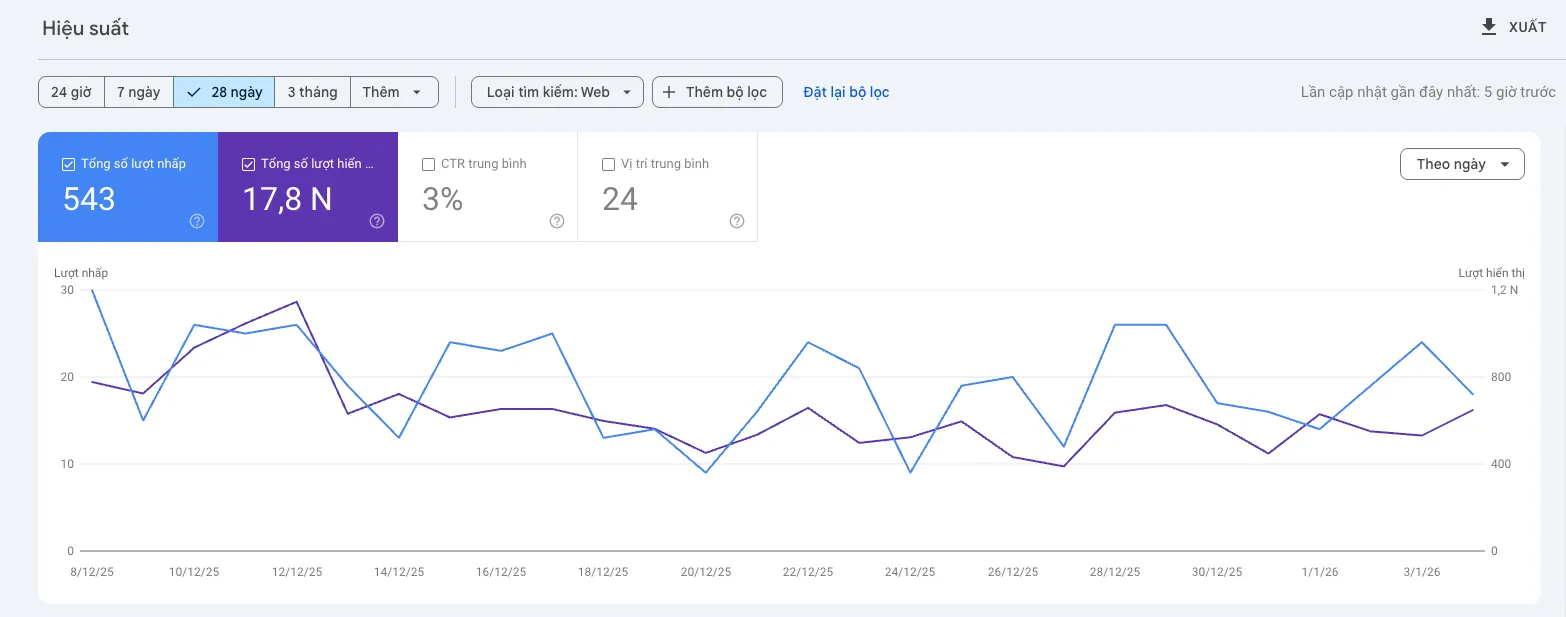
In the context of modern search engine optimization, the phenomenon of performance charts on Google Search Console (GSC) going flat or declining even though content and backlinks are still maintained at high quality has become a systemic challenge. At Tan Phat Digital, we've found that this deadlock often stems not from external factors but from deep technical "blind spots" within site architecture—factors that Google's 2025 algorithm has begun to prioritize more rigorously than ever before. When traditional methods like content injection and link building no longer deliver results, understanding complex mechanisms like Crawl Budget, Technical Cannibalization, and Rendering is the only key to breaking the stagnation.
Historic Data Shift: September 2025 Upheaval and the End of the "Impressions" Era virtual marketing"
To understand why the GSC chart has unusual developments, it is necessary to consider an important technical change that Google made in mid-September 2025. This was not a typical Core Update targeting content quality, but a fundamental adjustment in the way search data is collected and reported.
The removal of the &num=100 parameter and implications for performance reporting
From September 12 to 14, 2025, Google quietly disabled the &num=100 parameter in search URLs. The removal of this feature caused a widespread data shock, with approximately 87.7% of sites recording a significant drop in impressions on GSC.
In fact, a large portion of impressions previously came not from real users but from bots and scrapers. According to analysis from Tan Phat Digital, below is the change in data structure after this milestone:
Impressions: Recorded a decrease of 30% - 50%. The reason is that Google removes impressions from bots and scrapers, which often use the
&num=100parameter to scan results.Clicks: Maintains a stable state or fluctuates slightly. This proves that real users still click on the same Top 10 positions, not affected by the above technical change.
Average Position: There is a clear improvement trend (for example, from 25 to 15). This is actually a "mathematical illusion" due to the removal of low-ranking keywords (which are bot-impressed) from the denominator on average.
Click-through rate (CTR): Significant increase as clicks remained the same while the denominator (impressions) had a sharp decline after the data cleaning process.
The improvement in average position during this period is usually not real advancement in rank. If an admin sees a jump in average position but no increase in traffic, it's simply a process of "cleaning" the data to accurately reflect human behavior instead of bots.
The Rise of AI Overviews and the "Zero-Click" Phenomenon
The 2025 Google algorithm also marks the maturation of AI Overviews (AIO). AI Overviews extracts content from web pages to provide direct answers. This creates a paradox that Tan Phat Digital regularly warns customers about: a website can be trusted by Google to cite content (increasing impressions), but the number of actual clicks drops sharply because users have obtained the necessary information without visiting the website.
According to studies, the rate of zero-click searches has reached nearly 60% in developed markets. This is an important reason why the GSC chart is flat: the site still holds its position, but user behavior has been changed by the new SERP structure.
Crawl Budget: Perks instead of default benefits
In the era of AI, Googlebot no longer crawls indefinitely. In 2025, Google has officially transitioned to a "selective crawl" model, where crawl budget becomes a valuable resource that websites must "earn" through technical performance.
2026 "Quality Pre-check" mechanism
Google now performs a quick assessment based on surface technical signals before deciding to crawl the entire content. Critical factors in this process include:
Server response speed (TTFB): This is a factor with very high weight. If the server responds slowly (over 200ms), Googlebot will actively reduce the scanning frequency to avoid overloading the system.
Content Uniqueness: Very high weight. Duplicate or mass-generated AI content with no added value will be stopped from being crawled by Googlebot immediately.
Core Web Vitals (Especially LCP): High weight. Pages with an LCP exceeding 2.5 seconds are considered a poor experience and are downgraded in the crawl queue.
HTTPS Security: Average weight. Sites that are not secure or have SSL certificate errors will have their crawling restricted to ensure the safety of search users.
A flat GSC chart is often the result of Googlebot stopping discovering new pages or not updating changes on old pages due to depleted crawl budgets.
Effective management of crawl resources
Wasteful crawl budgets are a "point" blind" technique that many administrators ignore. Tan Phat Digital recommends that you immediately review the following wasteful factors:
Redirect Chains: Each redirect jump causes Googlebot to spend more resources. Google recommends not exceeding 2 hops in a crawl request.
Soft 404 Errors: Pages that do not exist but return a 200 (OK) status code force Googlebot to process useless content, causing serious waste.
Infinite URL parameters: Uncontrolled product filtering systems can generate millions of URLs with content similarities, creating "crawl traps".
Technical Cannibalization: When the system structure itself destroys rankings
Technical Cannibalization occurs when system components—such as parameter URLs, filter pages, or redirect structures—disperse the ranking and authority signals of the main page.
Fragmentation mechanism Search Authority (Search Equity Fragmentation)
In 2025, the concept of "Search Equity" becomes the focus of assessing domain power. The formula for calculating the loss of value due to technical scraping is described as follows:
Search Equity Gap = Lost Qualified Traffic + Lost Discoverability + Lost Intent Coverage
When a website has multiple versions of the same content, Googlebot will have to share the ranking power between these URLs. Instead of having a single page reach the Top 1 position, you will have many pages in the Top 20 position, causing overall traffic to stagnate.
Common forms of technical spam and solutions from Tan Phat Digital
Faceted Navigation: Filter combinations create thousands of similar URLs. Solution: Use absolute Canonical tags and block unnecessary filter combinations in robots.txt file.
Mobile/Desktop Asymmetry: Differences in HTML structure or internal links between two device versions. Solution: Ensure absolute consistency of content and structural data on all devices (Responsive Design).
Multilingual error (Internationalization): Wrong Hreflang tag configuration causes language versions to compete with each other. Solution: Check the symmetry of Hreflang tags and make sure the tags point to the correct national version.
Canonical Loops: The canonical tag points around or to the error page. Solution: Periodically audit to ensure the canonical tag always points to the root URL with status code 200.
Rendering and invisible content "Blindspots"
The biggest "blindspot" today is the difference between the content you see in the browser and the content that Googlebot actually indexes, especially with JavaScript-heavy websites.
Stagnation in the queue The Rendering Queue
Even though Googlebot is capable of processing JavaScript, this process still requires a lot of resources. Googlebot usually goes through two stages: Collecting the initial HTML source code and then putting it into the display queue to execute JavaScript. These queue delays can last weeks, preventing new content from appearing on the SERPs in a timely manner.
Server-Side Rendering (SSR) vs. Client-Side Rendering (CSR)
Based on the implementation experience of Tan Phat Digital, we classify display methods as follows:
Server-Side Rendering (SSR): Content is immediately displayed for bots, fastest indexing and extremely good support for AI Overviews. However, it puts a heavier load on the server. This is the preferred choice for content, news, and E-commerce sites.
Client-Side Rendering (CSR): Provides a smooth user experience and reduces server load, but there is a risk of content not being indexed in a timely manner. This method should only be used for web applications that are tool-based and require high interaction.
Hybrid (Hydration): Combines the agility of SSR and the interactivity of CSR. Although technically complex to implement, this is considered the "gold standard" for modern web platforms in 2025.
Testing and remediation process from Tan Phat Digital
When faced with a flat chart, you need to perform a systematic investigation:
Analyze partitions using Bubble Charts (Bubble Chart): Use Looker Studio to analyze keyword type. Pay special attention to keywords in the partition with high CTR but low position—this is a "gold mine" that is neglected due to technical errors that prevent promotion.
Control the "Indexing" report: Review statuses such as "Crawled - currently not indexed" or "Duplicate, Google chooses a different canonical than the user" to immediately detect self-stringing errors tear.
Optimize response speed: Ensure TTFB is below 200ms. Use CDN and WebP/AVIF format image compression to unleash the growth potential of the GSC graph.
Case Studies: Practically recovering traffic from technical "blind spots"
Below are practical examples of applying Technical SEO to break the stagnation of the GSC graph that Tan Phat Digital has compiled Case:
Case Study 1: Visit Seattle – Pruning content to revive rankings (2025): A tourism organization's website is experiencing "site bloat" with more than 8,400 pages but traffic is flat. By performing an audit and pruning (removing) 70% of poor quality pages (reduced to 2,535 pages), the website health score increased by 850%, helping the remaining main pages to have a strong ranking breakthrough.
Case Study 2: Recovering the article "Thermal Pollution in India" (2025): An article that was ranked Top 1 suddenly fell to position #15 After installing ads, it affects the experience and changes Meta Tags. After removing the ads, restoring the original Meta Tags and adding 2 more case studies of content, the article returned to Top 1 in just 5 days.
Case Study 3: Recovering 200% traffic for Luxury Brands (2025): After launching a new website, a luxury brand lost 50% of its traffic due to errors in navigation and sitemap structure. By thoroughly addressing redirect chains and re-optimizing internal links, the website achieved 200% growth within 6 months without building additional backlinks.
Frequently Asked Questions (FAQs) about Google Search Console & Technical SEO 2026
Here are answers to the most common questions when your GSC chart is flat or in trouble. error:
Why did impressions decrease sharply while average position increased? This is usually a consequence of the September 2025 update when Google removed the &num=100 parameter. Fake impressions from bots and scrapers are removed, making your data "cleaner". The increase in average position is because low-ranking keywords (outside the Top 20) no longer have impressions to pull the average number down.
What's the difference between "Discovered - not currently indexed" and "Crawled - not currently indexed"? "Discovered" means Google already knows the URL but doesn't have the budget or priority to crawl it. "Crawled" means that Google has read the content but decided not to include it in the index, usually due to low content quality or rendering errors that cause Google to see an empty page.
How to optimize Crawl Budget for large websites? You need to prioritize improving server speed (TTFB < 200ms), eliminating redirect chains that exceed 2 steps, blocking unnecessary parameter URLs with robots.txt and using the IndexNow protocol to notify instant content updates to search engines.
Does Google penalize duplicate content? Google usually doesn't "penalize" in the manual sense, but it will "remove" duplicate pages from search results to avoid diluting the SERP. This wastes Crawl Budget and disperses the main page's ranking power.
How do I know if Google is having a "blind spot" when rendering my JavaScript? Use the URL Inspection tool in GSC, select "View crawled page" and check the HTML tab. If important text or navigation links do not appear in this source code, Google is "blind" to your content.
Breaking stagnation with systems engineering thinking
A sideways Google Search Console chart is never a random phenomenon. In the algorithmic age of 2025, it's a warning about the disconnect between content value and search engines' technical reach.
Tan Phat Digital believes the key is not to do more, but to do smarter: cleaning data from impressions virtual, focusing your crawling resources on the most valuable pages, and ensuring that every word you write is fully "seen" by Googlebot. Today's stagnation is an opportunity to restructure the website to become more solid for the future.
Share