Hello everyone, those who are doing SEO day and night to bring their website to the top. I believe that, for veteran SEO guys, everyone has experienced this feeling: owning a new website, or an old domain that has had its index removed, and we have to rebuild from scratch. Instead of doing it hastily and waiting for results, many people have chosen a more methodical path: handling all Onpage, Offpage and Technical SEO factors, then officially opening the index for Google.
This is not a very new method. but to do it methodically and effectively, it requires meticulousness and strategy. Therefore, in the column "You may not know", I will share a few small tips that have been verified by Tan Phat Digital and colleagues in the industry, bringing high efficiency. Hopefully this knowledge will help you in your SEO journey.
1. Beautiful UX/UI & Optimized Speed: A Solid Foundation For Website
In the past, many SEOers often tended to cram a lot of content into main pages to increase their chances of competing for keywords. However, this approach often makes the website interface confusing, slow page loading speed, and difficult to use on the phone, leading to users "escaping" immediately.
Google is now much smarter. It not only reads content but also "sees" and "understands" user behavior on the website to score. A carefully designed website, with a scientific layout and smooth experience will retain customers longer, reduce bounce rate, and automatically be favored by Google.
What to do correctly?
Optimize Core Web Vitals: This is Google's set of metrics to measure user experience. You need to ensure:
LCP (Largest Contentful Paint): Main content loading time is less than 2 seconds.
FID (First Input Delay): Interaction time is less than 100ms.
CLS (Cumulative Layout Shift): Interface disturbance is close to 0. To achieve these indicators You can use tools like PageSpeed Insights or Lighthouse to measure this number, then compress images into WebP format, use CDN (like Cloudflare), and optimize and remove redundant JS and CSS files.
Mobile-First Design: More than 80% of search traffic comes from mobile devices. Therefore, website design must prioritize the mobile interface first. Make sure the font is large enough (>16px), the buttons are spaced properly (>48px), and test everything with the Google Mobile-Friendly Test tool.
Analyze user behavior: Use tools like Hotjar or Microsoft Clarity to view heatmaps, scrollmaps, and log user sessions. This data will let you know exactly where users are clicking, what problems they encounter, and where they leave the page for effective optimization.
Efficiency:
A fast-loading, easy-to-use website not only helps reduce bounce rate but also increases the time users stay on the page. This sends a strong signal to Google that your website is useful and deserves to be ranked higher.
2. Silo Structure - Building a House Must Have a Solid Foundation
Doing SEO with haphazard content and articles that are not linked together is like building a house without a foundation. Googlebot will have difficulty crawling and cannot understand what topic your website is about.
Silo structure (Topic Silo) is a scientific method of organizing content, dividing the website into clear categories with close internal links. It's like drawing a map, helping Googlebot go on the right path and understand the depth of each topic.
What to do correctly?
Draw Topical Map: Use keyword research tools like Ahrefs or Semrush to find keywords, then identify Core Topic (core topic) and Supporting Topic (subtopics) aid). Use XMind, Miro or Google Drawings to draw diagrams, identify pillar pages (Pillar Page) and detailed article pages (Cluster Content).
Optimize Internal Link (Internal Link): This is the most important part of the Silo structure.
Each article page should have 2-5 links pointing to related articles and Pillar Pages.
Anchor text must be diverse: use both branded anchor text (brand name), generic (see more, here) and exact match (main keyword).
Orphan Page Handling: Use the Screaming Frog tool to find "orphan" pages (pages without any internal links pointing to them), then add links from related pages so they can be discovered by Google
Effective:
Standard Silo structure helps Google understand that your website has deep expertise in a specific field (Topical Authority). This not only helps keywords reach the top faster, but also creates a sustainable ranking foundation over time.
3. Prepare Content and Internal Links Before Publishing
A common mistake of SEOers is to be too enthusiastic, publicize the website when it only has a few articles and submit it to the index immediately. As a result, Google sees an "empty" website, creating a bad impression and it will take more time to re-rank.
What to do correctly?
Pre-write content: Prepare at least 30-50 high-quality articles, each optimized for 1-2 main keywords and related secondary keywords. Use tools like Surfer SEO or Frase to analyze content length, keyword density, and important terms.
Optimize Meta Tags: Write compelling Title and Description tags that contain the main keyword and have a call to action (CTA). Standard size: Title under 60 characters, Description under 160 characters.
Apply Schema: Use Schema Markup (Structured Data) for important content such as Article, FAQ, or Breadcrumb. This helps Google understand your content more clearly, thereby increasing the visibility of rich snippets, attracting more users to click on the website.
Smart use of noindex: During preparation, place noindex tags for incomplete pages, or the entire website. Once you have enough content and internal links, remove this tag and submit the sitemap to Google Search Console.
Effective:
A public website with full and optimized content from the beginning will create a good impression with Google, helping it to be quickly indexed and achieve good rankings in a short time.
4. Building Entity & Backlink Directory Before Going Public
A new website is like a newborn baby, it needs to be "born" and recognized by the community. In SEO, this is called building Entity and initial brand signals.
What to do correctly?
Building Entity Stack: Create brand profiles (profiles) on reputable platforms such as Google Business Profile, LinkedIn, Crunchbase, and major social networks. Cross-link these profiles using Schema
SameAsso that Google understands that they all belong to a single entity.Building quality Backlinks: Focus on sending backlinks to category pages first. Choose domain names with high Trust Flow index, reputable in the industry.
Increase Social Signal: Share articles on social networks, create highly interactive posts. Signals from social networks help Google recognize your website as an active entity, interacting with the community.
Effective:
A strong Entity will help Google clearly identify your brand, increasing trust and authority. Category backlinks will help distribute power to all subpages in that category, promoting the rankings of related keywords to the top quickly.
5. Continuously Measure and Adjust – Don't Done When Done
After publishing the website, the SEO work is not over. A good SEO must be a data-driven person.
What to do correctly?
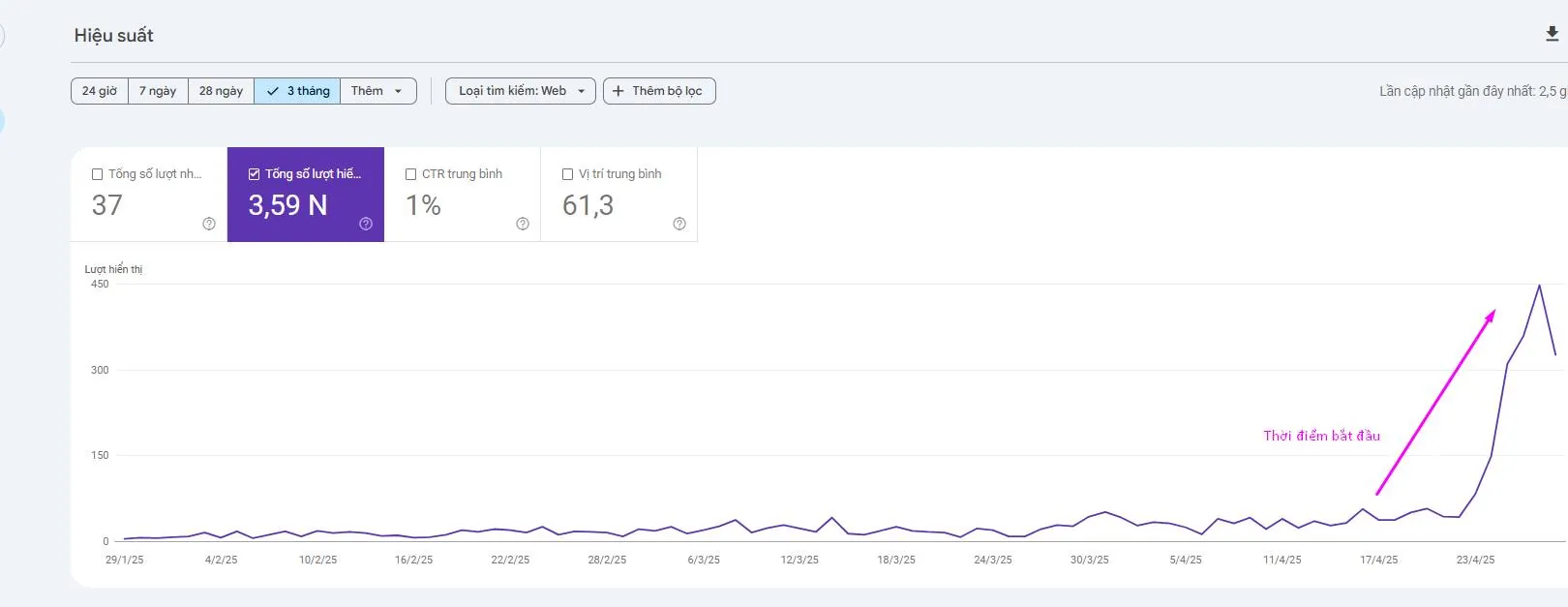
Track important metrics: Use Google Search Console (GSC) to track metrics about impressions, clicks, average position, and crawl errors. Use Google Analytics 4 (GA4) to analyze user behavior (time on page, bounce rate, conversion rate). Use in-depth tools like Ahrefs or Semrush to track keyword rankings and analyze competitors.
Handling the problem:
If the keyword is not in the top 20, add internal links, build more quality backlinks.
If the bounce rate is high, improve the user experience, make the content more attractive.
If there is a crawl error, fix it immediately in
robots.txtandsitemap.xml.
Continuous optimization: Periodically refresh old articles, add new information and optimize links.
Efficiency:
A website that is continuously measured and optimized can sustainably increase traffic and rankings steadily, usually 50-100% per quarter. Continuous improvement will help you maintain a competitive advantage in the volatile SEO market.
SEOing a new website is not only a technical job but also a comprehensive strategy, requiring systematic investment from the beginning. From optimizing user experience, building a scientific content structure, preparing adequate resources to building a brand foundation and continuous measurement, all are important pieces to create a strong and sustainable website.
At Tan Phat Digital, we always apply these principles in every project, from implementing SEO campaigns for new websites to restoring old websites. If you are looking for a partner to accompany and build a solid digital foundation, please contact us immediately to receive in-depth advice.
Share