Chapter 1: Analysis of the December 2025 Core Update Event and the Reconstruction of the Ranking System
The end of the Core Update on December 29, 2025 marked an important milestone in the history of Google's algorithm operation, closing one of the periods of strong fluctuations and the most far-reaching consequences for the global webmaster community. This update lasts a total of 18 days and 2 hours, starting on December 11 and officially completing at 2:05 pm ET on December 29. This is the third and final core update of 2025, after the updates in March and June.
The special feature of the December 2025 Core Update is not just the deployment time declaration but also at the extreme levels of volatility that tracking tools have recorded. SEMrush's Volatility Sensor Index has peaked at 8.7/10 — the highest level recorded throughout 2025. However, this volatility is not uniform across all sectors, creating a stark picture of performance between different industries.
Details of December 2025 Update:
Start Time start: December 11, 2025, 9:25 AM PST
End time: December 29, 2025, 11:00 AM PST
Total deployment time: 18 days 2 hours
Highest volatility: 8.7 / 10 (according to SEMrush)
Proportion of websites affected: Estimated 40 - 60% globally
Analysis of actual data from the system of Tan Phat Digital and publishers showing the News segment (News) is the field subject to the strongest fluctuations. Meanwhile, segments such as Autos & Vehicles, Games, Internet & Telecommunications, and Travel recorded a higher level of stability, with less ranking disturbance than average. This suggests that Google has made a fundamental recalibration of how it evaluates content quality, specifically prioritizing signals of expertise and actual user value over pure optimization tricks.
The rollout of this update is divided into two large waves of volatility. The first wave took place around December 12-13, causing sudden fluctuations immediately after the announcement was made. After a lull from December 14 to 19, a second — more intense — wave hit on December 20, sending many sites that had begun a slight recovery into further declines. Reports show that websites that rely entirely on unedited AI content have suffered traffic losses of 85% to 95%. On the contrary, content created by experts, integrating real data and personal experience, maintained or even improved rankings.
Negative influence rate by segment:
Affiliate marketing sites (Affiliate): 71%
Health and Finance (YMYL): 67%
E-commerce: 52%
Unedited AI content: 85-95% traffic loss
The essence of Core Update December 2025 is the amplification of the "Experience" signal in the E-E-A-T model. Google no longer only evaluates theoretical knowledge but focuses on the writer's ability to demonstrate practical experience. This explains why the News segment is the most volatile, as Google's systems try to filter between superficial general news and articles that are investigative journalism or reporting directly from the scene.
Chapter 2: Global Search Trends 2025: Artificial Intelligence and Behavioral Shifts
Google's "Year in Search 2025" report paints a comprehensive picture of what's going on the world is concerned during a turbulent year. Unlike previous years, the 2025 list reflects queries with a spike in traffic (trending queries) instead of being based on simple total search volume. This helps identify unique and emerging trends that traditional SEO tools may not have been able to update.
The dominance of Artificial Intelligence (AI) is the most prominent feature of search behavior in 2025. Gemini, Google's AI engine, topped the global trends list, reflecting the technology's deep integration into users' daily lives. Users are no longer just searching for "what" but are starting to ask "how" with the help of AI chatbots.
Top 6 Global Trending Queries 2025:
Gemini: AI Technology Sector
India vs England: Sports Sector (Cricket)
Charlie Kirk: News / Events Sector
Club World Cup: Sports Sector (Soccer)
India vs Australia: Sports Sector (Cricket)
DeepSeek: Technology Sector AI
Data shows a major shift in how people interact with search bars. Queries starting with "Tell me about..." increased 70% compared to 2024, while "How do I..." queries reached a record high with a 25% increase. This shows that search is becoming more conversational and action-oriented rather than just searching for static information.
In Vietnam, search trends in 2025 represent the intersection of national pride, interest in domestic cultural content and rapid adaptation to AI technology. Six of the top ten search trends in Vietnam are related to AI, with "DeepSeek" being the most popular keyword. Vietnamese users have moved from asking "What is AI?" to practical queries like "how to make videos with AI" or "create photos with AI".
Leading trends in Vietnam in 2025:
General trends - DeepSeek: Reflecting the explosion of AI chatbots.
Movies - Red Rain: Strong revival of calendar movies history.
Music - Bac Bling: A unique combination of cultural identity and modern music.
Concert - National Concert: Shows the spirit of patriotism and community cohesion.
Travel - Da Lat: Prioritizes domestic travel and finding nature.
Events Culture in Vietnam in 2025 also recorded strong marks with the historical film "Red Rain" leading in three different categories, showing that users are looking for stories that reflect their identity and roots. In the tourism sector, all ten most searched destinations are domestic landmarks such as Da Lat, Mui Ne, Da Nang and Ha Long, showing a sustainable consumption trend and a priority for exploring national landscapes.
Chapter 3: SEO Strategy in the AI Era: From Traditional SEO to GEO/AEO
The emergence of AI answer formats such as AI Overviews has given rise to new concepts such as Generative Engine Optimization (GEO) and Answer Engine Optimization (AEO). However, Danny Sullivan from Google strongly asserted that "Good SEO is good GEO". This message is intended to reassure the Marketer community that the fundamentals of creating useful, high-quality content are still the most sustainable strategy.
At Tan Phat Digital, the team of experts always emphasizes that instead of trying to "hack" the algorithms of AI chatbots, businesses should focus on meeting user intentions in the most authentic way. Modern content management systems (CMS) have taken over much of the technical work, allowing SEOs to focus more deeply on producing content of real value.
Focused optimization strategies:
Traditional SEO: Focuses on keywords, backlinks, and techniques. Google recommends continuing to maintain good technical foundations.
GEO / AEO: Optimized for AI synthetic answers. Need to provide succinct information that can be quoted directly.
Multimodal SEO: Combine text, images and videos. Diversify the format so that the AI system can easily identify and classify.
An important aspect of SEO in 2025 is the shift to multimodal content. Users today search across a variety of formats and often prioritize videos for how-to questions. Integrating videos, high-quality images, and podcasts not only helps increase visibility, but also creates a distinct "voice" that AI is unlikely to completely replace.
Google also emphasizes the importance of defining and tracking real business results rather than just looking at raw traffic. Tan Phat Digital also shares the same opinion that the number of clicks may decrease due to AI Overviews, but people who actually click on the website often have a deeper interest and a much higher conversion rate.
Chapter 4: AI Mode's Operating Mechanism and Robby Stein's 5 Core Elements
Robby Stein, Vice President of Product of Google Search, revealed that AI Mode is built on 25 years of experience in search quality of Google Search. Google is instead a system rebuilt from the ground up. To control the phenomenon of "hallucination" (AI illusion), Google uses signals of trust and usefulness that have been tested over decades.
Google's AI system works through a process called "Query Fan-out". When a user asks a complex question, the AI model will perform dozens of implicit search queries to collect information from many different sources, then synthesize it into a single answer. For a website's content to be included in the "context window" of this AI model, that content must meet strict quality standards.
Checklist of 5 Core Elements for AI Mode:
Ability to respond directly:Content needs to be concise and straight to the point, helping to increase the likelihood of being cited by AI.
Content quality High: Must have depth and clear structure to build long-term brand reputation.
Page loading speed: Prioritize Mobile-first and Core Web Vitals indicators to not be eliminated from the "game".
Originality: Provide unique data or perspective to differentiate from aggregated content from AI.
Cite sources clearly: Ensure transparency and trustworthiness, especially with health or financial information.
Robby Stein emphasizes that AI does not replace traditional search but is an extension. Users are asking more complex questions about advice or shopping decisions. For businesses, appearing in reputable lists or public articles that many people find is an effective way for AI to recognize and recommend.
Chapter 5: Redefining Optimization: From Keyword Density to Semantics and Entities
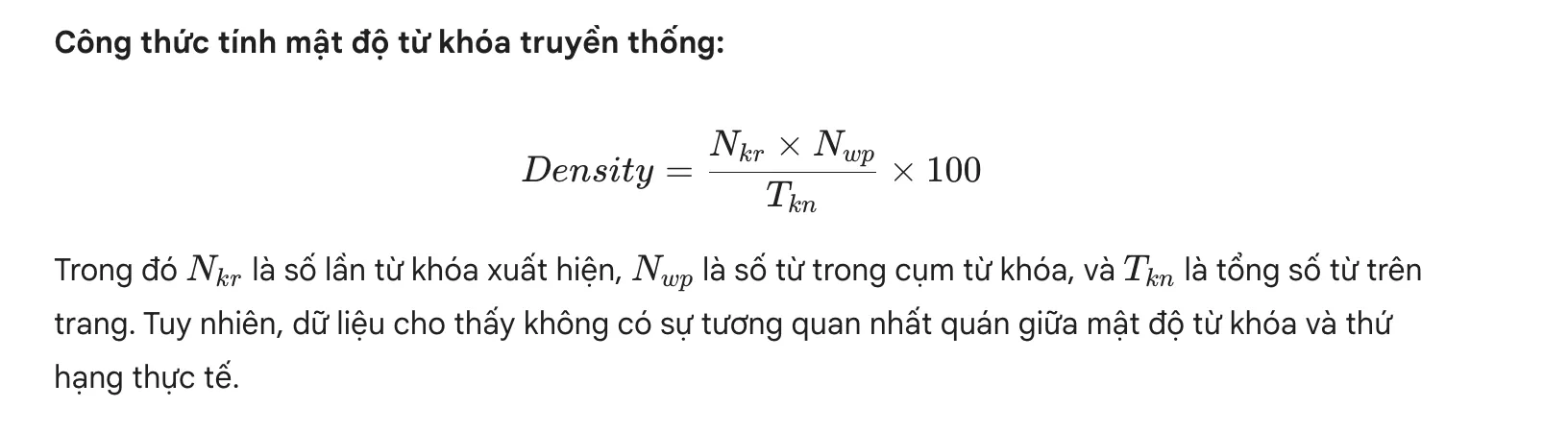
One of the biggest misconceptions in SEO is the existence of a perfect "keyword density." John Mueller and experts from Google have confirmed that keyword density has never been a direct ranking factor. According to the expert opinion at Tan Phat Digital, SEO tools that give optimization scores are just measurements based on predictions, not how AI systems actually operate.
Instead of focusing on keyword frequency, modern algorithms focus on understanding context and relationships between entities on the page. For example, if a website writes about "swimsuit", Google can understand that it is also related to "swimwear" without the page having to repeat the exact phrase many times.
Keyword stuffing occurs when a keyword is forced into the content in an unnatural way. While there is no hard limit, keyword density above 2% is often considered a sign of over-optimization.
Comparison between Keyword Stuffing and Current Optimization Great:
Goal: Stuffing aims to manipulate the algorithm; Modern optimization to serve user intentions.
Writing style: Stuffing is repetitive and unnatural; Modern optimization writes fluently and has depth.
Structure: Stuffing crammed into Header/Meta; Modern optimization uses entities and related words (LSI).
Result: Stuffing risks penalties and low CTR; Modern optimization delivers sustainable rankings and high authority.
In the current SEO era, the focus has shifted to "topical authority". Using semantic HTML structures and Schema.org markup makes it easier for AI to understand the entity a web page is representing.
Chapter 6: The Publisher Traffic Crisis: From Web Search to Discover
The latest data reveals a fundamental shift in the way readers read access news. Traffic from Google Web Search to news publishers decreased from 51.10% in 2023 to just 27.42% in Q4 2025. This is called the "Great Flip", when active traffic sources are replaced by passive traffic sources through Google Discover.
Google Discover now contributes 67.51% of traffic to news organizations. Although this number is impressive, it carries high risks due to the volatility of the recommendation algorithm.
Traffic source fluctuations from 2023 to Q4 2025:
Google Web Search: Sharp decrease of 23.68% (from 51.10% to 27.42%).
Google Discover: Soared by 30.48% (from 37.03% to 67.51%).
Google News: Reduced from 7.27% to 3.24%.
News Tab: Slightly decreased from 1.87% to 1.10%.
The cause of this decrease partly comes from the rise of AI Overviews, causing the click-through rate of organic search results to decrease by an average of more than 34%. Readers tend to get answers right in the search page without visiting the website, creating the phenomenon of "zero-click searches".
Dependence on Discover makes publishers more vulnerable to updates. Tan Phat Digital noted that during the Core Update in December 2025, many websites saw traffic from Discover completely eliminated within just 48 hours. This forces units to diversify their strategies, focusing on direct traffic and building brand loyalty.
Chapter 7: Economic Outlook and Digital Transformation in Vietnam for 2026
Vietnam is entering 2026 with ambitious economic goals. The government has set a GDP growth target of at least 10%, based on drivers such as the semiconductor industry, green transformation and institutional reform. 2026 is also forecast to be a booming year for e-commerce in Vietnam with expected revenue of 32 billion USD.
Forecast of Vietnam's economic indicators in 2026:
GDP growth: Forecasted to reach from 9.0% to 10.0%.
GDP per capita: Estimated about 5,400 - 5,500 USD.
E-Commerce Growth: Expected to remain at 25%.
Digital Advertising Revenue: Expected to reach 3.1 billion USD.
Digital labor market records a 37% increase in demand for Digital Marketing and e-commerce operations experts every year. In particular, AI is expected to support up to 40% of advertising campaign production tasks by 2026.
In the consumer sector, Tet 2026 is still the peak shopping season with total spending forecast to reach 3.85 million billion VND. However, consumer behavior is shifting to a "safety first" and "real value" mindset. Brands need to optimize advertising strategies based on trending keywords such as "gift ideas" or "safe Tet food" to capture users' shopping intentions.
Chapter 8: Conclusion and Strategic Recommendations for Businesses in 2026
The digital marketing picture in the period 2025-2026 shows a profound change. Search is no longer simply keyword matching but has become a complex AI inference process. To maintain competitiveness, Tan Phat Digital recommends businesses make the following strategic changes:
Focus on the "Experience" signal: Create content with a personal touch and real data to overcome algorithm updates.
Optimize for "Trust" (Trust): Build brand reputation through full citation of sources and use Schema Markup to make it easy for AI systems to verify business entities.
Adapt to the "Discovery-first" model: Invest heavily in Google Discover through attractive titles and high-quality images to compensate for the decline in traditional Web Search system.
Leveraging AI readiness in Vietnam: Deploying personalized and multimodal experiences. Founder Nguyen Van Tan Phat of Tan Phat Digital emphasized that combining traditional cultural values with modern technology will be the key to capturing consumers' minds.
The SEO game of 2026 is not for those looking for shortcuts. It belongs to businesses that deeply understand human needs and use technology as a tool to provide the best and most reliable value.
Share