I. Introduction: The Era of Conversational Shopping
I.A. Market Landscape and Shifting Shopping Models (Search to Chat)
The global e-commerce market is witnessing a fundamental change, driven by the maturation of Conversational AI technology. Consumer behavior is shifting from traditional keyword-based searches, where users must manually collate and verify results across multiple sources (also known as the "20 tabs cycle"), to complex natural language queries that require in-depth consultation and research. OpenAI quickly noticed clear signs of this shift: even before this specialized feature launched, consumers were making about 50 million shopping-related queries per day on ChatGPT. This strong demand indicates that a general tool that simply summarizes information on the web is insufficient to assist users in important shopping decisions.
The 'Shopping Research' feature was introduced to transform the product discovery process into an interactive dialogue. It is designed to assist users in deeper decision-making, especially for complex queries that require many constraints, rather than simply basic shopping questions.
I.B. 'Shopping Research' Overview: Objectives and Usability
The launch of Shopping Research is seen as a strategic move aligned with the global shopping calendar. This feature begins rolling out on Monday (near the end of November), right before the peak shopping season of Black Friday and the year-end holiday season. This timing strategy aims to attract a large number of users who want to shop and research products.
This feature is widely available to all logged in users, including Free, Go, Plus, and Pro plans, on both mobile and web platforms. More importantly, OpenAI has adopted an aggressive market penetration strategy by offering "nearly unlimited" usage for all plans throughout the festive season. The goal of providing free and unlimited access during this phase is to establish user behavior (User Habituation). If users become dependent on ChatGPT to do complex shopping research during peak periods, they are likely to maintain usage, even considering upgrading to a paid plan when the company imposes usage limits next year. This makes the tool a means to establish ChatGPT as a default product search channel, competing directly with e-commerce platforms and traditional search engines.
The core product categories where this tool performs particularly well are those that require high detail and where users have little tolerance for the risk of making the wrong purchase, including electronics, beauty, home and garden, kitchen and appliances, along with sports and outdoor equipment. The focus on high-value transactions that require thorough research shows that OpenAI is targeting a key decision-making segment.
II. Operating Mechanism and Platform Technology: mini GPT-5 and Reinforcement Learning
II.A. GPT-5 mini: Commerce-specific architecture
The technology foundation of Shopping Research is the performance differentiator. This feature is provided by a specialized version of the GPT-5 mini model, a not yet widely released version of the GPT-5 series. This is not a general-purpose AI model but a fine-tuned, commercially focused architecture, often referred to as a "research-first" model.
This model has undergone additional training focused on specific shopping tasks, specifically using Reinforcement Learning (RL) methods. The application of specialized RL is designed to address the biggest risk of large language models in e-commerce: hallucinations, especially regarding product specifications or prices. By training RL, OpenAI engineers prioritized the model's ability to: read trustworthy websites, cite trustworthy sources, and synthesize data from diverse sources to produce high-quality product research results. This emphasis on citation sourcing and data aggregation is a technical strategy aimed at establishing ChatGPT as a trusted advisor for complex procurement decisions.
II.B. Evaluating Model Performance and Accuracy (Accuracy Metrics)
In terms of performance, OpenAI has published clear comparative metrics. This specialized mini GPT-5 model achieves a product accuracy of 64% on complex queries with tight constraints, based on the company's internal evaluation.
This 64% accuracy level is a significant jump over ChatGPT's previous performance:
It is a drastic improvement over using traditional ChatGPT Search for general product queries, which only achieved 37% accuracy.
It outperformed GPT-5 Thinking, an advanced research model from OpenAI, which achieved only 56% accuracy on similar comparison tasks.
Improved accuracy has raised this tool to an acceptable level for important research tasks. However, OpenAI is also careful to admit that the 64% accuracy is "not perfect" and encourages users to visit the retailer's website to check the most up-to-date details on price and availability, as the model can still make errors on these details.
To provide an overview of the evolution of this technology, below is a performance comparison between OpenAI's different AI models in the shopping domain:
OpenAI AI Model Performance Comparison on Shopping Task
GPT-5 mini (Trained with RL):
Task Type/Characteristics: Shopping Research (Query complex, with constraints).
Product Accuracy: 64%.
Strategic Significance: Positioning as an in-depth research advisor, minimizing hallucination errors.
GPT-5 Thinking:
Task Type/Characteristics: General Research Model (Predecessor).
Product Accuracy: 56%.
Strategic Implications: Improved product data aggregation.
ChatGPT Search (Formerly):
Task Type/Characteristics: General Product Query.
Product Accuracy: 37%.
Strategic Implications: Too low for high-value purchasing decisions.
III. User Experience (UX) and Conversational Interaction Process
III.A. Discovery Workflow and Refine Results
The Shopping Research feature is designed to replace the linear search experience with a conversational discovery process. The feature is activated when users make general or specific shopping requests, for example, "help me find a smartphone with 18 hours of battery life under $1500".
After the initial query, ChatGPT opens an intuitive interface and offers a "quiz-like experience" to narrow the search scope. The AI will ask clarifying questions about budget, intended recipient, or other desired attributes.
The key point is a two-way interactive interface that allows users to navigate research in real time. When the model suggests potential products, users can mark them as "Not interested" or "More like this". If a user doesn't like an item, ChatGPT will ask for additional feedback about the specific reason (like price or style). This “like/dislike” mechanism not only improves user experience, but also serves as an extremely valuable, proprietary training data collection mechanism for OpenAI, as it provides detailed intent data to continuously refine the RL model.
III.B. Output: Personalized Buyer's Guide
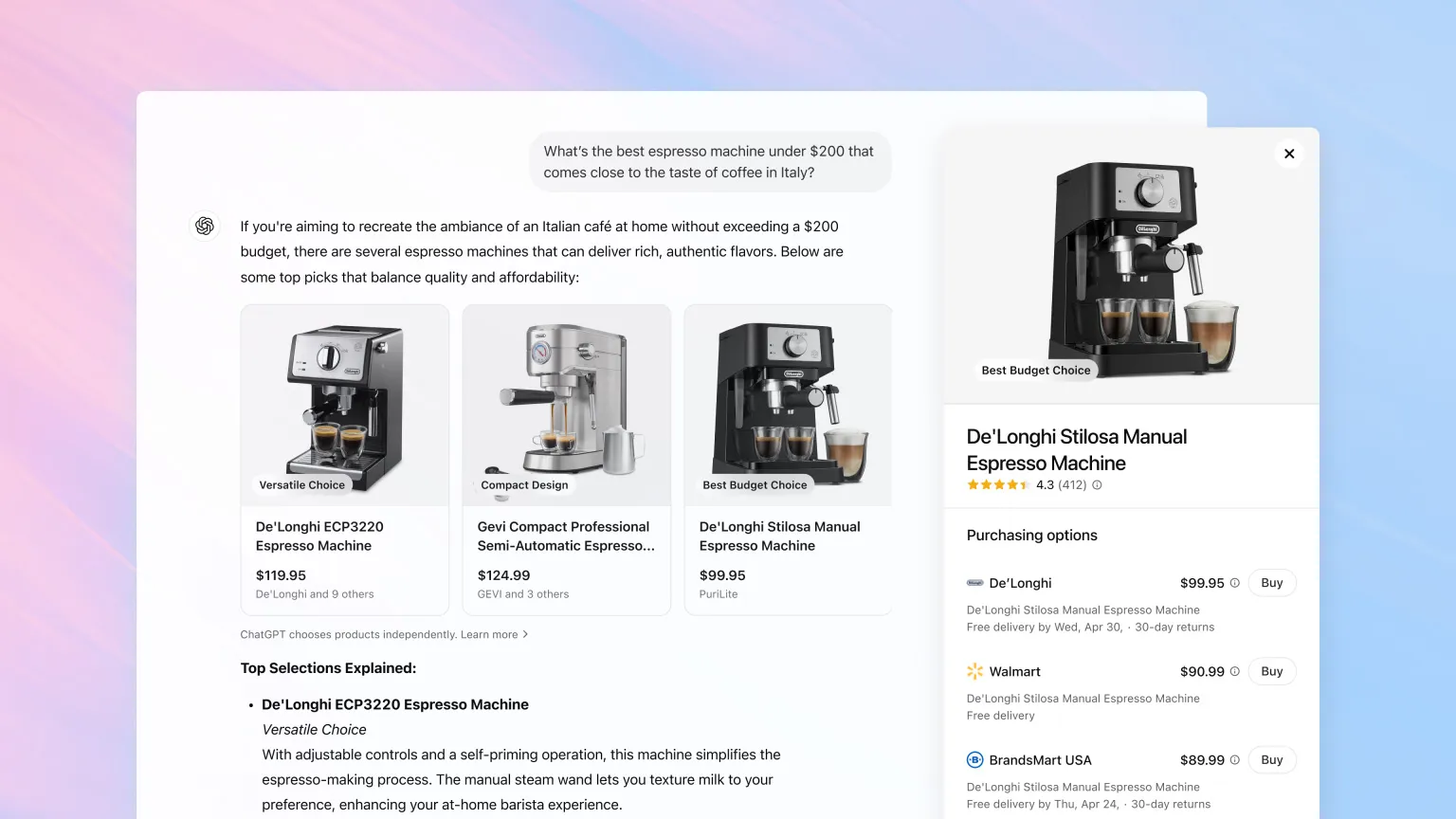
Once interactive and in-depth research is completed, the system provides a personalized buying guide in minutes. This guide is designed to eliminate the need for users to open dozens of tabs to compare products, making it highly efficient. It includes:
Top recommended products.
Clear analysis of key differences between options.
Specific tradeoffs for each product.
Up-to-date information on prices, availability, reviews, specifications and images, sourced from trusted retailers. In categories like fashion and apparel, instructions sometimes include outfit suggestions.
III.C. Personalization and Conversational Memory
Personalization is greatly enhanced through the use of conversational memory. If users enable this feature, research can be further personalized based on preferences, budget, or constraints discussed in previous conversations. This allows ChatGPT to act as a personal shopper with accumulated knowledge. OpenAI allows users to control the remembering of this information by providing the ability to enable or disable the feature in settings.
IV. Competitive Analysis and Trade Transformation Strategy (Agentic Commerce)
IV.A. Taking a Position in the Agent Commerce Wars
The launch of Shopping Research is a clear statement of OpenAI's intent to enter the Agency Commerce space, directly challenging the positions of Amazon and Google. Currently, the competition revolves around three major platforms:
Amazon: Still relies on proprietary data, customer loyalty, and instant transaction capabilities within its own ecosystem.
Google (Gemini/Shopping Graph): Implemented new AI shopping capabilities, leveraging over 50 billion product listings in the Shopping Graph and the ability to check out stock local inventory.
OpenAI (ChatGPT): Bet on deep, objective research and specialized AI technology, positioning yourself as a trusted advisor in the decision-making process.
The rise of these AI shopping tools signals a shift in commerce queries from traditional search engines to conversational AI, laying the foundation for an era where AI Agents become the default transaction portal determined.
IV.B. Strategic Differentiator: Objective Research and Source Quality
OpenAI's most prominent strategy is to prioritize source quality and objectivity. The GPT-5 mini model is tuned to search high-quality review sites and user forums like Reddit to gather genuine reviews.
More importantly, OpenAI claims that product recommendations are independent, based on relevance, and do not carry advertising or affiliate commissions at the time of launch of the research feature. This creates a strategic difference from the Google/Amazon advertising and referral fee based revenue model. The emphasis on objectivity builds trust with consumers in important purchasing decisions.
The implication for brands is the shift from Search Engine Optimization (SEO) to AI Optimization (AIO). If customers begin product discovery through ChatGPT, retailers need to optimize their data to be visible to these AI agents, rather than just focusing on traditional keywords.
Here is a Strategy comparison between major Platforms in Agentic Commerce:
Platform Strategy Comparison in Agentic Commerce
ChatGPT (OpenAI):
Mainstream Discovery Model: Research-First Agent (GPT-5 mini RL).
Strategic Focus: In-depth Consulting, Objective Review Aggregation.
Main Data Source: Public Web, High Quality Reviews, Reddit.
Current Monetization Mechanism: Instant Checkout Transaction Fee (ACP).
Google (Gemini):
Mainstream Discovery Model: AI Mode (Shopping Graph).
Strategic Focus: Multi-Source Comparison, Local Inventory Check set.
Primary Data Source: 50 billion exclusive product listings in the Shopping Graph.
Current Monetization Mechanism: Advertising/Product Recommendation.
Amazon:
- at: Referral Fees, Direct/Third Party Sales.
IV.C. Data Matters and 'The Amazon Wall'
One potential barrier to the comprehensiveness of Shopping Research is access to data from giant retail platforms. OpenAI adheres to the robots.txt of websites, only pulling information from pages that allow access by their browsing agents.
This leads to disruptions in data access: large retail platforms (especially Amazon) often limit the collection of detailed product data. If ChatGPT cannot access Amazon's comprehensive data, it cannot provide the most complete market comparison. OpenAI's strategy must therefore rely on aggregating high-quality reviews and product attribute data from public sources to compensate for the lack of real-time proprietary data from major competitors.
V. Business Model: Instant Checkout and Agent Commerce Protocol (ACP)
V.A. Instant Checkout: The Mandatory Monetization Path
OpenAI's long-term strategic goal is to integrate research with trading through Instant Checkout (IC). IC allows users to complete a purchase transaction (currently buying an item) right in the chat interface, eliminating conversion friction or "conversion leak" that occurs when users have to redirect to the retailer's website to pay.
Economically, IC is the main way for OpenAI to generate sustainable revenue sources beyond subscription fees. By charging a “small fee” on each transaction, OpenAI can start generating significant e-commerce revenue, which is needed to cover the huge costs of running AI. This Pay-per-Purchase business model is significantly different from the Pay-per-Click model of traditional search engines.
V.B. Partner Ecosystem and ACP Protocol
To implement IC, OpenAI partnered with Stripe to develop the Agent Commerce Protocol (ACP). ACP is designed to be an open standard that allows transactions to take place directly in an AI environment, as long as merchants remain in control of order fulfillment, shipping, and returns.
OpenAI has established strategic retail partnerships to expand this ecosystem:
Already Live: All US Etsy sellers are automatically IC enabled. Select Shopify merchants, including major D2C brands like Glossier, SKIMS, Spanx, and Vuori, are in the pipeline.
Coming soon: Walmart has announced a partnership to use IC. Target also announced shopping support through deep integration into Target's app. The participation of these major partners helps validate the ACP Protocol.
V.C. Analysis of Ranking Bias and Neutrality
OpenAI states that product recommendations are based on relevance and are not sponsored. Furthermore, using Instant Checkout is free to buyers, has no impact on price, and IC-enabled items are not prioritized in product results.
However, analysis of the seller rating mechanism reveals a complexity. When multiple retailers sell the same product, seller ranking factors include: inventory, price, quality, seller type (manufacturer or master seller), and whether Instant Checkout is available.
Taking into account the availability of Instant Checkout as a ranking factor creates an "Indirect Bias" towards merchants using ACP. Although IC does not directly increase product ratings, in a highly competitive market where price and quality are equivalent, the ability to provide a frictionless checkout experience becomes a decisive competitive advantage. This strongly drives ACP adoption, solidifying OpenAI's position as a key commerce intermediary.
Here is the status of Instant Checkout (IC) Integration with major partners:
Instant Checkout (IC) Integration Status
Etsy Sellers:
Integration Type: Direct Purchase (Instant Checkout).
Current Status (Time of report): Implemented (From Q3 2025).
Strategic Implications: Source unique, handcrafted products that are difficult to find with traditional SEO.
Shopify Merchants (Select):
Integration Type: Direct Purchase (ACP).
Current Status (Time of Report): Ongoing (Glossier, SKIMS, Spanx, Vuori, etc.).
Strategic Implications: Leverage a large D2C ecosystem where ICs reduce conversion friction.
Walmart:
Integration Type: Instant Checkout.
Current Status (Time of Report): Coming soon (“coming soon”) .
Strategic Implications: Large brick-and-mortar retail partner, validating IC model.
Target:
Integration Type: Supports purchases via Target app.
Current Status (Time of Report): Coming soon .
Strategic Implications: Differentiated model collaboration: Deep integration into Target's app instead of checkout in ChatGPT.
VI. Data Quality, Reliability, and AI Optimization (AIO) Challenges
VI.A. Review Data Collection and Aggregation Mechanism
ChatGPT performs deep research by searching the entire internet to gather real-time price, availability, reviews, specifications, and images information.
To provide buying guidance, the model generates review summaries based on public web pages, highlighting what users generally like and dislike about products. However, OpenAI publicly warns that these review summaries and ratings are model-generated and are not verified by OpenAI. Descriptive labels like "Budget-friendly" are inferred based on how often reviewers mention good value, not an endorsement of lowest price.
VI.B. The Shift to Optimizing Structured Product Data
In the AIO era, product visibility in ChatGPT depends on the quality of the input data. For products to display and rank well, merchants must provide structured, detailed, and AI-optimized product data.
OpenAI has established a direct Product Feed mechanism. This mechanism allows merchants to provide structured data straight to OpenAI, ensuring ChatGPT reflects the most accurate and up-to-date product information. This confirms that OpenAI is positioning itself as a new distribution channel where retailers need to invest in product attribute data enrichment and UGC to gain visibility.
VI.C. The Challenge of Trust and the Human Voice
While in-depth research has improved, consumer trust in AI trading remains a barrier. Initial studies show that conversion rates from ChatGPT traffic are still lower than from traditional channels, because consumers often cross-check information before purchasing. Low trust in AI trading is a potential explanation for users not using ChatGPT as the final step before making a purchase.
Furthermore, ChatGPT's model depends on aggregating reviews and opinions from human voices (journalists, product reviewers). If AI succeeds in becoming the default advisor, it risks eclipsing the role of original sources of review, risking itself undermining the high-quality data it depends on to compile objective information.
VII. Case Study: From Search to Piano Buying Advice
The Shopping Research feature is specifically designed to solve complex, detailed, and high-stakes queries, such as buying musical instruments.
User Query (Example):
“Looking for a digital piano for beginners, warm sound, weighted keys like an acoustic piano, lower price 15 million.”
This is a typical query, which cannot be solved with a simple keyword search because it requires a balance between Budget (under 15 million), Features (weighted keys - weighted keys/hammer action) and Quality (warm sound, for beginners study).
ChatGPT's Research Process:
Collect Constraints: ChatGPT will ask additional questions about room space (to suggest suitable piano models) and sound preferences (jazz, classical, etc.) . If the Memory feature is enabled, ChatGPT will automatically prioritize warm sounds and good pedal sensitivity if the user has Jazz Piano preferences.
Deep Discovery: The system will search the internet and high-quality review sites (such as piano/music forums) to find piano models that satisfy the technical conditions (
weighted keysandhammer action).Aggregating Reviews: The model will synthesize real users' opinions about potential models. For example, it might recommend models like the Roland FP-30X or Kawai ES120, with aggregated feedback from the community:
Some beginner users appreciate the budget-friendly Kawai Ca49 (around $2,000) for its acceptable key feel.
Models like the Roland F701 or FP-30X are prized for their weighty key feel and pleasant sound under the fingers.
Results Outputs: The results are not just a list, but a detailed comparison guide, highlighting the tradeoffs of each option. For example, it may turn out that a cheaper model may lack the
Escapementfeature or have a lower number of built-in tones (tones), helping new users understand their decision before spending big.
VIII. Frequently Asked Questions (FAQs)
Q1: What product categories is supported by Shopping Research? It works best for categories that require detailed and highly complex research, including: Electronics, Fashion/Cosmetics, Home and Garden, Kitchen and Appliances, and Sports and Outdoor Equipment.
Q2: Is there a fee to use Shopping Research? No. This feature is currently available for free to all logged in users, including Free, Go, Plus and Pro plans, on both web and mobile platforms. OpenAI also offers "nearly unlimited" usage throughout the holiday season .
Q3: Are ChatGPT's product recommendations sponsored or have an affiliate commission? OpenAI states that product recommendations are based on relevance, quality of the source, and relevance to the user's query, not on advertising or affiliate commissions.
Q4: How accurate is shopping research? In OpenAI's internal tests on complex queries, this specialized model achieved 64% product accuracy. While not perfect, this number is significantly higher than the 37% when using the traditional ChatGPT Search feature. OpenAI recommends that users always double check prices and availability on the retailer's website.
Q5: How to buy directly (Instant Checkout) right in ChatGPT? To buy directly, the product needs to be sold by a merchant participating in the Agent Commerce Protocol (ACP). Instant Checkout has now rolled out to all US Etsy sellers and select Shopify merchants, with Walmart and Target coming soon. If the product supports IC, the "Buy" button will appear immediately in the chat interface.
For Consumers: Transform your shopping experience today. Start with a complex query (e.g. "Compare the 3 best air purifier models for a 30m² room with pets, priced under 7 million") to experience the power of Shopping Research. Make the most of virtually unlimited usage this holiday season to make informed shopping decisions, no more opening dozens of tabs.
For Merchants and Retailers: The era of AI Optimization (AIO) has begun. To ensure your products are visible in ChatGPT's unbiased research results:
Structure data: Ensure your product attribute data and user ratings (UGC) are optimized for AI Agent.
Subscribe to Product Feed: Sign up to provide a live Product Feed to OpenAI to secure your pricing and inventory information always accurate.
Adopt ACP: Consider adopting Agent Commerce Protocol (ACP) to enable Instant Checkout, reduce conversion friction, and gain an indirect competitive advantage in merchant ratings.
The 'Shopping Research' feature represents an important technical step forward for OpenAI, by turning ChatGPT into a specialized AI agent, capable of performing complex shopping research tasks. The combination of a mini GPT-5 model trained with Reinforcement Learning—to increase product accuracy by 64%—and the Instant Checkout strategy, lays the foundation for the future AgenticCommerce model. The strategy is not just to provide a convenient tool, but also to establish ChatGPT as the default product discovery portal, competing directly with established search and e-commerce business models.
OpenAI is pursuing a dual positioning strategy: Trusted Advisor and Frictionless Trading Intermediary. By emphasizing objectivity (no advertising) and data source quality (focus on high-quality reviews), OpenAI builds trust, something that traditional advertising-reliant search engines struggle to maintain. At the same time, the development of the ACP and Instant Checkout Protocols ensures OpenAI can capture economic value from the transactions it creates, creating a sustainable Pay-per-Purchase alternative to the traditional Pay-per-Click model. Partnerships with retail giants like Walmart and Target confirm the legitimacy of this Outlet Commerce model.
The launch of 'Shopping Research' and Instant Checkout heralds the end of the traditional shopping model, where consumers must actively undertake the product research and comparison process. In the future, AI Agent will take on the role of discovering, consulting and ultimately executing transactions, establishing a trading ecosystem in which AI is the default trading gateway. Brands that do not adapt to this Dialogue Commerce model, especially through optimizing structured product data and adopting standards like ACP, risk losing visibility and conversion across the new value chain. The ability to personalize research through Memory and real-time interaction will solidify ChatGPT's position as an indispensable personal shopping companion.
Share