Customers asked: "The other party commits to KPI conversion, both cheap and guaranteed. Can you do it?" – I hear this sentence a lot. The desire to spend money and issue leads is legitimate. But if there is no agreement on the scope of control and measurement, both sides can easily "come to a dead end".
1) Essence: Can SEO control conversions?
SEO puts the website in front of the right people - the right needs and pulls them back to the site.
Conversion (filling out a form, calling, making a purchase) depends on many more variables beyond the control of the company. SEO team:
Product/service: value proposition, selling price, return policy.
Website & UX: speed, layout, message, CTA, reliability.
Sales: response speed, consulting script, closing rate.
Market Market & competitors: seasonality, promotions, industry standards.
Brand reputation: users lean towards familiar brands (for example, when buying a phone, they will lean towards large chains even though they have the same price range).
Business & marketing strategy: funnels, trial offers, remarketing, post-lead care.
=> SEO = increase opportunities.Turning opportunities into revenue is the task of the whole system: product - marketing - website - sales - operations.
2) Why are there still places that "commit to conversion KPIs"?
Mostly to meet the need to hear "commitments". Inside, the KPI they really pursue is still ranking & traffic. “Conversion KPI” is sometimes just an additional line to make it easier to sign, but when it doesn't, they... rely on keyword/traffic KPIs to keep the contract. The risk is motivation deviation: they easily optimize for quantity (many cheap leads) instead of quality (suitable leads), even using short-term tactics that harm the brand.
3) Risk when forcing conversion commitment
Goal deviation: optimizing for cheap (irrelevant) “form-submits”, bait CTR, title jerky.
Poor quality leads: sales take time, closing rate decreases.
SEO risks: producing "instant noodles" content, easy backlinks → long-term effects.
Attribution controversy: leads come from multi-channel (SEO, ads, social, direct). Not being clear about the responsibility framework will... endless debate.
4) How to "measure" effectiveness without being fake?
I recommend layered KPI model - transparent scope of responsibility:
Level 1 - Input (SEO bears):
Complete technical audit, fix Core Web Vitals, content architecture (topical). map), publishing schedule, onpage quality, internal link, schema, local SEO.
Floor 2 – Output (SEO bears):
Impressions, target keyword group rankings, Top 3/Top 10 shares, organic sessions non-brand, CTR by cluster.
Floor 3 – Outcome (co-responsible):
Qualified Leads/Bookings/Influenced Revenue from organic – only counted when: correct customer profile, right region, no overlap, sales responds ≤ 24h and has “contactable” status.
This method helps both sides look at the same business results, but does not push SEO to shoulder the burden that SEO has no control.
5) When can conversion KPIs be discussed?
Absolutely possible, if and only if the following conditions are met:
SEO has the right to optimize UX/CRO on landing: A/B test titles, CTAs, forms, social proof.
Have the right to create offers/funnels (trial, demo, voucher) to increase adoption rate.
Connected GA4 + CRM measurement channel, clear source assignment rules, deduplication.
Sales commits to response SLA (e.g. 15–30 minutes of office hours).
Has data baseline 30–60 days to estimate the actual target.
If these conditions are not sufficient, the conversion commitment is just "black and white paper" that is difficult to enforce.
6) Example of actual terms (for reference)
SEO commitment: 100% completion of technical items; publish X standard E-E-A-T articles/month; Increase the share of Top 10 of the target cluster to ≥ Y%; Increase organic non-brand sessions ≥ Z%/quarter.
Customer commitment: lead response ≤ 24 hours; Update inventory/prices/offers promptly; Allows A/B testing; Provide CRM data for control.
Efficiency bonus: bonus when Qualified Leads from organic reach the set milestone (unified QL definition from the beginning). Do not reward duplicate, fake, out-of-target leads.
7) Required measurement set to talk about “conversions”
GA4: standard events (view_item, generate_lead, purchase), Enhanced Measurement, cross-domain if necessary.
GSC: track non-brand queries, CTR, pages destination.
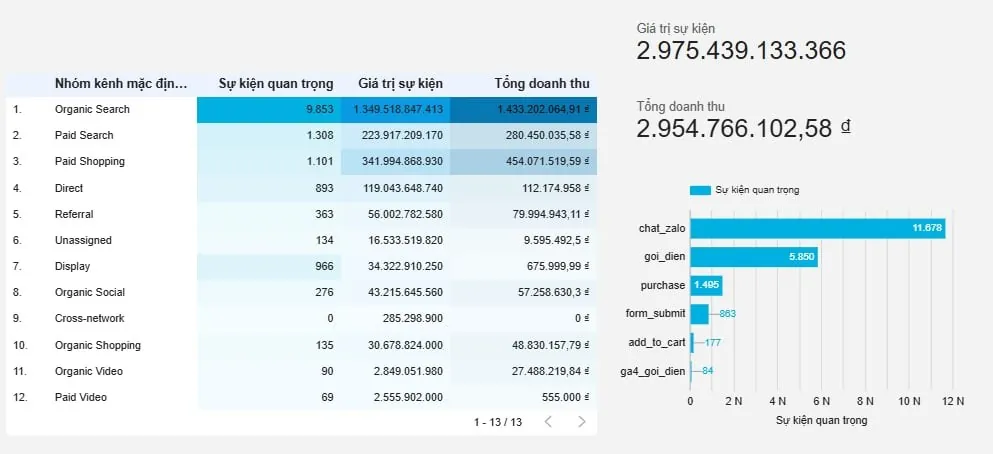
Call/Chat tracking: call number, missed rate, duration; Zalo/Chat widget has events.
CRM: source (source/medium), pipeline stage (MQL → SQL → Won), duplication, response SLA.
Common dashboard: 1 source of truth, both sides can see - avoid arguments.
8) What to do to "pull" the conversion up together SEO?
CRO on landing page: hero says the right benefits, clear CTA, compact form (4–6 fields), trust badge, real review.
Speed & mobile-first: under 2–3 seconds, “thumbs up” button, sticky CTA.
BOFU content: price list, comparison, case study, FAQ feedback argument; Include high-converting keywords.
Local SEO: Optimal Google Business Profile, real photos, Q&A, review with feedback.
Sales playbook: callback script in 15–30 minutes; lead classification; nurture by email/Zalo.
SEO opens up opportunities. Revenue is the result of the system. Don't chase after attractive "transformation commitments" that lack enforcement conditions. Choose a partner who tells the truth – advises frankly – clarifies responsibility – sticks to data, then together achieve sustainable business goals.
Tan Phat Digital's approach (professional web design service in HCM, Website Design in Ho Chi Minh): I propose KPIs by tier, prioritize lead quality, and simultaneously deploy SEO + CRO + Local SEO + tracking GA4/CRM to both rank up and increase real conversion.
Share


![[CASE STUDY] SEO FnB Ho Chi Minh City: Organic +180% & Booking +70% After 6 Months](https://res.cloudinary.com/dtmxgrnfn/image/upload/v1756640906/tanphatdigital/case-study-seo-fnb-tphcm-organic-180percent-and-booking-70percent-sau-6-thang_31082025_114823_933.webp)