This report analyzes the Search Engine Optimization (SEO) sector's landmark transformation from a traditional keyword-based model to a multi-layered strategic framework focused on AI, Entities and Trust. In the context of Google continuously updating AI features (such as AI Overviews and Search Generative Experience - SGE), SEO is no longer a race to win a position in the top 10 green links list, but a battle to become the most trustworthy source of information cited by Artificial Intelligence itself.
PART I: CONTEXTUAL ANALYSIS — THE AI AGE AND THE END OF TRADITIONAL SEO SYSTEM
1.1. The Dawn of AI Overviews (AIO) and SGE: Changing the Search Interface
In the past, marketing was highly tangible and personalized. Advertisements are hand-drawn signs, flyers distributed at intersections, or simply whispers based on physical trust [User Query]. As the world moves to cyberspace, businesses are required to have a "digital home" (Website). Traditional SEO was born, focusing on optimizing content to compete for TOP 10 positions for target keywords, with the sole goal of increasing organic traffic [User Query].
However, the search interface has undergone a fundamental change. Google is no longer a simple list of 10 links [User Query]. With the launch of Search Generative Experience (SGE) and AI Overviews (AIO), Google transformed itself into an Answer Engine, providing AI-generated summaries of information directly on the Search Results Page (SERP). Search results now include Featured Snippets, related questions (PAA), videos, images, and comprehensive AI-generated summaries.
The emergence of AIO creates a new fierce competition for display space on SERP. AIO and other information-rich SERP features have pushed traditional organic listings down, sometimes as much as 1,200 pixels. This makes the SEO strategy no longer simply focus on getting to rank 1, but must aim to occupy "Position Zero"—the top position occupied by a prominent AI or Snippet.
1.2. The Zero-Click Search Challenge: When Traffic Is No Longer Everything
The Zero-Click Search (ZCS) phenomenon is a direct consequence of the wealth of information on SERP. ZCS is defined as a situation where users get the answers they need right on the search results page without having to click on any website. The rise of Zero-Click Searches is certainly causing significant disruption to the SEO and organic traffic landscape.
Redefining SEO Success:
The obvious challenge is the decline in traffic (clicks) even as impressions (impressions) are still increasing. However, obsessing over CTR decline is a strategic mistake in the AI era. The truth is, ZCS has opened up an invaluable opportunity to build Brand Equity and Reputation right on the SERP.
This change redefines SEO success:
Soft Conversion: Every time a brand appears in a Featured Snippet, PAA, or is cited in AI Overviews, it is an indirect endorsement from Google itself, helping users remember the brand name as a trustworthy source. Trust (trust) is the new "transformation" in this era. Businesses need to measure metrics like Visibility and Citation Rate instead of simply Traffic Volume.
Repositioning the Role of the Website: If AI has answered basic informational queries, the website will transform into a destination for users who want to dig deeper, have been convinced by the concise answer and want to explore further. Websites have evolved into tools for the deeper consideration and conversion stages of the customer journey.
Optimize User Intent (Search Intent Alignment):
SEO is no longer a single keyword game, but rather optimization for a comprehensive user experience. Intent-based SEO requires content to fully address the user's intent and motivation when making a query. Google rewards content that meets this intent, helping to reduce bounce rate and increase engagement. If the content is just keyword-stuffed without solving the customer's core problem (e.g., they're looking for a solution because "they're stuck, they're frustrated," not just looking for "SEO service package") then the content will fail.
To clearly visualize this shift, it is necessary to analyze the strategic differences between the two eras:
Strategic Transformation: From Traditional SEO to AI Optimization
Ultimate Goal:
Traditional SEO (Keyword-Based): Reach TOP 10 (Increase Organic Clicks.
- key.
AI Optimization (Entity-Based/AEO, GEO): Entities, Intent, E-E-A-T.
Key Measures:
Traditional SEO (Keyword-Based): Organic Traffic, Click-through Rate (CTR).
AI Optimization (Entity-Based/AEO, GEO): Visibility, Zero-Click Answers, Citation Rate, Brand Equity.
Content Strategy:
Traditional SEO (Keyword-Based): Optimize length and broad keywords.
AI Optimization (Entity-Based/AEO, GEO): Optimize clarity, structure (Schema), and authenticity (Factual) Content).
PART II: AI COMPETENCE FOUNDATION — E-E-A-T CONCEPT AND EXPERTISE (THE AI TRUST CORE)
2.1. E-E-A-T: The Critical Factor for Content Survival
In the AI era, without trust, content has no value. Google's E-E-A-T (Experience, Expertise, Authoritativeness, Trustworthiness) concept has become the deciding factor in a website's survival. This isn't just a ranking algorithm; it is a license for content to be trusted and cited by AI Overviews. In particular, YMYL (Your Money or Your Life) topics such as health, finance, or law, require an absolute level of E-E-A-T.
E-E-A-T is evaluated by Google through the overall quality of the content, PageRank, references to the author, publisher, and link distance to reputable seed sites (seed sites) in the link graph.
Detailed Analysis of the Four Pillars of E-E-A-T:
Experience: Demonstrates practical knowledge, usage experience or personal experience of the product/service. Using first-person narrative (First-Person Narrative) in content can be a way to emphasize this experience.
Expertise: Ensure that content is written or edited by experts with qualifications, degrees, or in-depth knowledge in the field. Author bio pages (Author Bio Pages) are clearly indispensable evidence.
Authoritativeness: Established when other reputable organizations, experts or websites recognize and cite your content through quality links (link building).
Trustworthiness: The foundation of E-E-A-T. It is proven through technical factors such as HTTPS security, clear legal policies (Privacy Policy, Terms of Use), and transparency in error correction or user feedback.
2.2. Strategies for Building Topical Authority and Reputation
In the AI era, the success of GEO (Generative Engine Optimization) depends on Google and large language models (LLMs) recognizing a website as a highly authoritative source.
Building Topical Authority:
Instead of just focusing on a few keywords with high search volume, the strategy needs to shift to creating in-depth content clusters (Pillar & Cluster), covering every aspect of a topic. When your website has the ability to answer a whole host of questions around a core topic, Google/AI will consider it an absolute authority, increasing the likelihood of being cited in AI briefs.
Reputation Management and Leveraging UGC:
Online reputation plays an extremely important role in strengthening the Trustworthiness factor.
Feedback Management:Marketers must closely monitor negative user reviews and comments. Responding quickly and professionally is a way to demonstrate credibility and maintain brand reputation.
Leverage User-Generated Content (UGC): User-generated content, including product reviews, YouTube videos, or social media posts tagging a brand, is a strong signal of trust. UGC, when used effectively, can serve as "Main Content" (Main Content) on a website, helping to establish brand loyalty and improve E-E-A-T. 79% of online shoppers say UGC strongly influences their purchasing decisions, proving the importance of building a brand-advocating customer base.
2.3. Case Study: The Power of UGC in E-E-A-T
Success in the AI era depends on building Trust (Trustworthiness). One of the effective ways to generate evidence of authority and experience (Experience) is to leverage User-Generated Content (UGC).
Platform: 79% of online shoppers say UGC strongly influences their purchasing decisions, making it a strong signal of trust.
According to Google: Based on Google's Search Quality Rating Guidelines, UGC (such as product reviews, video reviews) is considered “Main Content” (Main Content), helping the page achieve its purpose.
Typical Example: An example is an Instagram video showing customer reviews of Pashion Footwear shoes. Encouraging customers to share product photos and tag brands on social media is an effective strategy for capturing UGC and improving E-E-A-T.
PART III: LAYERS OF ANSWER OPTIMIZATION (AEO, GEO, LEO) — ZERO-CLICK STRATEGIES
Modern SEO strategies must be clearly layered to deal with new search features, from basic answer boxes to complex AI summaries complex.
3.1. AEO (Answer Engine Optimization): Win Featured Answer Box
AEO is the first step in an AI optimization strategy. The goal of AEO is to structure content so that it is the "shortest, clearest" answer to common user questions. AEO success is measured by how well content dominates zero-click features like Featured Snippets and People Also Ask.
Concise Answer Technique (Answer Objects):
To optimize AEO, content must be turned into "answer objects" (Answer Objects). This includes:
Using a Q&A format, numbered or bulleted lists, and comparison tables to make it easy for the AI to extract information.
Providing succinct, self-contained answers that directly address the user's query in the opening paragraph, making the content a perfect candidate for a Featured Snippet.
Convergence Between AEO and VSO:
AEO strategy is also the most optimal strategy for Voice Search (VSO - Voice Search Optimization). When users interact with Siri or Google Assistant, they often use natural, conversational language ("Hey Google, find a coffee shop nearby") [User Query]. Content optimized for AEO (clear, concise, structured question-and-answer) will accurately match these conversational queries, giving the site the ability to be read aloud by voice devices. Pages that rank highly for voice search typically have conversational keywords, load quickly (52% faster on average), and are secured with HTTPS.
3.2. GEO (Generative Engine Optimization): Persuading AI to Cite
GEO is the highest layer of strategic optimization, focused on winning AI Overviews.
GEO Goals and Requirements:
GEO's goal is to optimize so that content is cited by Artificial Intelligence as a trusted source in its aggregated summaries. Cited in AI Overview as the “Position Zero” of the new era, providing invaluable brand recognition and authenticity.
To be successful in GEO, content needs to be:
Authentic and Logical:Must be high-quality content, data-based, verifiable, and presented in a logical, clearly structured manner.
Authority (E-E-A-T): Deep subject authority must be built to become the most trusted source of data that AI wants to use.
LEO (LLM Engine Optimization): Proactive Recommendation from AI
LEO is an evolution of GEO. Rather than just being listed or cited, LEO's goal is to build reputation and authority so deep that the large language model (LLM) proactively recommends the business's brand or content in chat conversations and interactive search results. This requires a superior level of Entity Authority and E-E-A-T consolidation.
PART IV: DATA ENTITIZATION (ERO & DEO) — BUILDING A DIGITAL BRAND IDENTITY
The most important change in the way search engines work is the shift from matching keyword strings to understanding the context and actual meaning of Entities (Entities).
4.1. ERO (Entity Relationship Optimization): The Language of Artificial Intelligence
Google and AI algorithms no longer just want to match single keywords; they want to understand the "Entity" (person, place, brand) that the words represent in the real world. Entity SEO, or ERO (Entity Relationship Optimization), is the practice of aligning a brand's digital presence with how search engines process meaning.
Strategic Benefits of Entity SEO:
Traditional SEO can help a website get short-term traffic, but ERO positions the brand as a long-term authority. This way, the business not only appears in search results but is also recognized as the definitive source for that topic. This is a sustainable foundation that helps websites achieve high rankings and long-term effectiveness for businesses, especially when compared to paid advertising methods that are expensive over time.
Entity Identification and Building Process:
Implementing ERO requires industry analysis and identification of target Entities. Professionals need to use tools like Google’s Knowledge Graph Search API and analyze SERP features (like PAA, Knowledge Panel, bold terms) to understand how Google connects ideas and identities in that field.
4.2. DEO (Data Engine Optimization): Encoding Reputation With Structured Data
If E-E-A-T is a qualification of quality, then DEO (Data Optimization) is a technical certification that is machine-validated for that qualification. DEO is the use of structured data (Structured Data) to "teach" Google about business Entities and the relationships between them.
The Core Role of Schema Markup (JSON-LD):
Implementing Schema Markup, especially JSON-LD, is the primary technical tool for implementing DEO. Adding structured data for an Organization (Organization Structured Data) to the homepage helps Google better understand administrative details and helps search engines clearly distinguish the organization from similar entities. Structured Data plays a key role in establishing trust and credibility when combined with other strong trust signals.
Optimize Important Schema Types:
In addition to Organization , other important Schema types to implement to strengthen E-E-A-T and Entity Authority include:
Person(to identify authors and experts).Product(important for e-commerce, helps Google understands product attributes and reviews.)
4.3. Tan Phat Digital: Physical Solutions and Sustainable Strategy
In an increasingly complex search environment, implementing ERO and DEO requires extensive technical expertise. Many businesses do not have internal resources to research issues surrounding main topics and implement Schema Markup methodically and accurately.
Tan Phat Digital provides reputable Entity SEO services, acting as a strategic partner to help businesses improve website rankings through Entity optimization. Tan Phat Digital helps customers thoroughly research professional issues, ensuring content not only focuses on rankings but also on core values.
With its service, Tan Phat Digital ensures the website is designed with SEO standards, complies with UI/UX principles, and implements a comprehensive marketing package for sustainable growth. This cooperation allows businesses to build a solid foundation, strengthen Entity Authority and Trustworthiness, creating favorable conditions for all future AEO and GEO strategies.
PART V: TRANSFORMATION ROADMAP AND STRATEGIC ACTIONS
To adapt to the AI era, businesses must implement a strategic transformation roadmap, breaking away from traditional keyword SEO thinking.
5.1. Technical Optimization for Engagement (VSO & ISO)
Interaction optimization goes beyond content. Technical factors play a vital role in VSO (Voice Search Optimization) and ISO (Search Engagement Optimization):
Page Speed: Pages that load 52% faster have a distinct advantage in voice search results. Page speed is a fundamental measure of user experience (UX) and is integral to achieving AEO/VSO goals.
Security: More than 70% of websites ranking in Google Voice results are secured with HTTPS. HTTPS is a fundamental Trustworthiness signal and a non-negotiable requirement.
5.2. Strategic Transformation Roadmap: From Traditional SEO to AI-Ready
To ensure an intelligent and useful presence wherever users need [User Query], the following steps need to be taken:
Step 1: Audit Content and Convert to AEO/E-E-A-T Thinking
Recheck all current content. Rebuild important pages into "Answer Objects" (concise, direct answers).
Reinforce E-E-A-T signals: Add clear authorship, evidence of expertise, and cite accurate data sources.
Evaluate and optimize content for deeper search Intent, targeting the consideration and purchase stage, rather than just basic informational queries answered by AI.
Step 2: Deploy Entities and Structured Data (ERO/DEO)
Conduct Entity research to identify the core Entities of the business and industry.
Comprehensive implementation of Schema Markup (JSON-LD) for
Organization,Person, and other related Schemas (e.g.Product,Review). This is a technical bridge for E-E-A-T to be understood and accepted by AI. Partners like Tan Phat Digital can ensure this technical implementation is carried out methodically and accurately.
Step 3: Change the Performance Measurement Framework (KPIs)
Shift KPIs from just tracking keyword rankings (Keyword Ranking) and CTR to focusing on new metrics:
Visibility: Frequency of appearance in Featured Snippets, PAA, and AI Overviews.
Citation Rate: How often content is used by AI as a trustworthy source.
Brand Lift: Growth in direct brand searches and reputation signals (UGC, positive reviews).
The SEO journey from traditional flyers to websites, and from traditional SEO to GEO, ERO, is a process of constant adaptation to the evolution of search technology. The era of AI Optimization is not a discarding of core SEO principles, but an upgrade, requiring much more detailed and profound strategy.
Sustained success in the era of AI Overviews depends on three strategic pillars:
Winning Trust (E-E-A-T):Building absolute authority to be recognized as a trusted source by Google and AI Trusted.
Dominate the Answers (AEO & GEO): Optimize content to not only reach the top of the list but also dominate "Position Zero" (AI Overview, Featured Snippet) through clear, logical content.
Identify Identity (ERO & DEO): Encode reputation and brand relationships with structured data (Schema Markup) so that AI can understand and verify organizational identities.
Businesses need to shift their mindset from "competing for clicks" to "competing for trust" to ensure a long-term and sustainable presence in an AI-dominated digital ecosystem.
PART VI: FREQUENTLY ASKED QUESTIONS (FAQs)
1. How are AEO, GEO, and LEO different from traditional SEO?
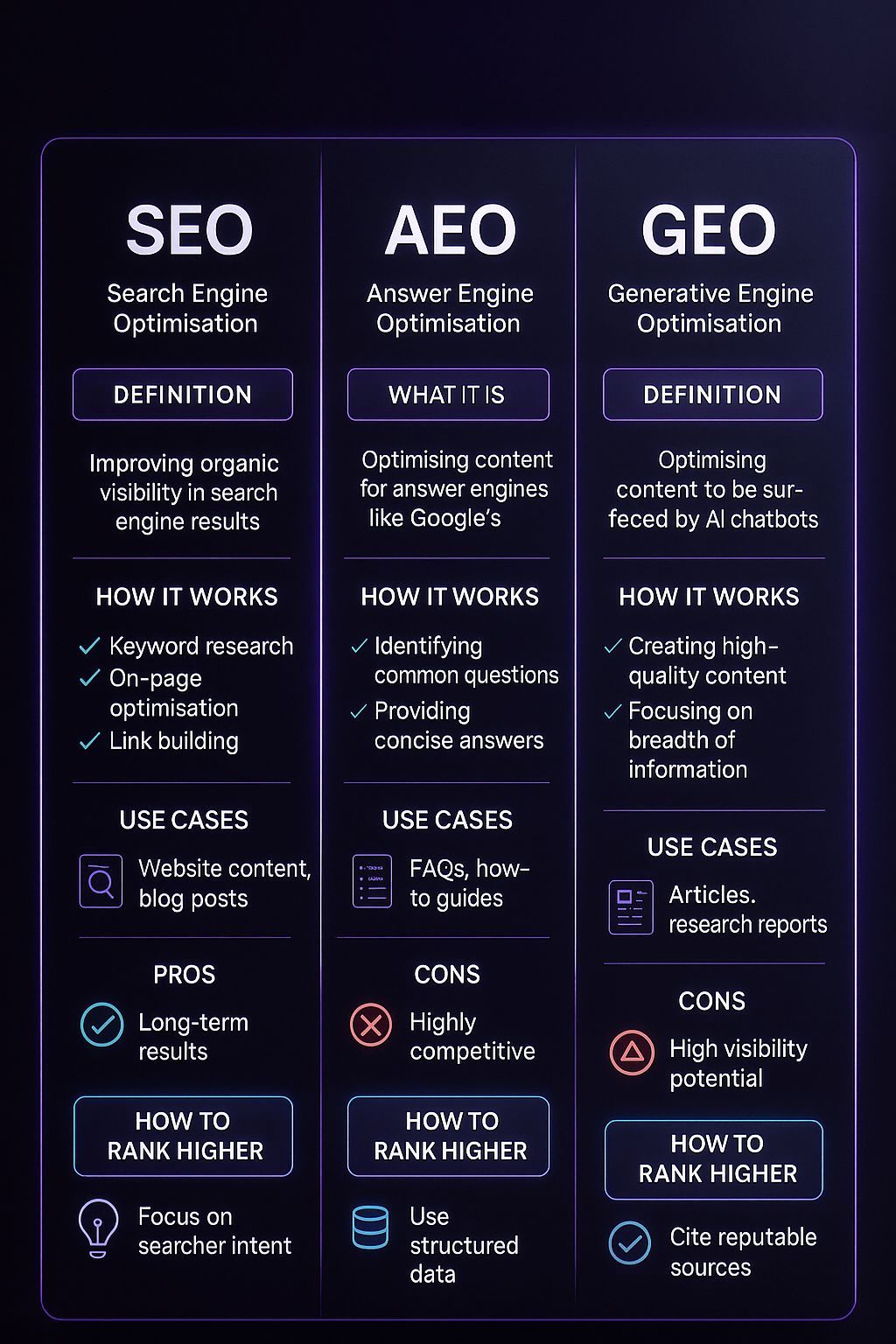
Traditional SEO focuses on ranking content in Google's top 10 green links list by optimizing keywords and keyword density [User Query].
AEO (Answer Engine Optimization) focuses on structuring content to provide direct, succinct answers to dominate zero-click features like Featured Snippet.
GEO (Generative Engine Optimization) focuses on building Authority (E-E-A-T) to be trusted and cited by AI tools (like AI Overviews) as the primary data source in aggregated summaries.
LEO (LLM Engine Optimization) is the higher goal, aiming to have content and brands proactively suggested by the large language model (LLM) in interactive AI conversations.
2. Is Zero-Click Search a challenge or an opportunity?
Zero-Click Search (ZCS) is both.
Challenges: Causes a decline in direct traffic (clicks) even as impressions (impressions) increase.
Opportunity: ZCS offers an invaluable opportunity to build Brand Equity and Reputation right on the SERP. Every time content is cited in a Featured Snippet or AI Overview, it is an indirect endorsement from Google, positioning the brand as a trustworthy source. Trust is the new "transformation" in this era.
3. How to start optimizing your website's E-E-A-T?
To start strengthening E-E-A-T, take the following steps:
Content Quality: Prioritize quality content, based on verifiable data.
Author Bio: Create a clear, detailed, author bio page, proves the expertise (Expertise) and experience (Experience) of the writer.
Structured Data: Implement Schema Markup (JSON-LD), especially the
OrganizationandPersontypes, so that Google can understand and verify the identity of the business and author.Reputation Signal: Make sure the website uses the HTTPS security protocol and has clear legal policy pages (Privacy Policy, Terms of Use).
Reputation: Monitor and professionally respond to negative reviews and encourage User Generated Content (UGC) to instill trust.
Don't let AI Overviews turn you into "Invisible"!
The era of traditional SEO has ended. If you're still stuck in the TOP 10 keyword battle, your business is missing out on the main stage: Position Zero in AI summaries.
To successfully transition from keyword SEO to a sustainable AEO, GEO and Entity Authority strategy, you need a partner with technical and strategic expertise.
Tan Phat Digital provides the solution Comprehensive SEO Entity, helping you:
Build solid E-E-A-T to be trusted by AI to cite.
Deploy accurate Schema Markup to strengthen Brand Entities (ERO/DEO).
Convert content into "Answer Objects" to win Zero-Click Search.
Contact Tan Phat Digital today to receive 1:1 consultation and start the AI optimization path for your business.
Share