Redefining Content Value in the AI Era
In the rapidly transforming digital search landscape, Google and AI-based search systems have enhanced the ability to evaluate relevance from the overall document level to the block-level. This deep semantic understanding requires a new ranking mechanism: faster, more accurate, and more computationally efficient than traditional Large Language Models (LLM).
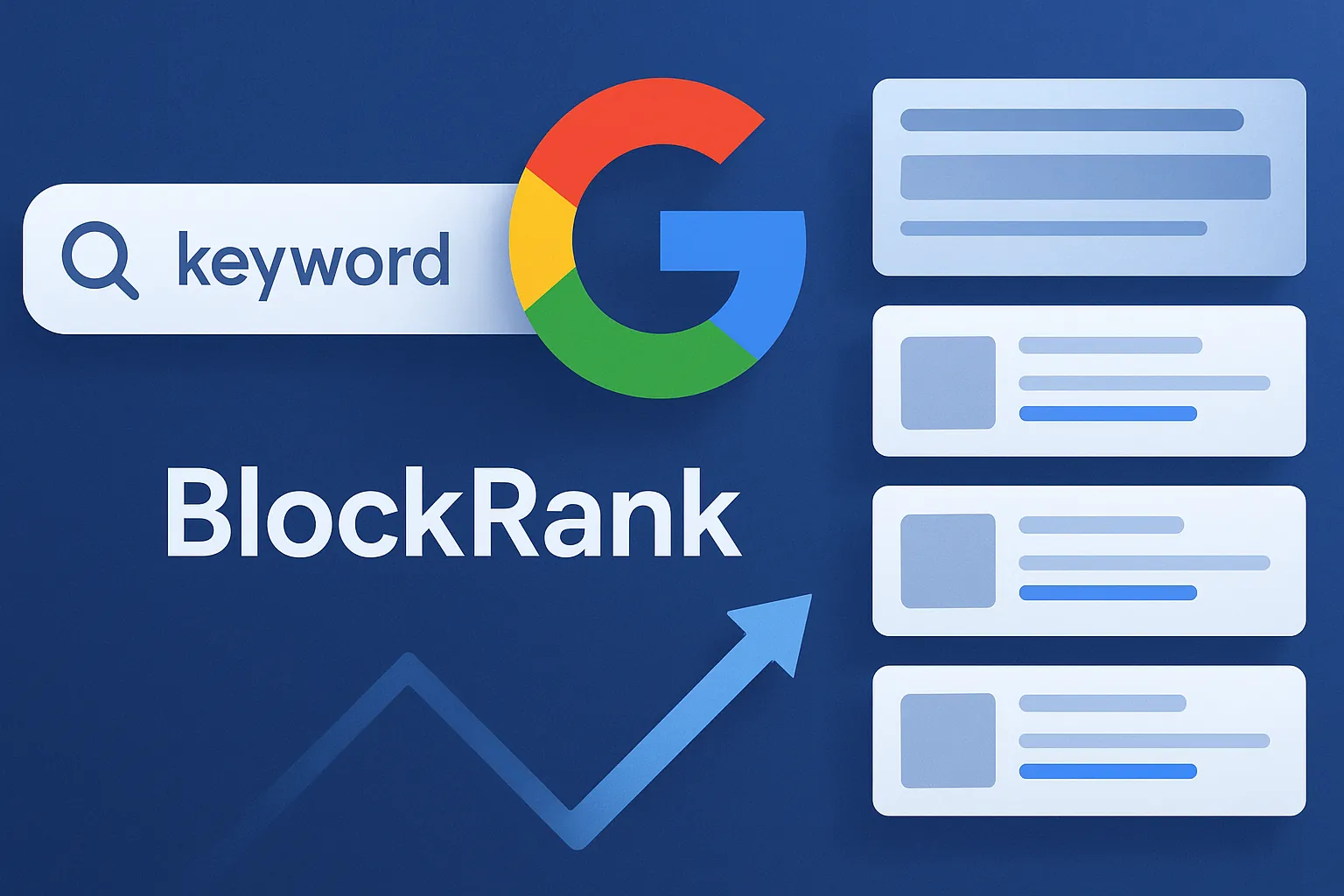
BlockRank (Blockwise In-context Ranking) is a pioneering architecture developed by researchers at DeepMind, designed to directly address the performance and scalability challenge of LLM in the task of Information Retrieval (Information Retrieval - IR).1 BlockRank is not just a new ranking algorithm; it is a groundbreaking solution that allows AI systems to quickly and accurately re-rank large lists of potential documents.
The emergence of BlockRank confirms that the future of SEO lies in optimizing contextual relevance and content structure. This poses a strategic requirement for pioneering businesses like Tan Phat Digital to shift the focus from document optimization (based on PageRank) to block optimization (based on BlockRank), ensuring that each piece of content is built as an independent, high-quality semantic unit and capable of achieving maximum ranking points on its own.
Chapter I: AI Platforms in Search Ranking: The Math of Performance Yield
1.1. From Traditional Ranking to Semantic Analysis
Google's search process is a complex, automated system that operates through three main phases: Crawling, Indexing, and Serving search results.2 During the result serving phase, Google uses many automated ranking systems, considering hundreds of factors and signals.3
These systems have evolved through many era:
PageRank era: PageRank was the original platform, focusing on authority and trust through link graph analysis.4 While PageRank is strong in overall evaluation and “permanence” (i.e. old documents still retain high scores if there are many citations), it lacks the ability to interpret context i.e. times.5
The Semantic Era (BERT/RankBrain): Algorithms like RankBrain and BERT (Bidirectional Encoder Representations from Transformers) represent a shift in focus toward understanding user meaning and intent.4 BERT is especially important because it allows Google to understand how combinations of words express different meanings and intent, going beyond single keyword matching pure.3
While BERT provides superior semantic accuracy, applying these complex Transformer models to rank all billions of documents in real time is not feasible in terms of cost and speed. This shift requires a system that can apply LLM (BERT-like) insights to a long list of potential documents without collapsing in terms of computational cost.
1.2. In-Context Ranking (ICR): The Ultimate Tool for LLM to Assess Relevance
In-Context Ranking (ICR) is an advanced paradigm in the field of Information Retrieval (IR). ICR exploits the context understanding capabilities of the Large Language Model (LLM) by injecting the query, task description, and a list of candidate documents into the input prompt. The model is then tasked with identifying (and ranking) the most relevant documents or text segments.1
ICR promises the highest ranking accuracy because it allows the AI model to perform listwise comparisons (comparing multiple documents at once) in a unified context, much like how an expert reads and evaluates text segments side by side to draw conclusions about relevance.
1.3. Core Problem: Attention $O(N^2)$ Barrier
The biggest challenge to implementing ICR on production scale is performance. The Transformer architecture, the foundation of LLMs, uses the Self-Attention mechanism. This Attention operation has quadratic complexity ($O(N^2)$) compared to the length of the input string (context length).1
As the candidate list grows—for example, when the model needs to re-rank hundreds of documents—computational costs skyrocket exponentially. This quadratic complexity makes the use of standard LLMs for large real-time re-ranking tasks slow and prohibitively resource-intensive.1
The cost impossibility of $O(N^2)$ has hindered the integration of deep LLM-based re-ranking systems into the main search process. BlockRank was developed to address exactly this computational barrier, turning ICR from an efficient theory into a viable solution.
Chapter II: Decoding BlockRank: A Foundational Architecture for Efficiency
2.1. Blockwise In-context Ranking
BlockRank is a specialized method, consisting of a lean architecture and a fine-tuning process designed to provide scalable context retrieval and ranking.7 The BlockRank system, tested on the Mistral-7B model, consists of three main components: a structured attention mechanism to enforce sparsity, an auxiliary attention loss function to enhance the retrieval signal, and an alternative attention-based inference method.8
Two important observations about how LLM has been fine-tuned for the task of ranking information processing provided the basis for the design of BlockRank.9
2.2. The Two Core Insights
A. Inter-document Block Sparsity
DeepMind researchers have observed a distinct behavioral pattern in LLMs tuned for ranking: when the model is fed a group of documents, it tends to focus densely on the content within each individual document, but exhibits sparse attention in direct comparison. between different documents.7
Technical Observation: Attention is dense within each document block but sparse between different document blocks in the context.1
Architectural Action: BlockRank has architected the implementation of this sparse model through the Blockwise Structured mechanism Attention.8 This way, it minimizes unnecessary computations (comparing documents with each other).9
Computational Results:Implementing this structure reduces the complexity of the Attention operation from quadratic ($O(N^2)$) to linear ($O(N)$) relative to context length, without sacrificing ranking performance.1
This sparsity shows that AI is working attempt to analyze each document (or block of content) as an independent entity within its overall context, emphasizing the importance of ensuring that each "block" of content is a complete and independent semantic unit.
B. Relevance Signal from Query Token (Query-document Block Relevance)
The second observation shows that the AI model does not treat every word in the query equally. Certain query tokens (e.g., specific keywords or delimiters) encode strong relevance signals in their attention patterns.7
Technical Observation: The attention scores from specific query tokens to a block of documents in the intermediate layers of the model were strongly correlated with the actual relevance of that document.1 This means that query tokens acted as strong retrieval signals. right from the first stage (prefill stage).
Training Action: BlockRank optimizes this signal during fine-tuning using an auxiliary contrastive training objective, called $L_{aux}$ (InfoNCE loss).1 The overall training objective is $L_{Total} = L_{NTP} + \lambda L_{aux}$, where $L_{NTP}$ is the standard cross-entropy loss.8
Purpose: By applying $L_{aux}$ only at a specific layer, BlockRank teaches the model to focus more effectively on the important retrieval signals encoded by the query, thereby improving retrieval in the attention operation itself.8
This has profound implications: content optimization requires more than just keyword matching, but the creation of content blocks with clear semantic associations with important elements in the query, making it easy for AI to identify and assign high relevance scores.
2.3. Performance and Scalability
The ability to reduce computational complexity is the deciding factor in making BlockRank a viable solution for ICR at scale.
Speed and Scalability: BlockRank Mistral-7B demonstrated superior performance, being significantly more efficient at the inference stage, achieving a 4.7x speedup over baseline for 100 MSMarco documents in context.1 Furthermore, it is capable of gracefully scaling up to 500 documents in context (equivalent to approximately 100K context lengths) in just one second.1 This speed allows accurate LLM models to participate in re-ranking nearly every query.
Rank Performance: BlockRank Mistral-7B is proven to be achieves or outperforms other state-of-the-art listwise rankers in tests on standard benchmarks such as BEIR, MS Marco, and Natural Questions (NQ).
Environmental Sustainability: Increased computational efficiency directly leads to reduced power consumption for retrieval-intensive LLM applications. This promotes more environmentally sustainable AI development and expands the technology's reach for optimal models or resource-constrained environments.10
This performance boost is core to the democratization of deep ranking systems. BlockRank enables the use of smaller models (like Mistral-7B) to perform complex ranking tasks previously only available to large models, expanding the ability to integrate LLM re-ranking systems into many other applications, beyond Google's core search.10
Chapter III: BlockRank's Strategic Role in the Ranking Ecosystem Google
3.1. Analyzing the Two-Phase Retrieval Model
BlockRank is not intended to completely replace existing ranking systems but is designed to operate effectively in the re-ranking phase of the Two-phase retrieval process.11
Phase 1: Initial Retrieval Retrieval/Candidate Generation):Computationally efficient models (e.g., BM25, approximate nearest neighbor indexing, or embedding-based retrieval) are used to quickly select a shortlist of hundreds of potential documents.11 This phase prioritizes speed and computational efficiency over absolute accuracy.
Phase 2: In-Context Reranking Re-ranking):BlockRank (or equivalent ICR models) is applied to this short list (up to 500 documents) to perform a deep assessment, accurately determining which documents/content blocks are most relevant to the query at a granular semantic level.1 Thanks to BlockRank's linear architecture, this re-ranking phase becomes possible in real time.
The ability to re-rank on the fly, BlockRank's passage-level accuracy reinforces its role as the final layer of quality control, ensuring that the results served not only have high authority (PageRank) and understand intent (BERT), but also contain specific blocks of information that accurately respond to the user's query.
3.2. Comparing the Architectural Properties of Major Ranking Systems
To understand BlockRank's strategic position, it is necessary to compare it with two models that represent previous ranking eras. As required by the report, this comparison is presented as a detailed list:
PageRank (Era 1: Authority and Links)
Rank Focus: Overall document authority, trust, and backlink quality/quantity.
Core Mechanisms: Link Graph Analysis and distribute trust across the entire web.
Computational complexity: Very low during serving, because ratings are mainly pre-computed.
Effective with Context/Intent: Ineffective. Only evaluates the document as a whole, regardless of complex user intent.4
Speed/Scale: Extremely fast when serving results, ideal for initial filtering based on reputation.
BERT/RankBrain (Epoch 2: Semantics and Intent)
Rank Focus: Intent User Intent and natural language context, focusing on understanding the meaning behind the query.3
Core mechanism: Semantic vector embeddings of queries and documents.4
Computational complexity: High. Requires Transformer-based computation, with quadratic complexity ($O(N^2)$) over context length.1
Context/Intent Efficiency: Very accurate in decoding language, but not applicable for large-scale re-ranking due to computational barriers.
Speed/Scale: Accurate but slow and expensive to process large document list.
BlockRank (Era 3: Context and Block-level Performance)
Rank Focus: Performance, Scalability, and Block-level relevance.
Core Mechanics: In-Context Ranking (ICR) using Blockwise Structured Attention, reduces the complexity from quadratic to linear ($O(N)$).1
Computational complexity: Linear ($O(N)$). Very effective compared to other LLM ranker models.1
Context/Intent Effectiveness:Very high. Deep analysis of shortlists (e.g. 500 documents) within 1 second, allowing for each passage (passage) scoring.1
Speed/Scale: Very fast and resource efficient, ideal for production-ready Re-ranking.
This clear difference shows that BlockRank is the missing piece, allowing Google to incorporate accuracy BERT's deep semantic precision with the scalability of a large-scale ranking system. This reinforces the importance of Semantic SEO, as AI can now check the integrity and relevance of each content segment.
Chapter IV: Block-Level Content Optimization Strategies for Ton Phat Digital
BlockRank's ability to score each content block forces optimization strategies to change. Tan Phat Digital needs to apply Semantic SEO 3.0 strategy, where quality and structure go together.
4.1. Semantic Constructionism
Semantic SEO is a strategy for building content around a comprehensive topic instead of just focusing on repeating keywords.13 This strategy focuses on satisfying search intent and providing comprehensive, high-value information.13
For Tan Phat Digital, the This means:
Building Topical Authority: Modern search models evaluate content based on accurate topic coverage.13 BlockRank enhances this ability by examining the depth and integrity of each segment. Not only does content need to be relevant, but it also needs to have specialized “chunks,” meeting niche search intents that competitors often miss.12
Enhancing Linking Context: Using synonyms and related terms (e.g., using “noise level,” “sound rating,” in addition to “quiet”) helps reinforce semantic meaning, allowing AI to connect related concepts, enhancing model understanding fig.16
4.2. Optimizing Document-Level Confidence Signals
Even though BlockRank scores at the block level, document-level signals are still extremely important for determining the original purpose and scope of a page.
H1, Title, Description Synchronization: These three elements are the most powerful signals that AI uses to interpret purpose and scope vi.16
Page Title: Must clearly summarize content in natural language, matching search intent.16
Descriptions: Help AI and users understand context and value, while avoiding keyword stuffing.16
H1 Tag: Must closely align with the Page Title, establishing clear expectations for the content that follows.16
Strategic Benefit: Consistent alignment between Page Title, H1, and Description improves discoverability and provides a strong "trust signal" to the system AI.16
4.3. Turn Content into Actionable Structuring
Because BlockRank operates at the block level, the HTML structure (head-ing, list, paragraph) must be designed to create "blocks" that are easy to parse and have high quality scores.
A. Segment Clearly with Headings (H2, H3)
Heading tags (, ) mark the boundaries between ideas. To the AI, they act as chapter titles, defining clear content slices.16 Each H2 or H3 should be a complete answer or a standalone idea that can be effectively scored by BlockRank.
Action: Instead of a vague title ("Learn more"), use a specific title, like "What Health Benefits Are Enhanced With the Regimen?" Eat Keto?".16
B. Prioritize Lists and Q&A for Reusability
Highly structured formats provide clean data that is easily reused by AI, especially important for Featured Snippets or AI Assistant responses:
Lists: Is the optimal format for breaking down complex details into relevant segments reusable, ideal for feature comparisons or step-by-step instructions.16
Q&A Formats: Live simulation of how users search. AI can extract these question-answer pairs verbatim (word for word) for AI-generated responses.16
Technical Analysis: Prioritizing Content Structure Signals for BlockRank/AI
Here is a summary of the content structure actions that the Tan Phat Digital team needs to prioritize First:
Page Title & H1
Signals to AI: Define purpose and scope, creating an initial “Trust Signal”.
Rank Benefits: Reinforce overall relevance and expectations of the document.16
Headings Tag (H2, H3)
Signals to AI: Divide content into separate blocks of ideas, creating "Document Blocks" that can be scored independently.
Rank Benefits: Help AI quickly identify the most relevant "blocks" (Query-document Block Relevance).9
List/Step Format (Bulleted/Numbered)
Signals to AI: Provide data that is clear, highly structured, and easy to reuse.
Rank Benefits: Maximize extraction to featured snippets or AI answers.16
Content Q&A
- dishwasher")
Signals to AI: Reinforce the semantic clarity of the content block.
Rank Benefits: Reduce ambiguity, increase the block's specific relevance score during re-ranking.16
Chapter V: In-Depth Technical Optimizations and Tan Phat's Leading Vision Digital
5.1. Overcoming AI Blind Spots: Content Visibility Guidelines
While Google has the ability to crawl via JavaScript, many other AI systems—and sometimes even key parts of search engines—still have difficulty processing content that is not directly displayed in the original HTML source code.17
Tan Phat Digital needs to strictly adhere to the Content Visibility Guidelines Visibility):
Avoid Hidden Content: Don't bury important text inside interactive elements (like accordions, tabs, or slideshows) that require a click or script to load. Content that loads only after user action can be invisible to AI crawlers.16
Prioritize HTML:
Avoid relying on PDFs for core information, as they often lack the structural cues (metadata, headings) that HTML provides.16
Don't place important information solely in images. Always provide Alt Text or present core details as HTML text to ensure the AI can reliably understand them.16
5.2. Deep Context Optimization
To take advantage of BlockRank's Query-document Block Relevance mechanism, content needs to be context-dense and semantically clear.
Write for Intent and Context: Instead of just using generic terms, add detailed context. For example, instead of saying “quiet dishwasher,” say “42 dB dishwasher designed for open kitchens.”16 Adding specific context helps BlockRank assign a higher relevance score to that block when users search for products for “open-concept kitchens.”
Eliminate Vague Language: Avoid words like “innovation” or “best” that don't provide specific, relevant facts measurable to anchor its claims.16 Data clarity helps the AI model build a more accurate semantic representation.
Simplify Sentence Structure:Keep punctuation simple and consistent. Avoid overusing decorative characters or em dashes, which can confuse sentence structure and make parsing by machines difficult.16
5.3. Tan Phat Digital's Initiation Strategy: From Research to Action
BlockRank is currently in the research stage of DeepMind/Google and has not been officially deployed in the live search environment. However, this technology represents a new standard for performance and accuracy in ICR, and its principles have come to dominate the Semantic SEO trend.
Tan Phat Digital needs to consider BlockRank not as an algorithm to be followed tomorrow, but a content design principle to be applied today:
Prepare the Semantic Infrastructure: Ensuring totality Content is designed in a logical block structure, with each H2/H3 being a complete unit of information.
Ensuring Processing Efficiency: Focuses on minimizing technical barriers (JavaScript, hidden content) to ensure Tan Phat Digital's high-quality content blocks can be processed effectively by AI systems with low latency
Leveraging Environmental Impact: BlockRank's performance and scalability are also related to sustainability. Tan Phat Digital's application of semantically and structurally efficient content strategies is in line with the trend of developing more energy-efficient AI.10
Frequently Asked Questions (FAQs)
Will BlockRank replace PageRank?
No. BlockRank operates at the re-ranking stage, focusing on contextual relevance and LLM processing performance at the content block level.1 PageRank is the core foundation, remaining essential in assessing the authority and overall trustworthiness of a document.4 BlockRank complements PageRank by ensuring that high authority documents also contain content blocks that are accurately related to the current search intent. at.
How do I know if my content has been optimized at the block-level?
Content is optimized at the block-level when each subheading tag (H2, H3) in the article represents a complete answer or an independent idea. This means that a paragraph delimited by an H2 must be able to be extracted and stand alone as a standalone answer in the Featured Snippet or AI Assistant without context from other H2s.
What does BlockRank have to do with Semantic Search and Topical Authority?
BlockRank is the technical tool that allows Semantic Search to operate at scale. Semantic Search focuses on understanding intent and context.15 BlockRank does this by allowing LLM to efficiently examine 500 potential documents, scoring each block for its exact relevance.1 This capability forces strategies like Tan Phat Digital to build Topical Authority—that is, content that must be comprehensive and cover the topic in an organized manner—to ensure each block scores. high.
Should Tan Phat Digital prioritize optimizing structure or content quality?
Both are inseparable. Content quality (depth, accuracy) is crucial to achieving a high relevance score ($L_{NTP}$ and BlockRank accuracy).18 However, if high-quality content is buried in long walls of text or hidden in JavaScript tags, it will be difficult for an AI system to decompose them into reusable blocks. Therefore, Tan Phat Digital must prioritize quality coupled with a clear structure (Lists, Headings, Q&A) to enhance AI's analytical capabilities.16
Tan Phat Digital's Leading Vision
BlockRank represents the next big evolution in search. By reducing the computational complexity of In-Context Ranking from quadratic to linear, BlockRank created the infrastructure necessary for Google to deploy LLM Re-ranking with unprecedented accuracy and speed. This confirms that Google is moving to a fragmented system, where quality is assessed at the most granular level: blocks of content.
For Tan Phat Digital, this means the end of the era of generic articles or uneven quality content. Each segment (block) must be a strong, self-defined semantic unit, and optimized for reuse. By applying clear structural design principles, synchronizing trust signals (Title/H1/Description), and avoiding technical blind spots (hidden content), Tan Phat Digital not only improves its ability to rank within the current system but also positions itself to be ahead of the most advanced search technology.
Tan Phat Digital is recommended to immediately conduct a content structure audit on all core documents. Prioritize converting walls of text into clear, easy-to-analyze blocks of data by thoroughly applying list formatting, clear subheadings (H2/H3), and Q&A structure. This will ensure that Tan Phat Digital's high-quality content is always optimized to become a top candidate for AI's high-speed and accurate re-ranking results.
Share