In 2020, Google ran more than 600,000 tests and updated its algorithm more than 4,500 times. Despite continuous innovation to create the world's smartest search engine, Google still needs help understanding new content. This is the purpose of On-page SEO (On-page search engine optimization).
On-page SEO helps Google better understand your website, thereby improving rankings and increasing organic traffic (Organic Traffic). This article will help you deeply understand Onpage SEO and the most effective optimization methods.
I. What is On-page SEO? Basic knowledge
1. Definition of Onpage SEO
Onpage SEO is a set of techniques that optimize structure, content, and any components located on a website for the purpose of increasing website rankings on search engines.
2. The importance of Onpage SEO
You need to take the Onpage SEO strategy seriously because:
Increase Rankings:The first page of search results (SERP) accounts for 91.5% of traffic. On-page SEO is the key to getting into the Top 10.
User Experience (UX): Modern On-page SEO factors always focus on the user. A good experience increases time on page and reduces bounce rate, which is a positive signal for Google.
Understanding Content: When done properly, On-page SEO allows search engines to accurately understand your content to rank the most relevant URLs for specific queries.
High ROI: On-page SEO typically provides areturn on investment Best (ROI)compared to other digital marketing strategies with relatively low costs and long-term benefits.
3. When to perform Onpage SEO
You should start Onpage SEO immediately after completing the website (optimize page structure, security, sitemap,...) and maintain continuously even when the website is already in the Top 1 to maintain the ranking.
II. 3 Most Important Factors to Optimize Onpage SEO
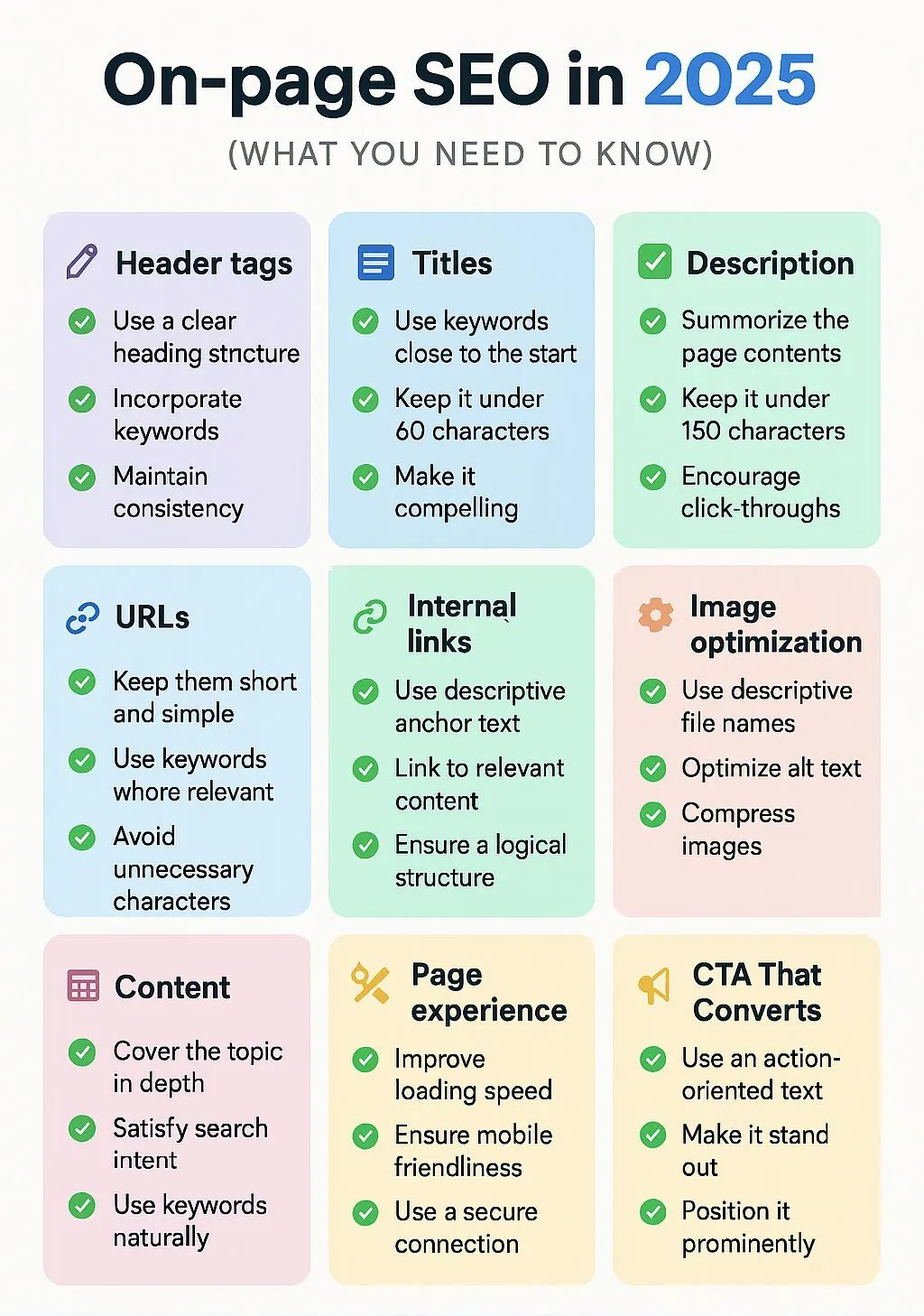
Optimizing meta data, content and internal links is the key to maintaining a successful Onpage strategy.
Meta Data: Includes Title Tag and Meta Description. This is what users and search engines see first on search results.
On-page Content: Quality content, keyword optimized and meeting Search Intent will ensure satisfaction of both search engines and user needs.
Internal Links and Structure Pages: Helps search engines crawl your website accurately, understand relationships between pages, and allocate ranking power (Link Equity).
III. 15 Most Important Onpage SEO Techniques
1. Platform Technical Optimization
Server Speed: Switch to a faster host, remove third-party scripts, and reduce total page size to increase page load speed (an important ranking factor).
Source Code: Optimize the source code (remove redundant functions, merge elements) for easy indexing by Googlebot more.
IP Address: Use a unique IP address for each web project to signal uniqueness.
2. Website Security (HTTPS)
Use the HTTPS protocol instead of HTTP. An SSL Certificate (Secure Socket Layer) is required to encrypt data.
Google Chrome displays HTTP pages as "Not Secure", negatively affecting user experience and reliability.
3. URL Optimization
Include Keywords: Place the main keyword in the URL to help both search engines and users understand the content.
Left Spotlight: Place the keyword as close to the beginning of the URL as possible.
Use Realistic Language: Avoid random letters and numbers of course.
Short and Engaging: Short, easy-to-understand URL structure.
Use Dashes: Use hyphens (
-) to separate words in the URL.Edit Geography: For local businesses, include the city or region name in the URL.
4. Optimize Title Tags and Meta Descriptions
Keyword Placement: Place main keyword near the beginning of the title tag.
Title Length: Keep it around 55-60 characters to avoid truncation.
Uniqueness: Per page needs a unique title.
Meta Length: Keep it around 155 characters and contain the main keyword.
Attractive: Create an attractive title and description to encourage users to click, helping to increase Click-Through Rate (CTR).
5. Apply CTR Boosting Techniques to Titles
Question Title Tags: Titles that contain questions have 14.1% higher CTR than other titles.
Add Emotion: Emotional titles are clicked on 7% more often (avoid jargon) tendon").
Add Current Year: This signals your content is new and up to date, especially useful for topics that easily go out of date.
6. Use Title Tags (H1, H2, H3,...)
H1 Tags: Only use a single H1 tag for each page, this is the main title of the article.
H2, H3, H4 Tags: Used to break up content, making it easier for users to follow and improve the experience read.
Include Keywords: Make sure to use the main keyword in the H1 and at least one or two H2 tags. Add Long-tail Keywords to subheadings.
7. Optimizing Structured Data (Structured Data/Schema Markup)
Role: Helps Google understand your content better (e.g. prices, ratings, cooking times, events...).
Increase CTR: Implementing Schema can increase your CTR by creating "Rich Snippets" Snippets) on SERPs.
Data Types: Applies to Articles, Reviews, Recipes, Local Business Information, etc.
8. Optimize Content to Meet Search Intent
Goal: Your content must completely and effectively solve the searcher's problem.
4 types of Search Intent:
Informational: The user searches for a specific information (how, how method).
Navigational: Users want to visit a specific website.
Commercial: Users research and evaluate before buying (keywords: best, top).
Transactional: People are actively wanting to buy something (need to optimize product display). product, price, CTA).
9. Optimizing SEO Content (SEO Copywriting)
Golden Rule: Content should be Unique, Valuable and Optimized for search.
Technique:
Write a short, compelling introduction, including target keywords in First 100 words.
Use short, readable sentences and paragraphs.
Incorporate target keywords naturally throughout the post (avoid stuffing).
Always write for your readers first.
10. Use Target, Semantic, and LSI Keywords
Target Keywords: Focus on long-tail keywords because they have lower competition and clearer search intent.
Semantic Keywords: Contextual keywords, help Google and users understand the overall topic of the article.
Keywords LSI (Latent Semantic Indexing):Synonyms or related terms. You can find them in the "Searches related to..." area at the bottom of the Google results page.
11. Image Optimization
- (Alt Text): Use image alt tags with appropriate keywords to help search engines understand the image.
Image sitemap: Submit an image sitemap in Google Search Console.
12. Optimize Featured Snippets
Goal: Significantly increase CTR.
How to: Include a short, concise definition right after the title, or make sure your page structure is consistent if the content is a list of steps or tips (use bullets/numbers). self).
13. Content Gap Optimization
Definition: Identify topics and keywords that your competitors rank highly for but your website does not have content or the content is not strong enough.
Action: Use tools (like Ahrefs, SEMrush) to analyze your competitors and create better content to fill the gap this.
14. Internal Linking
Purpose: Help Google understand the relationship between pages, allocate existing ranking authority (Page Authority) from Backlinks throughout the website.
Anchor Text: The anchor text must be a keyword or phrase for which you want the linked page to rank (avoid repeating the same Anchor over and over again). Text).
Number: Limit the number of links on a page to a reasonable number (a few thousand at most) to avoid diluting authority.
15. Mobile-Friendly
Mobile-First Indexing: More than 50% of Internet traffic comes from mobile devices, and Google has moved to mobile-first indexing.
Test: Use Google's Mobile-Friendly Test to test the Responsiveness of the website.
IV. Factors to Avoid When Optimizing Onpage SEO
Here are some low-value tactics that you should avoid:
Thin Content:Creating too many individual pages with thin content, repeating the same topic. Google encourages one comprehensive page on a topic.
Duplicate Content: Content shared between domains or between multiple pages of a domain. Use the
rel=canonicaltag to point to the original version if unavoidable.Cloaking:Hiding text or links in HTML code that normal users cannot see.
Keyword Stuffing: Unnatural repetition of keywords. Incorporate keywords naturally in a way that is easy for readers to understand.
Auto-Generated Content: Content that is programmatically generated for the purpose of manipulating search rankings and does not help users.
V. Onpage Factor Checking Support Tool
Yoast SEO: Free Onpage SEO checker tool, popular on WordPress.
SEOQuake: Free Onpage SEO checker tool, supports analyzing Onpage errors and keyword density.
Surfer SEO: Paid tool, minimal support In-depth content optimization, compared with top ranking content.
Onpage SEO Checker (SEMRush): Specialized tool, supports analyzing competitor websites and offering improvement solutions.
Website Auditor: Supports Onpage and On-site optimization, including analyzing page structure, checking page load speed, detecting links broken.
VI. Frequently Asked Questions (FAQ) About Onpage SEO
Q1: Should priority be given to optimizing Onpage or Offpage SEO first?
A: You should prioritize Onpage SEO first. A solid foundation (page structure, speed, quality content) is a prerequisite for Off-page SEO (Backlink building) efforts to be maximally effective. You cannot build a house on sand.
Q2: What is a safe keyword stuffing rate?
A: Google does not give a specific number. The rule is don't cram; let keyword density appear naturally in context. Instead of trying to hit a certain ratio, focus on using Semantic and LSI keywords to build context.
Q3: How important is image optimization for Onpage SEO?
A: Very important. Images not only make for a better user experience, but they are also an important page speed factor. Optimizing file size, file name, and Alt tags helps Google understand image content, thereby increasing the ability to rank on both image and regular searches.
Q4: When is the
rel=canonicaltag used?A: This tag is used when you have duplicate content on multiple URLs different (due to technical error or intentional). It signals to Google which URL is the original (canonical) version that you want Google to index and rank.
Q5: How long does it take to see results from Onpage SEO optimization?
A: Depending on the level of keyword competition and website authority (Domain Authority), results can start appearing in a few weeks to several months. Optimizing technical factors (speed, security) often has a faster impact than optimizing content.
On-page SEO is a continuous process and requires a smooth combination of technique, content creation and user understanding. Maintaining optimization of elements on your website is the key to improving rankings, traffic, and sustainable conversion rates.
If you are looking for a partner who can help you implement an effective Onpage SEO and overall SEO strategy, from technical structure to content that meets search intent, Tan Phat Digital is ready to partner.
Tan Phat Digital provides solutions Professional SEO Consulting and Implementation, ensuring your website not only meets the highest technical standards but is also optimized to surpass competitors on Google rankings.
Contact Tan Phat Digital today to receive a detailed score analysis report Onpage SEO strengths/weaknesses of the website and building a sustainable growth roadmap!
Share